




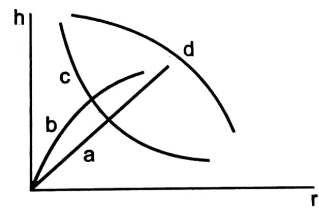
Which of the following graphs may represent the relation between the capillary rise and the radius $r$of the capillary?
A. a
B. b
C. c
D. d
Answer
 Verified
535.8k+ views
Hint:Capillary action is the process of a liquid flowing in small areas without the aid of external forces like gravity, or even in opposition to them. Liquids can be drawn up between the hairs of a paintbrush, in a narrow tube, in porous materials like paper and plaster, in non-porous materials like sand and liquefied carbon fibre, or in a biological cell.
Complete step by step answer:
Intermolecular forces between the liquid and the surrounding solid surfaces create this. If the tube's diameter is small enough, the liquid is propelled by a combination of surface tension and adhesion forces between the liquid and the container wall. Because both processes are opposed by viscous forces, capillary penetration in porous media has a similar dynamic mechanism to flow in hollow tubes.
As a result, the capillary tube is a frequent tool for demonstrating the phenomena. A concave meniscus formed when the lower end of a glass tube is immersed in a liquid, such as water. The liquid column is pulled along by adhesion between the fluid and the solid inner wall until there is enough liquid mass for gravity forces to overcome the intermolecular forces.
The radius of the tube is related to the contact length (around the edge) between the top of the liquid column and the tube, whereas the weight of the liquid column is proportional to the square of the tube's radius. So, if the inner water molecules cohere sufficiently to the outer ones, a narrow tube will draw a liquid column along further than a larger tube.
\[h = \dfrac{{2S\cos \theta }}{{r\rho g}}\] is the height h through which a liquid will ascend in a capillary tube of radius\[r\].where \[S\] denotes surface tension, $\rho $ denotes liquid density, and $\theta $ denotes contact angle.
Because \[h{\text{ }} \propto \dfrac{1}{r}\] is true, the graph between \[h\] and \[r\] will be a rectangular hyperbola.
So, option C is correct.
Note:Capillary activity can be detected in a variety of plants. Water is carried high up in trees by branching; evaporation at the leaves causes depressurization; osmotic pressure is likely provided at the roots; and potentially other areas inside the plant, especially when collecting humidity with air roots.
Complete step by step answer:
Intermolecular forces between the liquid and the surrounding solid surfaces create this. If the tube's diameter is small enough, the liquid is propelled by a combination of surface tension and adhesion forces between the liquid and the container wall. Because both processes are opposed by viscous forces, capillary penetration in porous media has a similar dynamic mechanism to flow in hollow tubes.
As a result, the capillary tube is a frequent tool for demonstrating the phenomena. A concave meniscus formed when the lower end of a glass tube is immersed in a liquid, such as water. The liquid column is pulled along by adhesion between the fluid and the solid inner wall until there is enough liquid mass for gravity forces to overcome the intermolecular forces.
The radius of the tube is related to the contact length (around the edge) between the top of the liquid column and the tube, whereas the weight of the liquid column is proportional to the square of the tube's radius. So, if the inner water molecules cohere sufficiently to the outer ones, a narrow tube will draw a liquid column along further than a larger tube.
\[h = \dfrac{{2S\cos \theta }}{{r\rho g}}\] is the height h through which a liquid will ascend in a capillary tube of radius\[r\].where \[S\] denotes surface tension, $\rho $ denotes liquid density, and $\theta $ denotes contact angle.
Because \[h{\text{ }} \propto \dfrac{1}{r}\] is true, the graph between \[h\] and \[r\] will be a rectangular hyperbola.
So, option C is correct.
Note:Capillary activity can be detected in a variety of plants. Water is carried high up in trees by branching; evaporation at the leaves causes depressurization; osmotic pressure is likely provided at the roots; and potentially other areas inside the plant, especially when collecting humidity with air roots.
Recently Updated Pages
Master Class 12 Economics: Engaging Questions & Answers for Success

Master Class 12 English: Engaging Questions & Answers for Success
Master Class 12 Social Science: Engaging Questions & Answers for Success
Master Class 12 Maths: Engaging Questions & Answers for Success
Master Class 12 Physics: Engaging Questions & Answers for Success
Master Class 9 General Knowledge: Engaging Questions & Answers for Success
Trending doubts
One Metric ton is equal to kg A 10000 B 1000 C 100 class 11 physics CBSE
Difference Between Prokaryotic Cells and Eukaryotic Cells
Find the value of the expression given below sin 30circ class 11 maths CBSE
Two of the body parts which do not appear in MRI are class 11 biology CBSE
1 ton equals to A 100 kg B 1000 kg C 10 kg D 10000 class 11 physics CBSE
Draw a diagram of nephron and explain its structur class 11 biology CBSE