




Which of the following fish is jawless?
A. Chondrichthyes
B. Osteichthyes
C. Cyclostomata
D. Amphibia
Answer
 Verified
591.6k+ views
Hint: The gill-bearing aquatic animals that lack limbs with digits are called fishes. They include cartilaginous, hagfish, lampreys, and bony fishes. The jawless fish means the fish species which lack true jaw or defined jaw structure. These are lampreys and hagfish. They have horny epidermal structures in their mouth.
Complete answer: Fishes are a large group of marine animals that lack limbs with digits, rather they have fins. They have gills in place of lungs to breathe deep inside the water. They have either a cartilaginous or body structure. Most of the fishes are ectothermic which allows them to change their body temperatures according to their surroundings. Most of the fishes have jaws with varied structures that enable them to have varied food. There are some jawless fishes like lamprey and hagfish.
A) Chondrichthyes are cartilaginous vertebrate fishes having defined jaws. They have paired fins and a skeleton made of cartilage rather than bone.
B) Osteichthyes that is also known as bony fish forms a diverse group of fishes that bear skeletons primarily made of bone tissue. They have a stable pattern of cranial bones. A rooted, medial insertion of mandibular muscles is seen in the lower jaw of these fishes.
C) Cyclostomata which means round mouth fishes are a group of agnathans. They comprise jawless fishes that have horny epidermal structures resembling the function of teeth. Unlike jawed fishes, these fishes have branchial gills positioned internally.
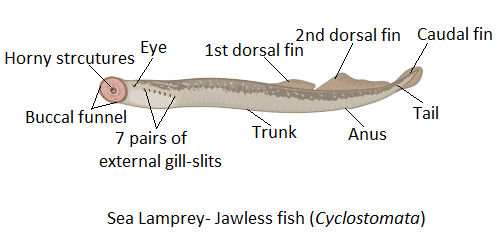
D) Amphibia fishes are also jawed fishes. They have upper jawbones fused to form a braincase. The lower jawbones form a mandible.
Hence, option C is the correct answer.
Note: Other differences seen in jawless fishes are lack of thymus, myelin, spleen and sympathetic ganglia. They also lack internal eye muscles. They have a single olfactory organ with a single nostril. The Lampreys have tooth plates on their tongue-like structures. The hagfish have cartilaginous plates on the floor of their mouth.
Complete answer: Fishes are a large group of marine animals that lack limbs with digits, rather they have fins. They have gills in place of lungs to breathe deep inside the water. They have either a cartilaginous or body structure. Most of the fishes are ectothermic which allows them to change their body temperatures according to their surroundings. Most of the fishes have jaws with varied structures that enable them to have varied food. There are some jawless fishes like lamprey and hagfish.
A) Chondrichthyes are cartilaginous vertebrate fishes having defined jaws. They have paired fins and a skeleton made of cartilage rather than bone.
B) Osteichthyes that is also known as bony fish forms a diverse group of fishes that bear skeletons primarily made of bone tissue. They have a stable pattern of cranial bones. A rooted, medial insertion of mandibular muscles is seen in the lower jaw of these fishes.
C) Cyclostomata which means round mouth fishes are a group of agnathans. They comprise jawless fishes that have horny epidermal structures resembling the function of teeth. Unlike jawed fishes, these fishes have branchial gills positioned internally.
D) Amphibia fishes are also jawed fishes. They have upper jawbones fused to form a braincase. The lower jawbones form a mandible.
Hence, option C is the correct answer.
Note: Other differences seen in jawless fishes are lack of thymus, myelin, spleen and sympathetic ganglia. They also lack internal eye muscles. They have a single olfactory organ with a single nostril. The Lampreys have tooth plates on their tongue-like structures. The hagfish have cartilaginous plates on the floor of their mouth.
Recently Updated Pages
Master Class 12 Economics: Engaging Questions & Answers for Success

Master Class 12 English: Engaging Questions & Answers for Success
Master Class 12 Social Science: Engaging Questions & Answers for Success
Master Class 12 Maths: Engaging Questions & Answers for Success
Master Class 12 Physics: Engaging Questions & Answers for Success
Master Class 9 General Knowledge: Engaging Questions & Answers for Success
Trending doubts
One Metric ton is equal to kg A 10000 B 1000 C 100 class 11 physics CBSE
Difference Between Prokaryotic Cells and Eukaryotic Cells
Two of the body parts which do not appear in MRI are class 11 biology CBSE
1 ton equals to A 100 kg B 1000 kg C 10 kg D 10000 class 11 physics CBSE
Draw a diagram of nephron and explain its structur class 11 biology CBSE
10 examples of friction in our daily life