




Which of the following compounds will exhibit geometrical isomerism?
A. \[2 - phenyl - 1 - butene\]
B. \[1,1 - diphenyl - 1 - propane\]
C. \[1 - phenyl - 2 - butene\]
D. \[\;3 - phenyl - 1 - butene.\]
Answer
 Verified
640.5k+ views
Hint: Geometrical isomerism is a type of stereoisomerism having the same molecular formula and same structure but differ in the relative arrangement of atoms. Geometric isomerism also known as Cis–Trans isomerism or configurational isomerism.
Complete step by step solution:
To identify geometrical isomerism it follow two conditions -
There are two necessary conditions for a compound to possess geometrical isomerism:
(i) It must contain a carbon-carbon double bond in the molecule.
(ii) Two unlike atoms or groups must be linked to each doubly bonded carbon atom.
Based on the group or atom attached to the carbon on each side with respect to double bond they are differentiate in two types - Cis isomer and –trans isomer.
If the two groups with the higher priorities are on the same side of the double bond, that is described as the (Cis)- isomer. If the two groups with the higher priorities are on opposite sides of the double bond, then this is the (Trans)-isomer.
As per given option – based on the conditions of geometrical isomerism-
\[1 - phenyl - 2 - butene\] satisfies both the conditions.
It has 2 different groups on the left hand side and the right hand side. It has restricted rotation.
Thus this compound shows geometrical isomerism

The other structure in this option doesn’t follow the mentioned conditions in their structure. Its structure is given below –
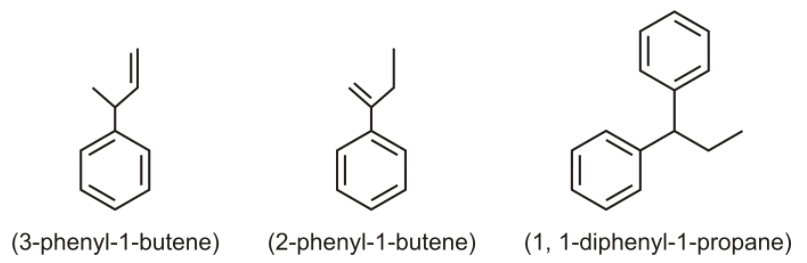
So, option (C) is correct
Note:
In geometrical isomerism, the double bond is planer so there is always \[{180^0}\] rotation during the conversion of Cis to Trans and Trans to Cis. Cis/Trans isomers also have similar chemical properties but different physical properties.
Complete step by step solution:
To identify geometrical isomerism it follow two conditions -
There are two necessary conditions for a compound to possess geometrical isomerism:
(i) It must contain a carbon-carbon double bond in the molecule.
(ii) Two unlike atoms or groups must be linked to each doubly bonded carbon atom.
Based on the group or atom attached to the carbon on each side with respect to double bond they are differentiate in two types - Cis isomer and –trans isomer.
If the two groups with the higher priorities are on the same side of the double bond, that is described as the (Cis)- isomer. If the two groups with the higher priorities are on opposite sides of the double bond, then this is the (Trans)-isomer.
As per given option – based on the conditions of geometrical isomerism-
\[1 - phenyl - 2 - butene\] satisfies both the conditions.
It has 2 different groups on the left hand side and the right hand side. It has restricted rotation.
Thus this compound shows geometrical isomerism
The other structure in this option doesn’t follow the mentioned conditions in their structure. Its structure is given below –
So, option (C) is correct
Note:
In geometrical isomerism, the double bond is planer so there is always \[{180^0}\] rotation during the conversion of Cis to Trans and Trans to Cis. Cis/Trans isomers also have similar chemical properties but different physical properties.
Recently Updated Pages
If x a + bt + ct2 where x is in meters and t is in class 11 physics CBSE

A car covers the first half distance between two places class 11 physics CBSE
The resultant of two vectors overrightarrow P and overrightarrow class 11 physics CBSE
Find the value of cos 135 class 11 maths CBSE
A mass M is held in place by an applied force F and class 11 physics CBSE
A solution of glucose in water is labelled as 10 dfracwv class 11 chemistry CBSE
Trending doubts
One Metric ton is equal to kg A 10000 B 1000 C 100 class 11 physics CBSE
Find the value of the expression given below sin 30circ class 11 maths CBSE
Draw a diagram of nephron and explain its structur class 11 biology CBSE
10 examples of friction in our daily life
Proton was discovered by A Thomson B Rutherford C Chadwick class 11 chemistry CBSE
Bond order ofO2 O2+ O2 and O22 is in order A O2 langle class 11 chemistry CBSE