




Which of the following class includes octopus?
A. Mollusca
B. Pelecypoda
C. Arthropoda
D. Cephalopoda
Answer
 Verified
611.1k+ views
Hint: Octopus is a soft-bodied animal which has eight limbs. It belongs to the order Octopoda. Octopus animals are bilaterally symmetrical and have a beak and two eyes. Due to its soft body, it can squeeze itself to move through small gaps.
Complete answer: The scientific study which involves naming and defining and classifying biological organisms in groups depending on the shared characteristics is called taxonomy. The organisms are grouped into taxon and are given taxonomic rank to each taxon. Depending upon the rank the taxon is named as domain, kingdom, phylum, class, order, family, genus, and species. In botany instead of phylum, the division is used. The current system of taxonomy is found by the Swedish botanist Carl Linnaeus. The critical component of the taxonomic process is biological classification. A soft-bodied animal with eight limbs called octopus belongs to the phylum Mollusca and class of Cephalopoda of kingdom Animalia. The body of an octopus is bilaterally symmetrical with its head in the center of eight limbs. The limbs of an octopus are called appendages. As they swim, they trail their appendages behind them. The siphon is used for the process of locomotion and for respiration by expelling jets of water. The second-largest phylum of invertebrates is phylum Mollusca. Arthropoda is a phylum of invertebrates that show the presence of an exoskeleton, paired jointed appendages, and segmented body. Therefore, octopus belongs to the class of Cephalopoda.
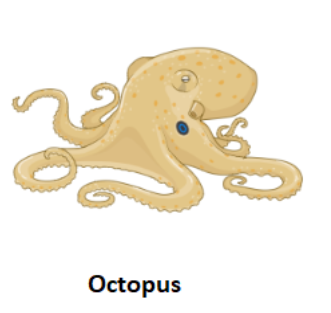
So, option D is the correct option.
Note: Other animals that belong to class Cephalopoda are squids, cuttlefish, and nautilus. Cephalopods are extremely marine animals that are characterized by the presence of a prominent head, set of arms or tentacles, and bilateral symmetrical body. Cephalopods are commonly called ink fish by the fishermen.
Complete answer: The scientific study which involves naming and defining and classifying biological organisms in groups depending on the shared characteristics is called taxonomy. The organisms are grouped into taxon and are given taxonomic rank to each taxon. Depending upon the rank the taxon is named as domain, kingdom, phylum, class, order, family, genus, and species. In botany instead of phylum, the division is used. The current system of taxonomy is found by the Swedish botanist Carl Linnaeus. The critical component of the taxonomic process is biological classification. A soft-bodied animal with eight limbs called octopus belongs to the phylum Mollusca and class of Cephalopoda of kingdom Animalia. The body of an octopus is bilaterally symmetrical with its head in the center of eight limbs. The limbs of an octopus are called appendages. As they swim, they trail their appendages behind them. The siphon is used for the process of locomotion and for respiration by expelling jets of water. The second-largest phylum of invertebrates is phylum Mollusca. Arthropoda is a phylum of invertebrates that show the presence of an exoskeleton, paired jointed appendages, and segmented body. Therefore, octopus belongs to the class of Cephalopoda.
So, option D is the correct option.
Note: Other animals that belong to class Cephalopoda are squids, cuttlefish, and nautilus. Cephalopods are extremely marine animals that are characterized by the presence of a prominent head, set of arms or tentacles, and bilateral symmetrical body. Cephalopods are commonly called ink fish by the fishermen.
Recently Updated Pages
Master Class 11 English: Engaging Questions & Answers for Success

Master Class 11 Social Science: Engaging Questions & Answers for Success
Master Class 11 Maths: Engaging Questions & Answers for Success
Master Class 11 Biology: Engaging Questions & Answers for Success
Master Class 11 Physics: Engaging Questions & Answers for Success
Master Class 11 Chemistry: Engaging Questions & Answers for Success
Trending doubts
One Metric ton is equal to kg A 10000 B 1000 C 100 class 11 physics CBSE
Difference Between Prokaryotic Cells and Eukaryotic Cells
Find the value of the expression given below sin 30circ class 11 maths CBSE
1 ton equals to A 100 kg B 1000 kg C 10 kg D 10000 class 11 physics CBSE
Two of the body parts which do not appear in MRI are class 11 biology CBSE
What are hard magnetic materials class 11 physics CBSE