




Which of the following can make a parallel beam of light when light from a point is incident on it?
A. Concave mirror as well as convex lens
B. Convex mirror as well as concave lens
C. Two plane mirrors placed at ${{90}^{o}}$ to each other
D. Concave mirror as well as concave lens
Answer
 Verified
615.3k+ views
Hint: We will use the mirror formula and lens formula with values of image distance as infinite and find the distance of the object and then we will check it for both concave and convex mirrors and lenses. The ones that will have a real image at the focus will be the correct answer.
Formula used:
Mirror formula
$\dfrac{1}{v}+\dfrac{1}{u}=\dfrac{1}{f}$
Lens formula
$\dfrac{1}{v}-\dfrac{1}{u}=\dfrac{1}{f}$
Complete answer:
Complete solution Step-by-Step:
We will first find the mirror formula and lens formula so that the image distance becomes infinite. Mirror formula will become
$\dfrac{1}{v}+\dfrac{1}{u}=\dfrac{1}{f}\Rightarrow \dfrac{1}{\infty }+\dfrac{1}{u}=\dfrac{1}{f}\Rightarrow \dfrac{1}{u}=\dfrac{1}{f}$
And the lens formula will now become
$\dfrac{1}{v}-\dfrac{1}{u}=\dfrac{1}{f}\Rightarrow \dfrac{1}{\infty }-\dfrac{1}{u}=\dfrac{1}{f}\Rightarrow -\dfrac{1}{u}=\dfrac{1}{f}$
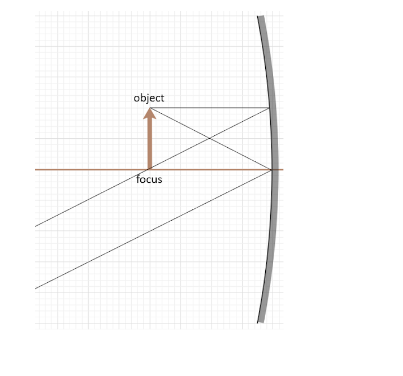
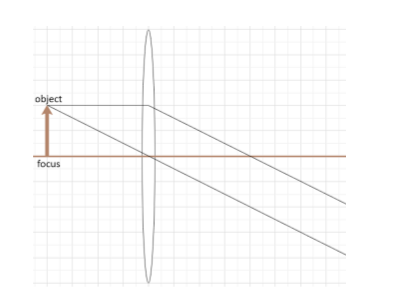
So, as we see that object must always be at the focus of the mirror or lens. And that can only happen if the focus is negative for the mirror and positive for the lens. For the mirror, a convex mirror has a positive focus and for a concave mirror the focus is negative, so the mirror we need will be concave. The focus for a convex lens is positive and that of a concave mirror is negative. We need the lens with positive focus, which is the convex lens. Hence, the correct option will be A, i.e. Concave mirror as well as convex lens
Here is how the rays will go for convex lenses and concave mirrors if the object is kept at distance equal to their focus.
Note:
Take care that two plane mirrors placed at ${{90}^{o}}$ to each other will not be a correct option as only two rays of light will go parallel to each other. Whereas others will be scattered in all directions. For the option choses all light waves going through the lens or reflecting from the mirror will become parallel to each other.
Formula used:
Mirror formula
$\dfrac{1}{v}+\dfrac{1}{u}=\dfrac{1}{f}$
Lens formula
$\dfrac{1}{v}-\dfrac{1}{u}=\dfrac{1}{f}$
Complete answer:
Complete solution Step-by-Step:
We will first find the mirror formula and lens formula so that the image distance becomes infinite. Mirror formula will become
$\dfrac{1}{v}+\dfrac{1}{u}=\dfrac{1}{f}\Rightarrow \dfrac{1}{\infty }+\dfrac{1}{u}=\dfrac{1}{f}\Rightarrow \dfrac{1}{u}=\dfrac{1}{f}$
And the lens formula will now become
$\dfrac{1}{v}-\dfrac{1}{u}=\dfrac{1}{f}\Rightarrow \dfrac{1}{\infty }-\dfrac{1}{u}=\dfrac{1}{f}\Rightarrow -\dfrac{1}{u}=\dfrac{1}{f}$
So, as we see that object must always be at the focus of the mirror or lens. And that can only happen if the focus is negative for the mirror and positive for the lens. For the mirror, a convex mirror has a positive focus and for a concave mirror the focus is negative, so the mirror we need will be concave. The focus for a convex lens is positive and that of a concave mirror is negative. We need the lens with positive focus, which is the convex lens. Hence, the correct option will be A, i.e. Concave mirror as well as convex lens
Here is how the rays will go for convex lenses and concave mirrors if the object is kept at distance equal to their focus.
Note:
Take care that two plane mirrors placed at ${{90}^{o}}$ to each other will not be a correct option as only two rays of light will go parallel to each other. Whereas others will be scattered in all directions. For the option choses all light waves going through the lens or reflecting from the mirror will become parallel to each other.
Recently Updated Pages
Master Class 12 Economics: Engaging Questions & Answers for Success

Master Class 12 English: Engaging Questions & Answers for Success
Master Class 12 Social Science: Engaging Questions & Answers for Success
Master Class 12 Maths: Engaging Questions & Answers for Success
Master Class 12 Physics: Engaging Questions & Answers for Success
Master Class 9 General Knowledge: Engaging Questions & Answers for Success
Trending doubts
Explain the Treaty of Vienna of 1815 class 10 social science CBSE
Who Won 36 Oscar Awards? Record Holder Revealed
Why is it 530 pm in india when it is 1200 afternoon class 10 social science CBSE
Make a sketch of the human nerve cell What function class 10 biology CBSE
What is the full form of POSCO class 10 social science CBSE
Define Potential, Developed, Stock and Reserved resources