




Which of the following are noncellular organisms that are characterized by having an inert crystalline structure outside the living cell?
(a) Viruses
(b) Mycoplasma
(c) Bacteria
(d) Lichen
Answer
 Verified
526.2k+ views
Hint: Most of this type of microorganism possesses single-stranded RNA as genetic material. Only a few of these species have DNA as genetic material. Some scientists believe that these organisms are non-living until they get into the host cell.
Complete answer:
Viruses are non-cellular species that have an inert, crystalline structure outside the living cell. Once a cell is infected with a virus, the virus takes over the host cell's machinery to replicate itself, thereby destroying the host cell. Viruses are obligate parasites (obligate parasites require a host cell to complete a part/the entire replication process). Viruses can infect all living cells such as plant cells, animal cells, bacteria, archaea, etc., Mycoplasma, bacteria, and lichen do not have an internal crystalline structure outside the living cells.
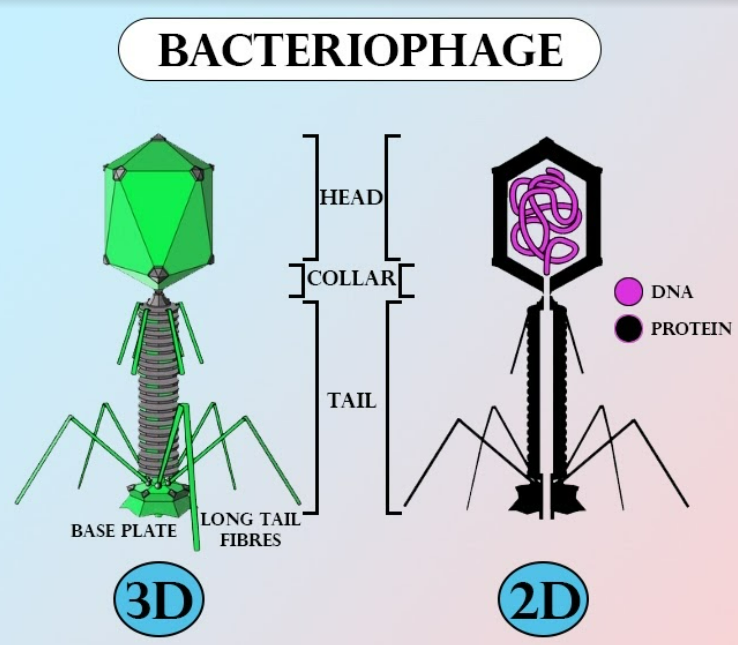
A host cell is induced upon infection to quickly produce thousands of identical copies of the infected virus. When viruses do not exist within an infected cell or during the process of infecting a cell, they exist in the form of individual particles or virions consisting of:
-genetic material: long DNA or RNA molecules that encode the protein structure by which the virus works. The genetic material of most viruses is a single-stranded RNA molecule.
-A protein coat/ capsid which surrounds and protects the genetic material.
-In some viruses, it possesses an outside envelope of lipids.
These virus particles have shapes ranging from basic helical and icosahedral forms to more complex structures. Viruses are too small to be seen with an optical microscope, as they are one hundredth the size of most bacteria.
The viruses transmit through vectors (an organism/animal which can transmit pathogens from one person to another), air transmission, fecal waste, sexual contact, etc.
So, the correct answer is, ‘Viruses’.
Note:
Viruses cause most of the world’s deadliest diseases such as ebola, HIV, etc. To date, the treatment for HIV is not discovered. HIV causes AIDS and it affects our immune system, thus our immune system cannot fight back against this disease. Since the HIV virus impairs the immune system of the affected individual, the person is susceptible to various other infections such as tuberculosis, and other environmental pathogenic microorganisms and will die.
Complete answer:
Viruses are non-cellular species that have an inert, crystalline structure outside the living cell. Once a cell is infected with a virus, the virus takes over the host cell's machinery to replicate itself, thereby destroying the host cell. Viruses are obligate parasites (obligate parasites require a host cell to complete a part/the entire replication process). Viruses can infect all living cells such as plant cells, animal cells, bacteria, archaea, etc., Mycoplasma, bacteria, and lichen do not have an internal crystalline structure outside the living cells.
A host cell is induced upon infection to quickly produce thousands of identical copies of the infected virus. When viruses do not exist within an infected cell or during the process of infecting a cell, they exist in the form of individual particles or virions consisting of:
-genetic material: long DNA or RNA molecules that encode the protein structure by which the virus works. The genetic material of most viruses is a single-stranded RNA molecule.
-A protein coat/ capsid which surrounds and protects the genetic material.
-In some viruses, it possesses an outside envelope of lipids.
These virus particles have shapes ranging from basic helical and icosahedral forms to more complex structures. Viruses are too small to be seen with an optical microscope, as they are one hundredth the size of most bacteria.
The viruses transmit through vectors (an organism/animal which can transmit pathogens from one person to another), air transmission, fecal waste, sexual contact, etc.
So, the correct answer is, ‘Viruses’.
Note:
Viruses cause most of the world’s deadliest diseases such as ebola, HIV, etc. To date, the treatment for HIV is not discovered. HIV causes AIDS and it affects our immune system, thus our immune system cannot fight back against this disease. Since the HIV virus impairs the immune system of the affected individual, the person is susceptible to various other infections such as tuberculosis, and other environmental pathogenic microorganisms and will die.
Recently Updated Pages
Master Class 11 Social Science: Engaging Questions & Answers for Success

Master Class 11 Physics: Engaging Questions & Answers for Success
Master Class 11 Maths: Engaging Questions & Answers for Success
Master Class 11 Economics: Engaging Questions & Answers for Success
Master Class 11 Computer Science: Engaging Questions & Answers for Success
Master Class 11 Chemistry: Engaging Questions & Answers for Success
Trending doubts
One Metric ton is equal to kg A 10000 B 1000 C 100 class 11 physics CBSE
How many bones are in the spine class 11 biology CBSE
1 Quintal is equal to a 110 kg b 10 kg c 100kg d 1000 class 11 physics CBSE
There are 720 permutations of the digits 1 2 3 4 5 class 11 maths CBSE
State and prove Bernoullis theorem class 11 physics CBSE
Difference Between Prokaryotic Cells and Eukaryotic Cells