




Which of the following animals is having longitudinal binary fission?
A. Euglena
B. Plasmodium
C. Planaria
D. Paramecium
Answer
 Verified
639.9k+ views
Hint: It is found in the unicellular eukaryotes having flagella.
Complete answer:
Fission is a type of asexual reproduction. It is the division of one entity into two or more parts that grow separately and forms a new entity.
Euglena reproduces through asexual reproduction by the process of binary fission.
In Euglena, binary fission is longitudinal, here division occurs along the longitudinal axis.
Binary fission is a process of mitosis, where cell organelles are duplicated and two separate sets of daughter cells are formed.
Additional information:
Fission may be of two types:
- Binary fission – in this single organism produces two parts.
- Multiple fissions – in this single organism produces many parts.
Binary fission in an organism can occur in four ways:
- Irregular – cell divides in any plane are always perpendicular to the division of the nucleus.
- Longitudinal – cell division occurs along its longitudinal axis.
- Transverse – cell division takes place along the transverse axis.
- Oblique – cell division occurs Obliquely.
So, the correct answer is Euglena.
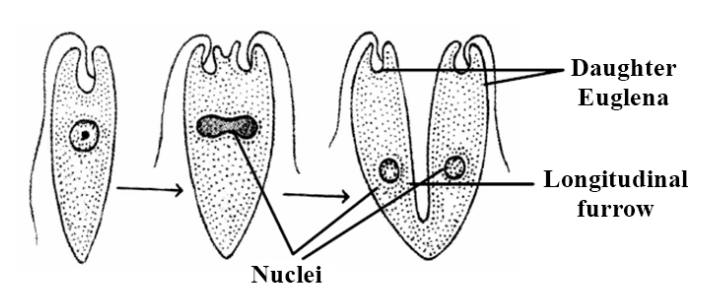
Longitudinal Binary Fission in Euglena
Note: In Plasmodium reproduction takes place through multiple fission, Planaria reproduces by fragmentation asexual reproduction in which organism is broken into several pieces and each piece develops into new individual and lastly Paramecium reproduces by transverse binary fission.
Complete answer:
Fission is a type of asexual reproduction. It is the division of one entity into two or more parts that grow separately and forms a new entity.
Euglena reproduces through asexual reproduction by the process of binary fission.
In Euglena, binary fission is longitudinal, here division occurs along the longitudinal axis.
Binary fission is a process of mitosis, where cell organelles are duplicated and two separate sets of daughter cells are formed.
Additional information:
Fission may be of two types:
- Binary fission – in this single organism produces two parts.
- Multiple fissions – in this single organism produces many parts.
Binary fission in an organism can occur in four ways:
- Irregular – cell divides in any plane are always perpendicular to the division of the nucleus.
- Longitudinal – cell division occurs along its longitudinal axis.
- Transverse – cell division takes place along the transverse axis.
- Oblique – cell division occurs Obliquely.
So, the correct answer is Euglena.
Longitudinal Binary Fission in Euglena
Note: In Plasmodium reproduction takes place through multiple fission, Planaria reproduces by fragmentation asexual reproduction in which organism is broken into several pieces and each piece develops into new individual and lastly Paramecium reproduces by transverse binary fission.
Recently Updated Pages
Master Class 12 Economics: Engaging Questions & Answers for Success

Master Class 12 English: Engaging Questions & Answers for Success
Master Class 12 Social Science: Engaging Questions & Answers for Success
Master Class 12 Maths: Engaging Questions & Answers for Success
Master Class 12 Physics: Engaging Questions & Answers for Success
Master Class 11 Social Science: Engaging Questions & Answers for Success
Trending doubts
One Metric ton is equal to kg A 10000 B 1000 C 100 class 11 physics CBSE
Difference Between Prokaryotic Cells and Eukaryotic Cells
Find the value of the expression given below sin 30circ class 11 maths CBSE
Two of the body parts which do not appear in MRI are class 11 biology CBSE
Draw a diagram of nephron and explain its structur class 11 biology CBSE
10 examples of friction in our daily life