




Which mollusk gives black pearls?
A. Pinctada maxima
B. Tridacna noae
C. Pinctada fucata
D. Pinctada margaritifera
Answer
 Verified
552k+ views
Hint: The real pearl oyster belongs to the family Pteriidae, order Dysodonta, and the genus Pinctada (Roding). Members of the Pteriidae family have a straight hinge with \[1-2\] tiny tooth-like thickening, a cavity for the byssus below the anterior angle, and generally a scaly surface on the outer shell valves. Pearl oysters of the genus Pinctada are members of this family.
Complete solution:
Option A - Pinctada maxima produces white, silver, champagne and gold color pearls.
Thus, option A is not correct.
Option B – Large white pearls with an undulating, porcelain-like surface are produced by Tridacna clams and are known as "non-nacreous pearls."
Thus, option B is not correct.
Option C – Pinctada fucata produces white and yellowish colored pearls of high quality which are called Akoya pearls.
Thus, option C is also not correct.
Option D – Pinctada margaritifera is a saltwater mollusk which produces black colored pearls and thus is commonly known as black lip pearl oyster.
Thus, option D is the correct answer.
Hence, Option D Pinctada margaritifera is the correct answer.
Additional information:
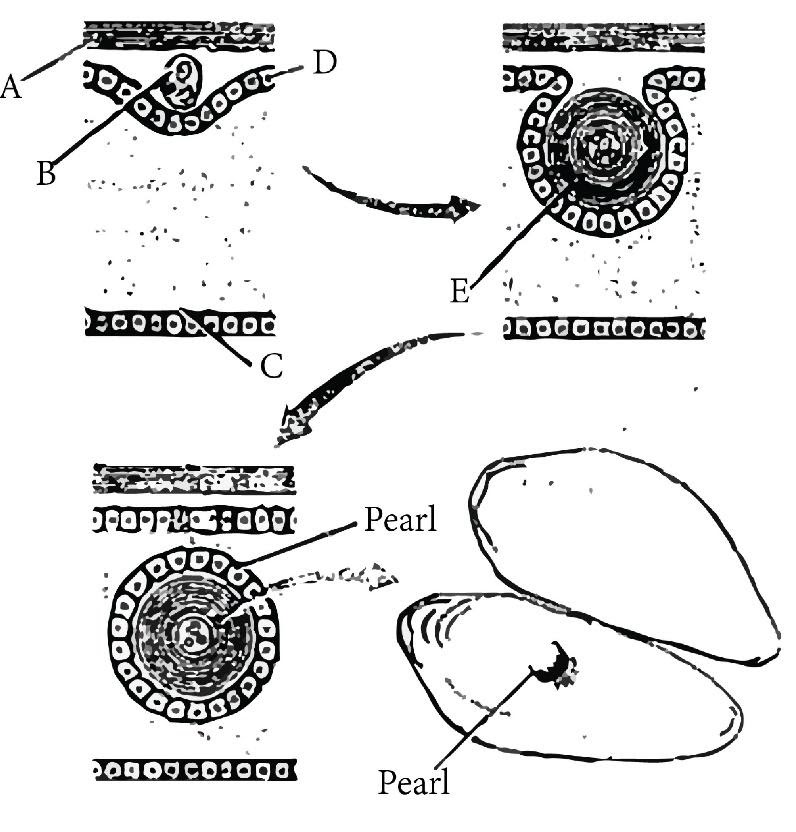
When a foreign particle enters the gap between the oyster's mantle and shell by mistake, it clings to the mantle. As a protective strategy, the mantle epithelium encloses it like a sac and begins to secrete concentric layers of nacre around it. The mantle's epithelial layer secretes nacre on a constant basis, which is deposited around the foreign particle, and the hard and lustrous pearl is formed over time by the creation of successive layers of calcium carbonate.
Note:
The calcareous secretion of the nacre (mother of pearl) found in the glandular mantle of pearl oysters is produced in concentric layers around a centre made of foreign item causing irritation, forming a spherical or irregular mass. The form, size, and colour of pearls vary depending on the type of pearl. The form of the pearls is usually uneven.
Complete solution:
Option A - Pinctada maxima produces white, silver, champagne and gold color pearls.
Thus, option A is not correct.
Option B – Large white pearls with an undulating, porcelain-like surface are produced by Tridacna clams and are known as "non-nacreous pearls."
Thus, option B is not correct.
Option C – Pinctada fucata produces white and yellowish colored pearls of high quality which are called Akoya pearls.
Thus, option C is also not correct.
Option D – Pinctada margaritifera is a saltwater mollusk which produces black colored pearls and thus is commonly known as black lip pearl oyster.
Thus, option D is the correct answer.
Hence, Option D Pinctada margaritifera is the correct answer.
Additional information:
When a foreign particle enters the gap between the oyster's mantle and shell by mistake, it clings to the mantle. As a protective strategy, the mantle epithelium encloses it like a sac and begins to secrete concentric layers of nacre around it. The mantle's epithelial layer secretes nacre on a constant basis, which is deposited around the foreign particle, and the hard and lustrous pearl is formed over time by the creation of successive layers of calcium carbonate.
Note:
The calcareous secretion of the nacre (mother of pearl) found in the glandular mantle of pearl oysters is produced in concentric layers around a centre made of foreign item causing irritation, forming a spherical or irregular mass. The form, size, and colour of pearls vary depending on the type of pearl. The form of the pearls is usually uneven.
Recently Updated Pages
Master Class 11 Social Science: Engaging Questions & Answers for Success

Master Class 11 English: Engaging Questions & Answers for Success
Master Class 11 Accountancy: Engaging Questions & Answers for Success
Master Class 11 Physics: Engaging Questions & Answers for Success
Master Class 11 Computer Science: Engaging Questions & Answers for Success
Master Class 11 Business Studies: Engaging Questions & Answers for Success
Trending doubts
Find the value of the expression given below sin 30circ class 11 maths CBSE
One Metric ton is equal to kg A 10000 B 1000 C 100 class 11 physics CBSE
10 examples of friction in our daily life
Draw a diagram of nephron and explain its structur class 11 biology CBSE
The teeth used for biting and cutting food are called class 11 biology CBSE
Proton was discovered by A Thomson B Rutherford C Chadwick class 11 chemistry CBSE