




Which model is shaded to show a fraction equivalent to \[\dfrac{3}{6}\]
A)

B)
C)
D)
Answer
 Verified
591.6k+ views
Hint:
First, we will simplify the given ratio by the questions into its simplest form. After that we will convert all the given figures into their respective rational numbers, then we will simplify all the ratios associated with their respective figures, then we will compare the calculated simplest ratios with the ratio given in the question to get to the final answer.
Complete step by step solution:
We will first convert the given ratio into its simplest form (that is simplify the ratio until numerator and denominator are co-primes to each other.)
According to the question, the given ratio is \[\dfrac{3}{6}\] .
Cancelling out the ratio by their common factor 3 we get.
\[ \Rightarrow \dfrac{3}{6} = \dfrac{1}{2}\]
Hence, we will now compare all the ratios by the simplest ratio calculated, that is \[\dfrac{1}{2}\]
Now we will convert all the figures into their respective ratios,
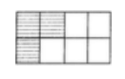
Figure1:

Assume that all the subparts are equal, we get
\[ \Rightarrow Ratio = \dfrac{{number\,of\,subparts\,shaded}}{{Total\,\,number\,of\,subparts}}\]
Here the number of subparts shaded =1 and the Total number of subparts = 4
Hence, the ratio for figure 1 is
\[ \Rightarrow {R_{figure1}} = \dfrac{1}{4}\]
Since, \[{R_{figure1}} \ne \dfrac{1}{2}\] , Figure1 is not the answer.
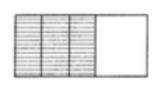
Figure2:
Assume that all the subparts are equal, we get
\[ \Rightarrow Ratio = \dfrac{{number\,of\,subparts\,shaded}}{{Total\,\,number\,of\,subparts}}\]
Here the number of subparts shaded =3 and the Total number of subparts = 8
Hence, the ratio for figure 2 is
\[ \Rightarrow {R_{figure2}} = \dfrac{3}{8}\]
Since, \[{R_{figure2}} \ne \dfrac{1}{2}\] , Figure2 is not the answer.
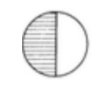
Figure3:
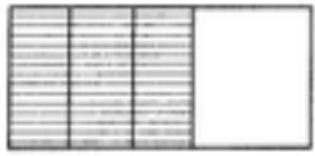
Here, we can see that, the unshaded part is equal to 2 subparts of the figure
Now, assume that all the subparts are equal, we get
\[ \Rightarrow Ratio = \dfrac{{number\,of\,subparts\,shaded}}{{Total\,\,number\,of\,subparts}}\]
Here the number of subparts shaded =3 and the Total number of subparts = 5
Hence, the ratio for figure 3 is
\[ \Rightarrow {R_{figure3}} = \dfrac{3}{5}\]
Since, \[{R_{figure3}} \ne \dfrac{1}{2}\] , Figure3 is not the answer.
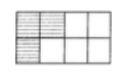
Figure 4:
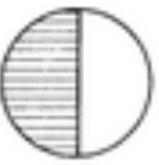
Assume that all the subparts are equal, we get
\[ \Rightarrow Ratio = \dfrac{{number\,of\,subparts\,shaded}}{{Total\,\,number\,of\,subparts}}\]
Here the number of subparts shaded =1 and the Total number of subparts = 2
Hence, the ratio for figure 4 is
\[ \Rightarrow {R_{figure4}} = \dfrac{1}{2}\]
Since, \[{R_{figure4}} = \dfrac{1}{2}\] , Figure4 is the answer
Hence, the final answer is D.
Note:
In these types of questions, sometimes the subparts are merged to confuse us. In that case, we must predict how many equal subparts are merged in the given figure. It will help us in identifying the number of shaded subparts and the number of total equal subparts present in the given figure.
First, we will simplify the given ratio by the questions into its simplest form. After that we will convert all the given figures into their respective rational numbers, then we will simplify all the ratios associated with their respective figures, then we will compare the calculated simplest ratios with the ratio given in the question to get to the final answer.
Complete step by step solution:
We will first convert the given ratio into its simplest form (that is simplify the ratio until numerator and denominator are co-primes to each other.)
According to the question, the given ratio is \[\dfrac{3}{6}\] .
Cancelling out the ratio by their common factor 3 we get.
\[ \Rightarrow \dfrac{3}{6} = \dfrac{1}{2}\]
Hence, we will now compare all the ratios by the simplest ratio calculated, that is \[\dfrac{1}{2}\]
Now we will convert all the figures into their respective ratios,
Figure1:
Assume that all the subparts are equal, we get
\[ \Rightarrow Ratio = \dfrac{{number\,of\,subparts\,shaded}}{{Total\,\,number\,of\,subparts}}\]
Here the number of subparts shaded =1 and the Total number of subparts = 4
Hence, the ratio for figure 1 is
\[ \Rightarrow {R_{figure1}} = \dfrac{1}{4}\]
Since, \[{R_{figure1}} \ne \dfrac{1}{2}\] , Figure1 is not the answer.
Figure2:
Assume that all the subparts are equal, we get
\[ \Rightarrow Ratio = \dfrac{{number\,of\,subparts\,shaded}}{{Total\,\,number\,of\,subparts}}\]
Here the number of subparts shaded =3 and the Total number of subparts = 8
Hence, the ratio for figure 2 is
\[ \Rightarrow {R_{figure2}} = \dfrac{3}{8}\]
Since, \[{R_{figure2}} \ne \dfrac{1}{2}\] , Figure2 is not the answer.
Figure3:
Here, we can see that, the unshaded part is equal to 2 subparts of the figure
Now, assume that all the subparts are equal, we get
\[ \Rightarrow Ratio = \dfrac{{number\,of\,subparts\,shaded}}{{Total\,\,number\,of\,subparts}}\]
Here the number of subparts shaded =3 and the Total number of subparts = 5
Hence, the ratio for figure 3 is
\[ \Rightarrow {R_{figure3}} = \dfrac{3}{5}\]
Since, \[{R_{figure3}} \ne \dfrac{1}{2}\] , Figure3 is not the answer.
Figure 4:
Assume that all the subparts are equal, we get
\[ \Rightarrow Ratio = \dfrac{{number\,of\,subparts\,shaded}}{{Total\,\,number\,of\,subparts}}\]
Here the number of subparts shaded =1 and the Total number of subparts = 2
Hence, the ratio for figure 4 is
\[ \Rightarrow {R_{figure4}} = \dfrac{1}{2}\]
Since, \[{R_{figure4}} = \dfrac{1}{2}\] , Figure4 is the answer
Hence, the final answer is D.
Note:
In these types of questions, sometimes the subparts are merged to confuse us. In that case, we must predict how many equal subparts are merged in the given figure. It will help us in identifying the number of shaded subparts and the number of total equal subparts present in the given figure.

Recently Updated Pages
In a plane electromagnetic wave the electric field class 12 physics CBSE

A plane electromagnetic wave travels in vacuum along class 12 physics CBSE
The magnetic field in a plane electromagnetic wave class 11 physics CBSE
Basicity of sulphurous acid and sulphuric acid are
Master Class 11 Business Studies: Engaging Questions & Answers for Success
Master Class 11 Computer Science: Engaging Questions & Answers for Success
Trending doubts
Give 10 examples for herbs , shrubs , climbers , creepers
What is the chemical symbol for gold?
What is the shape of Earth A Circle B Square C Sphere class 6 social science CBSE
The planet nearest to earth is A Mercury B Venus C class 6 social science CBSE
Which country first gave women the right to vote?
What is the chemical symbol for gold? A) Au B) Ag C) Ga D) Ge