




Which land snail is the giant of the following,
(a) Limax
(b) Helix
(c) Achatina
(d) Pila
Answer
 Verified
600.3k+ views
Hint: The above type of snail belongs to species of large land snail that belongs to the Achatinidae family. It is also known as the ground snail of Giant Africa.
Complete step by step answer:
Achatina belongs to the family achatinidae as mentioned above and its scientific name is Achatina Fulica. It is native to Africa, so the name giant African snail originated.
One of the largest terrestrial gastropods is the Giant African Land Snail. They have shells that are medium to dark brown with vertical lines and a deeper shade of brown. They have a lifespan of around 5-7 years on average. They prefer to live much longer when they have enough food and the weather is good. Some of them are known to live for up to ten years.
Let's dig a little deep into other snails and find some interesting facts about them.
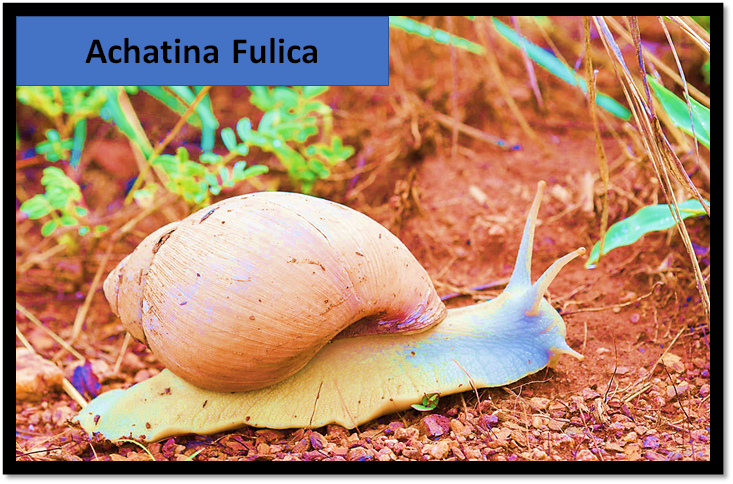
So, the correct answer is ‘Achatina’.
Additional information:
Limax: In the earthly pulmonate gastropod mollusc family Limacidae, Limax is a genus of air-breathing ground slugs.
Helix: Helix is a genus native to Europe and the Mediterranean region of large, air-breathing land snails. They are the type genus of the Helicidae family and one of the first genera of animals described by Carl Linnaeus. During the Oligocene, members of the genus first appeared.
Pila: In the family Ampullariidae, the apple snail, Pila is a genus of large freshwater snails with an operculum, African and Asian apple snails, aquatic gastropod mollusks. Belonging to the phylum- Mollusca.
Note: The species is one of the most dangerous pests in agriculture and one of the least desired animals because, given the parasites it harbors, it can spread different diseases to both animals and humans. For a long time, various methods for the management and control of populations of Achatina Fulica have been applied by individuals.
Complete step by step answer:
Achatina belongs to the family achatinidae as mentioned above and its scientific name is Achatina Fulica. It is native to Africa, so the name giant African snail originated.
One of the largest terrestrial gastropods is the Giant African Land Snail. They have shells that are medium to dark brown with vertical lines and a deeper shade of brown. They have a lifespan of around 5-7 years on average. They prefer to live much longer when they have enough food and the weather is good. Some of them are known to live for up to ten years.
Let's dig a little deep into other snails and find some interesting facts about them.
So, the correct answer is ‘Achatina’.
Additional information:
Limax: In the earthly pulmonate gastropod mollusc family Limacidae, Limax is a genus of air-breathing ground slugs.
Helix: Helix is a genus native to Europe and the Mediterranean region of large, air-breathing land snails. They are the type genus of the Helicidae family and one of the first genera of animals described by Carl Linnaeus. During the Oligocene, members of the genus first appeared.
Pila: In the family Ampullariidae, the apple snail, Pila is a genus of large freshwater snails with an operculum, African and Asian apple snails, aquatic gastropod mollusks. Belonging to the phylum- Mollusca.
Note: The species is one of the most dangerous pests in agriculture and one of the least desired animals because, given the parasites it harbors, it can spread different diseases to both animals and humans. For a long time, various methods for the management and control of populations of Achatina Fulica have been applied by individuals.
Recently Updated Pages
Master Class 11 Social Science: Engaging Questions & Answers for Success

Master Class 11 Physics: Engaging Questions & Answers for Success
Master Class 11 Maths: Engaging Questions & Answers for Success
Master Class 11 Economics: Engaging Questions & Answers for Success
Master Class 11 Computer Science: Engaging Questions & Answers for Success
Master Class 11 Chemistry: Engaging Questions & Answers for Success
Trending doubts
One Metric ton is equal to kg A 10000 B 1000 C 100 class 11 physics CBSE
There are 720 permutations of the digits 1 2 3 4 5 class 11 maths CBSE
1 Quintal is equal to a 110 kg b 10 kg c 100kg d 1000 class 11 physics CBSE
State and prove Bernoullis theorem class 11 physics CBSE
Difference Between Prokaryotic Cells and Eukaryotic Cells
Which among the following are examples of coming together class 11 social science CBSE