




Which is true for repressible operon?
(A)${ Off }\underset { Inducer }{ \rightarrow } { On }$
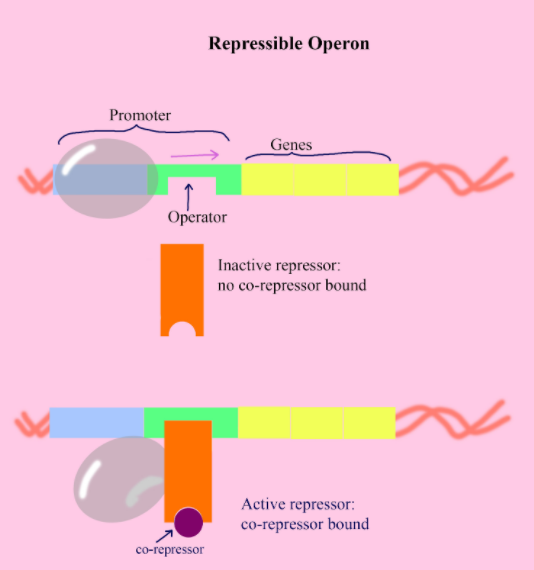
(B)${ Inactive\, repressor }{ + }{ Co-repressor }{ = }{ active\, repressor }$
(C)${ Active\, repressor }{ + }{ Inducer }{ = }{ inactive\,epressor }$
(D)${ On }\underset { Inducer }{ \rightarrow } { Off }$
Answer
 Verified
613.2k+ views
Hint: In the repressible operon, earlier the repressor was in that state in which it can’t perform a function, but in the latter state, it gets converted to a state when the repressor is able to perform the function assigned to it.
Complete answer:
A repressible operon is that the one during which transcription is reduced within the presence of a specific substance. This substance is usually the top product of a biosynthetic pathway. For instance, the trp operon may be a repressible operon. If tryptophan is present within the environment, then E. coli doesn't get to synthesize it; trp operon is turned off.
Additional Information: In genetics, an operon is a functioning unit of DNA containing a cluster of genes under the control of one promoter. The genes are transcribed together into an mRNA strand and either translated together within the cytoplasm or undergo splicing to make monocistronic mRNAs that are translated separately, i.e. several strands of mRNA that every encodes one gene product. A substance that inhibits the expression of genes not by direct binding to DNA but instead indirectly regulates organic phenomenon by binding to repressors is understood as a co-repressor. Binding of the tryptophan repressor complex at the operator prevents the RNA polymerase to bind to the downstream genes and this in turn prevents their transcription. Here, tryptophan functions as a co-repressor. A molecule that regulates organic phenomenon by binding to repressors or activators to stop or start the transcription respectively, is understood as an inducer
So, the correct answer is ‘${ Inactive\,repressor }{ + }{ Co-repressor }{ = }{ active\,repressor}$’.
Note: The lac operon model of the bacterium Escherichia coli was the first operon to be discovered. It provides a typical example of operon function. In fact, the trp operon in E. coli was the first repressible operon to be discovered and studied.
Complete answer:
A repressible operon is that the one during which transcription is reduced within the presence of a specific substance. This substance is usually the top product of a biosynthetic pathway. For instance, the trp operon may be a repressible operon. If tryptophan is present within the environment, then E. coli doesn't get to synthesize it; trp operon is turned off.
Additional Information: In genetics, an operon is a functioning unit of DNA containing a cluster of genes under the control of one promoter. The genes are transcribed together into an mRNA strand and either translated together within the cytoplasm or undergo splicing to make monocistronic mRNAs that are translated separately, i.e. several strands of mRNA that every encodes one gene product. A substance that inhibits the expression of genes not by direct binding to DNA but instead indirectly regulates organic phenomenon by binding to repressors is understood as a co-repressor. Binding of the tryptophan repressor complex at the operator prevents the RNA polymerase to bind to the downstream genes and this in turn prevents their transcription. Here, tryptophan functions as a co-repressor. A molecule that regulates organic phenomenon by binding to repressors or activators to stop or start the transcription respectively, is understood as an inducer
So, the correct answer is ‘${ Inactive\,repressor }{ + }{ Co-repressor }{ = }{ active\,repressor}$’.
Note: The lac operon model of the bacterium Escherichia coli was the first operon to be discovered. It provides a typical example of operon function. In fact, the trp operon in E. coli was the first repressible operon to be discovered and studied.
Recently Updated Pages
Master Class 12 Business Studies: Engaging Questions & Answers for Success

Master Class 12 Biology: Engaging Questions & Answers for Success
Master Class 12 Chemistry: Engaging Questions & Answers for Success
Class 12 Question and Answer - Your Ultimate Solutions Guide
Master Class 11 Social Science: Engaging Questions & Answers for Success
Master Class 11 English: Engaging Questions & Answers for Success
Trending doubts
Which are the Top 10 Largest Countries of the World?
Draw a labelled sketch of the human eye class 12 physics CBSE
Differentiate between homogeneous and heterogeneous class 12 chemistry CBSE
Why is the cell called the structural and functional class 12 biology CBSE
Draw ray diagrams each showing i myopic eye and ii class 12 physics CBSE
Which is the correct genotypic ratio of mendel dihybrid class 12 biology CBSE