




Which is the gas used for making vegetables and Vanaspati from vegetable oils?
Answer
 Verified
625.2k+ views
Hint: The gas is the lightest element of the periodic table and is added to oils to make it more solid and spreadable.
Step by Step answer:
In the food industry hydrogen is added to oil to make them more solid or spreadable. Hydrogenated oils can be sold directly as spreads, but are also used in the food industry in the manufacture of many food stuff such as biscuits and cakes. This process is known as hydrogenation.
Vanaspati is a desi vegetable ghee that has been hydrogenated and hardened. We can also define Vanaspathi as a fully or partially hydrogenated vegetable cooking oil often used as a cheaper substitute for ghee and butter in India. Vanaspati is usually made from palm oil. Hydrogenation is performed using a catalyst known as supported Nickel catalyst in a reactor at low medium pressure about (3-10 bar).
Here is the diagram which explains the process of hydrogenation:
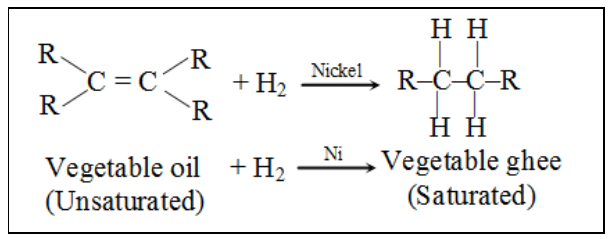
As you can see in the above mentioned hydrogenation process the liquid vegetable oil gets converted into solid or semi-solid fats such as those present in margarine. Changing the degree of saturation of the fat changes some important physical properties such as the melting range, which is why liquid oils become semi solid.
Thus, we can say hydrogen is the gas which is used for making vegetables and Vanaspati from vegetable oils.
Note: The main advantage of hydrogenated oil is that these oils are more stable and resistant to oxidation, which is the breakdown of fats when exposed to heat. They are easy to use in baked or fried foods as they are less likely to become rancid than other fats.
Step by Step answer:
In the food industry hydrogen is added to oil to make them more solid or spreadable. Hydrogenated oils can be sold directly as spreads, but are also used in the food industry in the manufacture of many food stuff such as biscuits and cakes. This process is known as hydrogenation.
Vanaspati is a desi vegetable ghee that has been hydrogenated and hardened. We can also define Vanaspathi as a fully or partially hydrogenated vegetable cooking oil often used as a cheaper substitute for ghee and butter in India. Vanaspati is usually made from palm oil. Hydrogenation is performed using a catalyst known as supported Nickel catalyst in a reactor at low medium pressure about (3-10 bar).
Here is the diagram which explains the process of hydrogenation:
As you can see in the above mentioned hydrogenation process the liquid vegetable oil gets converted into solid or semi-solid fats such as those present in margarine. Changing the degree of saturation of the fat changes some important physical properties such as the melting range, which is why liquid oils become semi solid.
Thus, we can say hydrogen is the gas which is used for making vegetables and Vanaspati from vegetable oils.
Note: The main advantage of hydrogenated oil is that these oils are more stable and resistant to oxidation, which is the breakdown of fats when exposed to heat. They are easy to use in baked or fried foods as they are less likely to become rancid than other fats.
Recently Updated Pages
Master Class 11 Social Science: Engaging Questions & Answers for Success

Master Class 11 Physics: Engaging Questions & Answers for Success
Master Class 11 Maths: Engaging Questions & Answers for Success
Master Class 11 Economics: Engaging Questions & Answers for Success
Master Class 11 Computer Science: Engaging Questions & Answers for Success
Master Class 11 Chemistry: Engaging Questions & Answers for Success
Trending doubts
One Metric ton is equal to kg A 10000 B 1000 C 100 class 11 physics CBSE
There are 720 permutations of the digits 1 2 3 4 5 class 11 maths CBSE
1 Quintal is equal to a 110 kg b 10 kg c 100kg d 1000 class 11 physics CBSE
State and prove Bernoullis theorem class 11 physics CBSE
Difference Between Prokaryotic Cells and Eukaryotic Cells
Which among the following are examples of coming together class 11 social science CBSE