




Which factor does not affect convection?
A. Temperature difference.
B. The rate of moment of carrying medium.
C. The volumetric specific heat of the carrying medium.
D. The thermal conductivity of a carrying medium.
Answer
 Verified
540k+ views
Hint:In this question we first have to deal with the factors that affect convection or the rate of convection (whether it slows down or makes the process faster). We will analyse each of the points given in the above question and if these points are affecting the process of convection to some extent or not.
Complete answer:
Convection is the process of heat transfer by the bulk movement of molecules within fluids such as gases and liquids. The fluid that is heated moves up and the colder fluid moves down forming a loop called convection current.
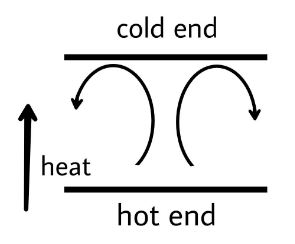
The above diagram shows convection and the movement of convection currents. Temperature difference promotes convection, generally the larger the temperature difference the faster the convection process occurs in a liquid or a gas.The rate of movement of carrying medium means the rate at which the particles of fluid will move up and pass the heat energy to the above particles in order to make the convection happen. Higher the rate faster the convection.
The volumetric heat capacity of a material is the heat capacity of a sample of the substance divided by the volume of the sample. More volumetric specific heat more heat energy will be required to set up the convection current. So, this factor will also affect the convection process. The thermal conductivity of the carrying medium is a factor that affects the rate of heat transfer via conduction in a given medium, it doesn't affect the convection. More thermal conductivity faster the conduction.
So, the correct answer is option (D).
Note: In the process of convection (this question), we only consider those factors that affect the flow of heat from one part of the liquid to the other part of the liquid. But in case of conduction, we have to consider those factors that lower the thermal resistance of the conducting medium present and in radiation process properties like surface area and heat absorption of a substance plays the major role.
Complete answer:
Convection is the process of heat transfer by the bulk movement of molecules within fluids such as gases and liquids. The fluid that is heated moves up and the colder fluid moves down forming a loop called convection current.
The above diagram shows convection and the movement of convection currents. Temperature difference promotes convection, generally the larger the temperature difference the faster the convection process occurs in a liquid or a gas.The rate of movement of carrying medium means the rate at which the particles of fluid will move up and pass the heat energy to the above particles in order to make the convection happen. Higher the rate faster the convection.
The volumetric heat capacity of a material is the heat capacity of a sample of the substance divided by the volume of the sample. More volumetric specific heat more heat energy will be required to set up the convection current. So, this factor will also affect the convection process. The thermal conductivity of the carrying medium is a factor that affects the rate of heat transfer via conduction in a given medium, it doesn't affect the convection. More thermal conductivity faster the conduction.
So, the correct answer is option (D).
Note: In the process of convection (this question), we only consider those factors that affect the flow of heat from one part of the liquid to the other part of the liquid. But in case of conduction, we have to consider those factors that lower the thermal resistance of the conducting medium present and in radiation process properties like surface area and heat absorption of a substance plays the major role.
Recently Updated Pages
Master Class 11 Social Science: Engaging Questions & Answers for Success

Master Class 11 English: Engaging Questions & Answers for Success
Master Class 11 Accountancy: Engaging Questions & Answers for Success
Master Class 11 Physics: Engaging Questions & Answers for Success
Master Class 11 Computer Science: Engaging Questions & Answers for Success
Master Class 11 Business Studies: Engaging Questions & Answers for Success
Trending doubts
One Metric ton is equal to kg A 10000 B 1000 C 100 class 11 physics CBSE
Find the value of the expression given below sin 30circ class 11 maths CBSE
Draw a diagram of nephron and explain its structur class 11 biology CBSE
10 examples of friction in our daily life
Proton was discovered by A Thomson B Rutherford C Chadwick class 11 chemistry CBSE
The teeth used for biting and cutting food are called class 11 biology CBSE