




Which enzyme, present in saliva, breaks down starch?
Answer
 Verified
531.3k+ views
Hint: Starch is a complex carbohydrate which is present in the plant-based food. The plants store the prepared food in the leaves in the form of starch. The digestion of food starts with the breakdown of starch in the mouth by the hemp of enzymes which breaks into dextrin and maltose.
Complete answer:
The digestion of food is the process of breakdown down food into simpler substances that can be easily absorbed by the body. This is mediated by the action of the enzymes at different levels of the alimentary canal which converts the complex nutrients in the food to simpler forms. The chief nutrients present in the food are carbohydrates, proteins and fats which are converted into monosaccharides or glucose, amino acids and fatty acids and glycerol.
The digestion of the starch a polysaccharide begins in the mouth. The saliva plays an important role in converting the starch. Salivary amylase is the enzyme that is present in saliva. Salivary amylase is also known as ptyalin. It breaks down the starch which is a polymer of glucose into dextrin and maltose. These carbohydrates can be absorbed easily by our body.
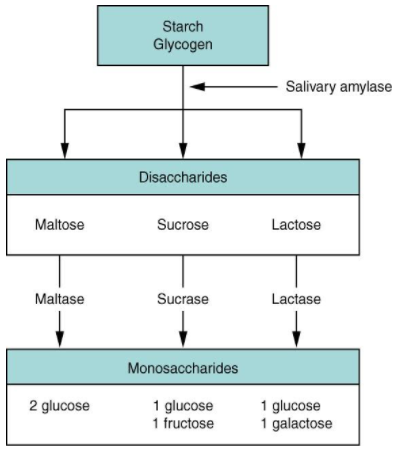
We can conclude that Ptyalin or salivary amylase is an enzyme that is secreted by the salivary gland helps in the chemical breakdown of starch.
Note: The proteins are metabolised in the stomach by the enzymes called peptidases. They hydrolyse the peptide bonds and work at acidic pH. The fats are emulsified in the small intestine by the help of lipases which are present in the bile and pancreatic juice. This mixture is poured into the small intestine where the total breakdown of the food takes place.
Complete answer:
The digestion of food is the process of breakdown down food into simpler substances that can be easily absorbed by the body. This is mediated by the action of the enzymes at different levels of the alimentary canal which converts the complex nutrients in the food to simpler forms. The chief nutrients present in the food are carbohydrates, proteins and fats which are converted into monosaccharides or glucose, amino acids and fatty acids and glycerol.
The digestion of the starch a polysaccharide begins in the mouth. The saliva plays an important role in converting the starch. Salivary amylase is the enzyme that is present in saliva. Salivary amylase is also known as ptyalin. It breaks down the starch which is a polymer of glucose into dextrin and maltose. These carbohydrates can be absorbed easily by our body.
We can conclude that Ptyalin or salivary amylase is an enzyme that is secreted by the salivary gland helps in the chemical breakdown of starch.
Note: The proteins are metabolised in the stomach by the enzymes called peptidases. They hydrolyse the peptide bonds and work at acidic pH. The fats are emulsified in the small intestine by the help of lipases which are present in the bile and pancreatic juice. This mixture is poured into the small intestine where the total breakdown of the food takes place.
Recently Updated Pages
Master Class 12 Economics: Engaging Questions & Answers for Success

Master Class 12 English: Engaging Questions & Answers for Success
Master Class 12 Social Science: Engaging Questions & Answers for Success
Master Class 12 Maths: Engaging Questions & Answers for Success
Master Class 12 Physics: Engaging Questions & Answers for Success
Master Class 11 Social Science: Engaging Questions & Answers for Success
Trending doubts
One Metric ton is equal to kg A 10000 B 1000 C 100 class 11 physics CBSE
Difference Between Prokaryotic Cells and Eukaryotic Cells
Find the value of the expression given below sin 30circ class 11 maths CBSE
1 ton equals to A 100 kg B 1000 kg C 10 kg D 10000 class 11 physics CBSE
Two of the body parts which do not appear in MRI are class 11 biology CBSE
Draw a diagram of nephron and explain its structur class 11 biology CBSE