




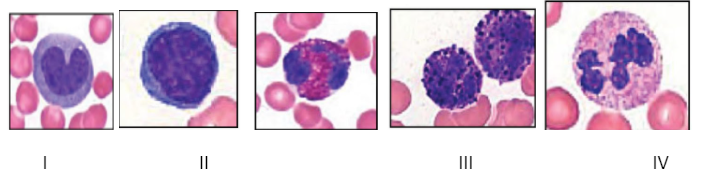
Which are the phagocytic cells from the given diagram?
a. I and V
b. I and III
c. I and IV
d. I and II
Answer
 Verified
616.2k+ views
Hint: Phagocytes are those types of cells that engulf and “eat” other cells. Macrophages and neutrophils are the two types of phagocytes, which are both essential cells involved in immunity. Phagocytic cells are monocytes, macrophages, neutrophils, tissue dendritic cells, and mast cells.
Complete answer:
The given diagram shows different types of white blood cells(WBCs) or leucocytes.
- I represent monocytes.
- II represents lymphocytes.
- III represents eosinophil.
- IV represents basophil
- V represents neutrophil.
Out of these cells, phagocytic cells are monocytes and neutrophils i.e. I and V.
Monocytes are agranulocytes which are actively motile and phagocytic cells. Neutrophils are granulocytes that perform phagocytosis and destroy harmful bacteria entering the body.
Hence, the correct answer is option (A).
Additional information:
The phagocytosis process occurs when the cell tries to destroy foreign particles or pathogens such as bacteria or an infected cell by engulfing it in lytic enzymes. This process is also observed in single-celled organisms such as amoeba during the ingestion of food particles.
In humans, phagocyte cells protect the body by ingesting harmful pathogens like viruses, bacteria, and other infected/ dying cells. Phagocytosis is a vital aspect of the immune system and is undertaken by special cells like neutrophils and macrophages. By destroying the pathogens, the immune system stops the spread of infection or pathogens in the body.
Note: Figure I represents macrophages and figure V represents neutrophils both of which are the phagocytic cells of the body. Macrophages are precursors of monocytes, a type of agranulocytes and neutrophils are granulocytes with multilobed nuclei. Figures II, III and IV represent lymphocyte, eosinophil, and basophil respectively which do not perform phagocytosis.
Complete answer:
The given diagram shows different types of white blood cells(WBCs) or leucocytes.
- I represent monocytes.
- II represents lymphocytes.
- III represents eosinophil.
- IV represents basophil
- V represents neutrophil.
Out of these cells, phagocytic cells are monocytes and neutrophils i.e. I and V.
Monocytes are agranulocytes which are actively motile and phagocytic cells. Neutrophils are granulocytes that perform phagocytosis and destroy harmful bacteria entering the body.
Hence, the correct answer is option (A).
Additional information:
The phagocytosis process occurs when the cell tries to destroy foreign particles or pathogens such as bacteria or an infected cell by engulfing it in lytic enzymes. This process is also observed in single-celled organisms such as amoeba during the ingestion of food particles.
In humans, phagocyte cells protect the body by ingesting harmful pathogens like viruses, bacteria, and other infected/ dying cells. Phagocytosis is a vital aspect of the immune system and is undertaken by special cells like neutrophils and macrophages. By destroying the pathogens, the immune system stops the spread of infection or pathogens in the body.
Note: Figure I represents macrophages and figure V represents neutrophils both of which are the phagocytic cells of the body. Macrophages are precursors of monocytes, a type of agranulocytes and neutrophils are granulocytes with multilobed nuclei. Figures II, III and IV represent lymphocyte, eosinophil, and basophil respectively which do not perform phagocytosis.
Recently Updated Pages
Master Class 12 Economics: Engaging Questions & Answers for Success

Master Class 12 English: Engaging Questions & Answers for Success
Master Class 12 Social Science: Engaging Questions & Answers for Success
Master Class 12 Maths: Engaging Questions & Answers for Success
Master Class 12 Physics: Engaging Questions & Answers for Success
Master Class 9 General Knowledge: Engaging Questions & Answers for Success
Trending doubts
One Metric ton is equal to kg A 10000 B 1000 C 100 class 11 physics CBSE
Difference Between Prokaryotic Cells and Eukaryotic Cells
Two of the body parts which do not appear in MRI are class 11 biology CBSE
1 ton equals to A 100 kg B 1000 kg C 10 kg D 10000 class 11 physics CBSE
Draw a diagram of nephron and explain its structur class 11 biology CBSE
10 examples of friction in our daily life