




Which among the following glands is situated beneath the brain and whose over secretion produces giant size children
A. Pituitary
B. Thyroid
C. Adrenal
D. Pancreas
Answer
 Verified
596.1k+ views
Hint: The growth hormone is responsible for the normal growth in our body. It is secreted by an endocrine gland. Overproduction and underproduction of growth hormone cause severe abnormalities in children.
Step by step answer:The other name of the pituitary gland is hypophysis. It is a small pea-shaped gland that is located in a bony cavity called sella tursica. It is an example of an endocrine gland and it produces several hormones essential for the normal metabolism of our body. It has two lobes called the anterior pituitary lobe and the posterior pituitary lobe. The posterior pituitary lobe contains hormones that are produced by the hypothalamus.
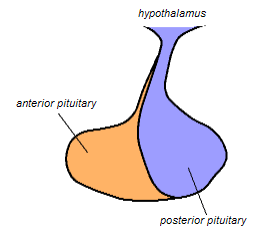
Anterior lobe is called pars distalis and the posterior lobe is called pars nervosa. The middle lobe atrophies during the foetal development. Major hormones secreted by the pituitary gland are growth hormone, thyrotropic hormone, adrenocorticotropic hormone, prolactin, and gonadotropins. Growth hormone is secreted by somatotropic cells present in the pituitary gland. It controls the synthesis and accumulation of proteins in the body which leads to bodybuilding. It also helps for the growth and elongation of bones along with growth of muscles. Abnormal secretion of growth hormones leads to several problems. Decreased growth hormone secretion leads to dwarfism in which the individual is short in stature. Also, the excess secretion of growth hormones from childhood results in a large-sized body, and the condition is called gigantism.
Hence the correct option is A
Note: Hypersecretion of growth hormone in adults also creates problems. The condition is called acromegaly. In these individuals, abnormal elongation of bones and other body parts is seen. Facial bones become enlarged along with disproportionate growth of body parts.
Step by step answer:The other name of the pituitary gland is hypophysis. It is a small pea-shaped gland that is located in a bony cavity called sella tursica. It is an example of an endocrine gland and it produces several hormones essential for the normal metabolism of our body. It has two lobes called the anterior pituitary lobe and the posterior pituitary lobe. The posterior pituitary lobe contains hormones that are produced by the hypothalamus.
Anterior lobe is called pars distalis and the posterior lobe is called pars nervosa. The middle lobe atrophies during the foetal development. Major hormones secreted by the pituitary gland are growth hormone, thyrotropic hormone, adrenocorticotropic hormone, prolactin, and gonadotropins. Growth hormone is secreted by somatotropic cells present in the pituitary gland. It controls the synthesis and accumulation of proteins in the body which leads to bodybuilding. It also helps for the growth and elongation of bones along with growth of muscles. Abnormal secretion of growth hormones leads to several problems. Decreased growth hormone secretion leads to dwarfism in which the individual is short in stature. Also, the excess secretion of growth hormones from childhood results in a large-sized body, and the condition is called gigantism.
Hence the correct option is A
Note: Hypersecretion of growth hormone in adults also creates problems. The condition is called acromegaly. In these individuals, abnormal elongation of bones and other body parts is seen. Facial bones become enlarged along with disproportionate growth of body parts.
Recently Updated Pages
Master Class 11 Social Science: Engaging Questions & Answers for Success

Master Class 11 Physics: Engaging Questions & Answers for Success
Master Class 11 Maths: Engaging Questions & Answers for Success
Master Class 11 Economics: Engaging Questions & Answers for Success
Master Class 11 Computer Science: Engaging Questions & Answers for Success
Master Class 11 Chemistry: Engaging Questions & Answers for Success
Trending doubts
One Metric ton is equal to kg A 10000 B 1000 C 100 class 11 physics CBSE
There are 720 permutations of the digits 1 2 3 4 5 class 11 maths CBSE
1 Quintal is equal to a 110 kg b 10 kg c 100kg d 1000 class 11 physics CBSE
State and prove Bernoullis theorem class 11 physics CBSE
Difference Between Prokaryotic Cells and Eukaryotic Cells
Which among the following are examples of coming together class 11 social science CBSE