




‘Wheel organ' is found in
A. Herdmania
B. Amphioxus
C. Balanoglossus
D. All of the above
Answer
 Verified
559.7k+ views
Hint: They are fish-le benthic filter-feeding chordates.
Complete answer:
The wheel organ is the specialized epithelium in the roof and the sides of the adult amphioxus oral cavity. Amphioxus is also called a lancelet.
Wheel organ borders the oral epithelium properly. These cells are tall and strongly ciliated and have dark, heterochromatin-rich nuclei.
Additional information
- Amphioxus holds a wheel organ which is also known as the rotatory gland or muller’s gland in the vocal hood.
- It produces a whorling liquid flow to clean food bion into the mouth.
- It borders the oral epithelium proper, separated by a thin strip of margin cells which are not ciliated but contain a few large dense cored vesicles apically.
- The organ is further specialized, forming the so-called Hatschek's groove having two ciliated cell types.
- Each cell bears one tall cilium surrounded by microvilli and is involved in the production of secretory material into the groove.
- The task of the wheel organ is to transport dissolved particles towards the mouth. It draws food through the use of its cilia for digestion.
So, the correct answer is Amphioxus.
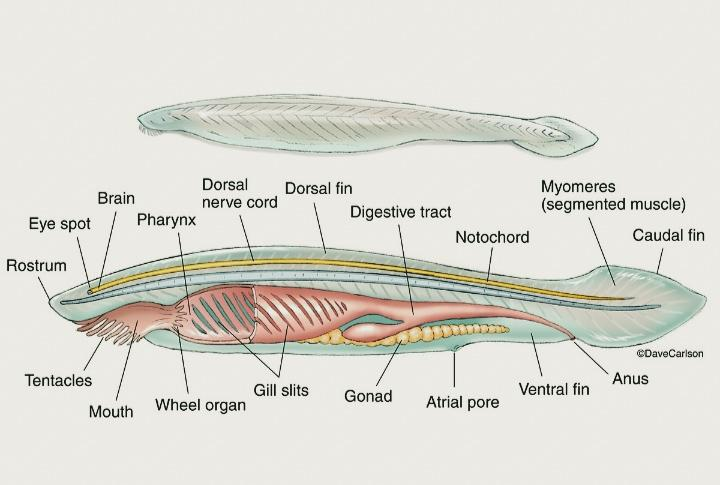
Note: The name amphioxus or lancelet is taken from Greek which refers to its shape as “both ends pointed “, they are cephalochordates which are small, eel-like, unprepossessing animals that spend much of their time buried in the sand.
Complete answer:
The wheel organ is the specialized epithelium in the roof and the sides of the adult amphioxus oral cavity. Amphioxus is also called a lancelet.
Wheel organ borders the oral epithelium properly. These cells are tall and strongly ciliated and have dark, heterochromatin-rich nuclei.
Additional information
- Amphioxus holds a wheel organ which is also known as the rotatory gland or muller’s gland in the vocal hood.
- It produces a whorling liquid flow to clean food bion into the mouth.
- It borders the oral epithelium proper, separated by a thin strip of margin cells which are not ciliated but contain a few large dense cored vesicles apically.
- The organ is further specialized, forming the so-called Hatschek's groove having two ciliated cell types.
- Each cell bears one tall cilium surrounded by microvilli and is involved in the production of secretory material into the groove.
- The task of the wheel organ is to transport dissolved particles towards the mouth. It draws food through the use of its cilia for digestion.
So, the correct answer is Amphioxus.
Note: The name amphioxus or lancelet is taken from Greek which refers to its shape as “both ends pointed “, they are cephalochordates which are small, eel-like, unprepossessing animals that spend much of their time buried in the sand.
Recently Updated Pages
Master Class 12 Economics: Engaging Questions & Answers for Success

Master Class 12 English: Engaging Questions & Answers for Success
Master Class 12 Social Science: Engaging Questions & Answers for Success
Master Class 12 Maths: Engaging Questions & Answers for Success
Master Class 12 Physics: Engaging Questions & Answers for Success
Master Class 9 General Knowledge: Engaging Questions & Answers for Success
Trending doubts
One Metric ton is equal to kg A 10000 B 1000 C 100 class 11 physics CBSE
Difference Between Prokaryotic Cells and Eukaryotic Cells
Two of the body parts which do not appear in MRI are class 11 biology CBSE
Find the value of the expression given below sin 30circ class 11 maths CBSE
1 ton equals to A 100 kg B 1000 kg C 10 kg D 10000 class 11 physics CBSE
Draw a diagram of nephron and explain its structur class 11 biology CBSE