




What is TMV?
Answer
 Verified
609.9k+ views
Hint: The full form of TMV is Tobacco Mosaic Virus. This virus belongs to the genus Tobamovirus. It is a virus that infects many plants, especially plants of tobacco and plants of family Solanaceae.
Complete Answer:
TMV was the first virus that has been discovered. It is a thermostable virus which means it can withstand up to 50 degree celsius temperature for 30 minutes. This virus has a very wide survival range.
Structure of TMV:
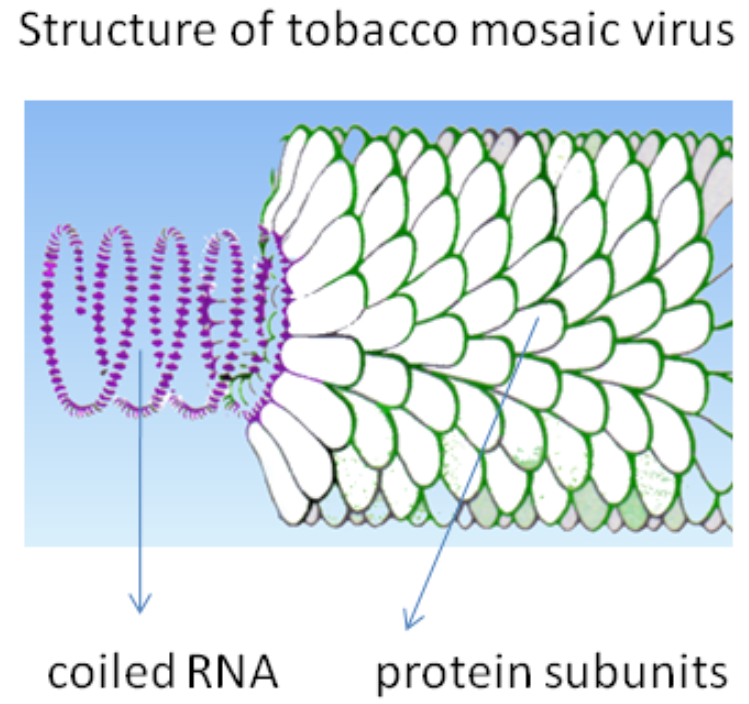
- TMV has a rod-like appearance. Its capsid is made from 2130 molecules of coated proteins called capsomeres and one molecule of genomic single stranded RNA.
- All the capsomeres (coat protein) arranged into a rod like helical structure. It consists of 6.3 – 6.5 kb single stranded RNA genomes.
- The 3’-terminus of the genome of this virus has tRNA (transfer ribonucleic acid) like appearance and 5’-terminus of the genome of this virus has a methylated nucleotide cap.
Disease cycle associated with TMV:
TMV infect the tobacco stalks and leaves. First the TMV goes through the infection process and then the replication process.
1. Infection process – After its entry into a particular cell of a plant, it enters the neighbouring cells through plasmodesmata. The infection spreads by direct contact and also by the phloem.
2. Replication process – Following the entry of the virus into the host cell, the virus uncoats itself and releases its genome into the host cell. Then the viral genome replicates itself into the host cell. After the host coat proteins and genome has been synthesised, they spontaneously assemble into complete TMV virions.
Symptoms in host:
- Light discoloration between the veins of young leaves.
- Development of mosaic or mottled pattern of light and dark green areas in the leaves.
- Leaves can be crinkled, puckered or elongated.
Note: TMV virus can be used to engineer viral vectors. Viral vectors are the tools that are used in recombinant DNA technology in order to transfer the desired genetic material into the host cell. It is an ideal candidate to be incorporated into the battery electrodes. The incorporation of TMV into the battery electrodes increases the reactive surface area.
Complete Answer:
TMV was the first virus that has been discovered. It is a thermostable virus which means it can withstand up to 50 degree celsius temperature for 30 minutes. This virus has a very wide survival range.
Structure of TMV:
- TMV has a rod-like appearance. Its capsid is made from 2130 molecules of coated proteins called capsomeres and one molecule of genomic single stranded RNA.
- All the capsomeres (coat protein) arranged into a rod like helical structure. It consists of 6.3 – 6.5 kb single stranded RNA genomes.
- The 3’-terminus of the genome of this virus has tRNA (transfer ribonucleic acid) like appearance and 5’-terminus of the genome of this virus has a methylated nucleotide cap.
Disease cycle associated with TMV:
TMV infect the tobacco stalks and leaves. First the TMV goes through the infection process and then the replication process.
1. Infection process – After its entry into a particular cell of a plant, it enters the neighbouring cells through plasmodesmata. The infection spreads by direct contact and also by the phloem.
2. Replication process – Following the entry of the virus into the host cell, the virus uncoats itself and releases its genome into the host cell. Then the viral genome replicates itself into the host cell. After the host coat proteins and genome has been synthesised, they spontaneously assemble into complete TMV virions.
Symptoms in host:
- Light discoloration between the veins of young leaves.
- Development of mosaic or mottled pattern of light and dark green areas in the leaves.
- Leaves can be crinkled, puckered or elongated.
Note: TMV virus can be used to engineer viral vectors. Viral vectors are the tools that are used in recombinant DNA technology in order to transfer the desired genetic material into the host cell. It is an ideal candidate to be incorporated into the battery electrodes. The incorporation of TMV into the battery electrodes increases the reactive surface area.
Recently Updated Pages
Master Class 12 Economics: Engaging Questions & Answers for Success

Master Class 12 English: Engaging Questions & Answers for Success
Master Class 12 Social Science: Engaging Questions & Answers for Success
Master Class 12 Maths: Engaging Questions & Answers for Success
Master Class 12 Physics: Engaging Questions & Answers for Success
Master Class 9 General Knowledge: Engaging Questions & Answers for Success
Trending doubts
One Metric ton is equal to kg A 10000 B 1000 C 100 class 11 physics CBSE
Difference Between Prokaryotic Cells and Eukaryotic Cells
Two of the body parts which do not appear in MRI are class 11 biology CBSE
1 ton equals to A 100 kg B 1000 kg C 10 kg D 10000 class 11 physics CBSE
Draw a diagram of nephron and explain its structur class 11 biology CBSE
10 examples of friction in our daily life