




What is the symbol of diagonal?
Answer
 Verified
588.9k+ views
Hint: A diagonal in geometry is defined as the line joining the two opposite vertices of a polygon. A polygon is defined as the two dimensional shape having three or more vertices. But for opposite vertices, a diagonal is defined only for the polygons having four or more sides. The symbol for the diagonal is chosen in accordance with its general orientation.
Complete step by step solution:
We know that the diagonal is a line which is defined for the polygons in geometry. Geometrically, it is defined as the line which connects the two opposite vertices of a polygon.
Now, we know that the polygon is a two dimensional figure and this term can be used for all of the closed figures which have a minimum of three sides. We know that the number of sides of a closed shape or a figure is equal to the number of vertices. And for opposite vertices, there must be a minimum of four vertices. Therefore, the definition of a diagonal is valid only for the polygons having a number of sides equal to four or more. So the three sided polygon, known as the triangle, is excluded from this definition.
Now, let us consider a parallelogram, which is a four sided polygon, as shown in the below figure.
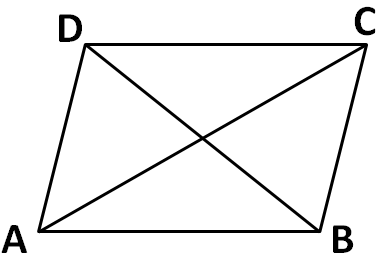
In the above parallelogram ABCD we can see that there are two diagonals AB and CD. Both of the two diagonals have a slanted orientation. Since the diagonals are generally slanted, a slanted symbol $/$ is used to denote diagonals.
Hence, the symbol $/$ is used for a diagonal.
Note: The symbol of a diagonal is a slanted line, but it does not mean that a diagonal must necessarily be slanted. A diagonal can be slanted, vertical or horizontal. We can also note that the symbol $/$ is for the division operator too. But it is also used to represent diagonals in geometry.
Complete step by step solution:
We know that the diagonal is a line which is defined for the polygons in geometry. Geometrically, it is defined as the line which connects the two opposite vertices of a polygon.
Now, we know that the polygon is a two dimensional figure and this term can be used for all of the closed figures which have a minimum of three sides. We know that the number of sides of a closed shape or a figure is equal to the number of vertices. And for opposite vertices, there must be a minimum of four vertices. Therefore, the definition of a diagonal is valid only for the polygons having a number of sides equal to four or more. So the three sided polygon, known as the triangle, is excluded from this definition.
Now, let us consider a parallelogram, which is a four sided polygon, as shown in the below figure.
In the above parallelogram ABCD we can see that there are two diagonals AB and CD. Both of the two diagonals have a slanted orientation. Since the diagonals are generally slanted, a slanted symbol $/$ is used to denote diagonals.
Hence, the symbol $/$ is used for a diagonal.
Note: The symbol of a diagonal is a slanted line, but it does not mean that a diagonal must necessarily be slanted. A diagonal can be slanted, vertical or horizontal. We can also note that the symbol $/$ is for the division operator too. But it is also used to represent diagonals in geometry.

Recently Updated Pages
Master Class 11 English: Engaging Questions & Answers for Success

Master Class 11 Social Science: Engaging Questions & Answers for Success
Master Class 11 Maths: Engaging Questions & Answers for Success
Master Class 11 Biology: Engaging Questions & Answers for Success
Master Class 11 Physics: Engaging Questions & Answers for Success
Master Class 11 Chemistry: Engaging Questions & Answers for Success
Trending doubts
Full Form of IASDMIPSIFSIRSPOLICE class 7 social science CBSE
Write in numerals Ten lakh ninety thousand nine hundred class 7 maths CBSE
How many crores make 10 million class 7 maths CBSE
One lakh eight thousand how can we write it in num class 7 maths CBSE
One lakh eight thousand how can we write it in num class 7 maths CBSE
List of coprime numbers from 1 to 100 class 7 maths CBSE