




What is the shape of guard cells?
Answer
 Verified
531.9k+ views
Hint: leaves are the part of the plant which absorbs water and other nutrients as it is an aerial part of the plant. Leaves also absorb sunlight for the photosynthesis to occur. Guttation is the phenomenon of secreting water from the pores of plants. Guard cells are found in stomata. Stomatal pores contain guard cells. As the name suggests, they are used for the purpose of guarding so that plants do not drain much water.
Complete answer:
The guard cells are generally crescent-shaped or kidney shaped from the surface view and they have wall material on the upper and lower sides. All guard cells present in monocots or dicots are almost similar possessing a stomatal complex with kidney shaped guard cells in dicots and monocots have dumbbell shaped guard cells, which have subsidiary cells adjacently arranged.
Also, guard cells change shape because of the turgor pressure, the turgor pressure gets high, turgor pressure is the pressure inside the cells. So, when turgor pressure is high the cell swells, opening the stomata and bend away from each other. And when water leaves the cells, the turgor pressure reduces and the guard cells become flat, hence closing the pore.
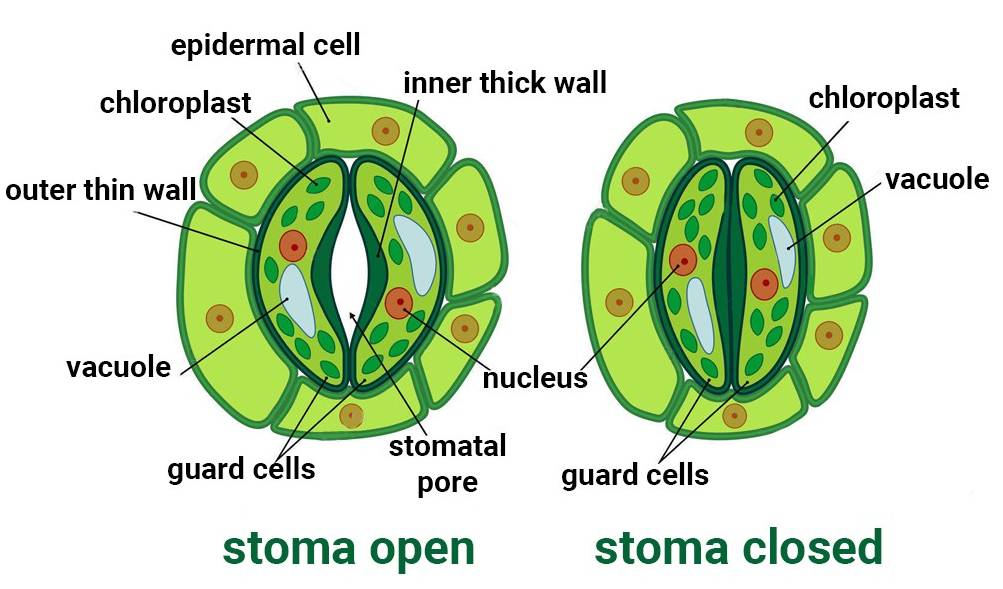
Additional information-
The pressure which is responsible for guttation to happen is root pressure. Root pressure mainly functions as forcing water to travel to the upper parts of plants. Roots take up nutrients and send to the aerial parts of plants in return leaves conduct the photosynthesis process which provides food to the entire plant. Leaves release water from its surface when excessive water enters the cell sap. Leaves check transpiration because it reaches water to every part or not. Transpiration decreases the pressure called hydrostatic pressure in plants due to which water easily moves upward due to this capillary action.
Note:
When guard cells play the crucial role in photosynthesis by which they regulate the entry of materials necessary for the process. Just like the plasma membrane in animal cells, plant cells have guard cells which help to release water from leaves. They have been shown to contain chloroplast which makes a site for photosynthesis.
Complete answer:
The guard cells are generally crescent-shaped or kidney shaped from the surface view and they have wall material on the upper and lower sides. All guard cells present in monocots or dicots are almost similar possessing a stomatal complex with kidney shaped guard cells in dicots and monocots have dumbbell shaped guard cells, which have subsidiary cells adjacently arranged.
Also, guard cells change shape because of the turgor pressure, the turgor pressure gets high, turgor pressure is the pressure inside the cells. So, when turgor pressure is high the cell swells, opening the stomata and bend away from each other. And when water leaves the cells, the turgor pressure reduces and the guard cells become flat, hence closing the pore.
Additional information-
The pressure which is responsible for guttation to happen is root pressure. Root pressure mainly functions as forcing water to travel to the upper parts of plants. Roots take up nutrients and send to the aerial parts of plants in return leaves conduct the photosynthesis process which provides food to the entire plant. Leaves release water from its surface when excessive water enters the cell sap. Leaves check transpiration because it reaches water to every part or not. Transpiration decreases the pressure called hydrostatic pressure in plants due to which water easily moves upward due to this capillary action.
Note:
When guard cells play the crucial role in photosynthesis by which they regulate the entry of materials necessary for the process. Just like the plasma membrane in animal cells, plant cells have guard cells which help to release water from leaves. They have been shown to contain chloroplast which makes a site for photosynthesis.
Recently Updated Pages
Master Class 9 General Knowledge: Engaging Questions & Answers for Success

Master Class 9 Maths: Engaging Questions & Answers for Success
Master Class 9 Science: Engaging Questions & Answers for Success
Master Class 9 English: Engaging Questions & Answers for Success
Master Class 9 Social Science: Engaging Questions & Answers for Success
Class 9 Question and Answer - Your Ultimate Solutions Guide
Trending doubts
One Metric ton is equal to kg A 10000 B 1000 C 100 class 11 physics CBSE
Difference Between Prokaryotic Cells and Eukaryotic Cells
Two of the body parts which do not appear in MRI are class 11 biology CBSE
1 ton equals to A 100 kg B 1000 kg C 10 kg D 10000 class 11 physics CBSE
10 examples of friction in our daily life
Name the Largest and the Smallest Cell in the Human Body ?