




What is the Pythagorean identity?
Answer
 Verified
544.8k+ views
Hint: We first describe the Pythagorean identity with respect to the right-angle triangle. We use the formula of ${{\left( base \right)}^{2}}+{{\left( height \right)}^{2}}={{\left( hypotenuse \right)}^{2}}$. Putting the values, we get ${{a}^{2}}+{{b}^{2}}={{c}^{2}}$. Then we use the angles of the triangles to denote the sides and express it in the form of trigonometric ratios. We get ${{\sin }^{2}}\theta +{{\cos }^{2}}\theta =1$.
Complete step by step answer:
The Pythagorean identity is about the trigonometric identity that is used n case of right-angle triangle.
The Pythagorean trigonometric identity, also called simply the Pythagorean identity, is an identity expressing the Pythagorean theorem in terms of trigonometric functions. Along with the sum-of-angles formulae, it is one of the basic relations between the sine and cosine functions.
We express it for $\Delta ABC$ where $\angle B=\dfrac{\pi }{2}$.
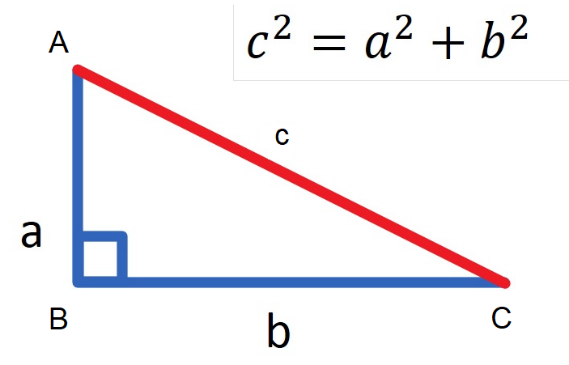
We have the expression for the triangle as ${{\left( base \right)}^{2}}+{{\left( height \right)}^{2}}={{\left( hypotenuse \right)}^{2}}$.
For $\Delta ABC$, $base=BC=b,height=AB=a,hypotenuse=AC=c$
Applying the rule, we get ${{\left( a \right)}^{2}}+{{\left( b \right)}^{2}}={{\left( c \right)}^{2}}$.
We can also express it with respect to the angle $\angle BCA$. Let $\angle BCA=\theta $.
The equation ${{\left( a \right)}^{2}}+{{\left( b \right)}^{2}}={{\left( c \right)}^{2}}$ can be simplified
$\begin{align}
& {{a}^{2}}+{{b}^{2}}={{c}^{2}} \\
& \Rightarrow {{\left( \dfrac{a}{c} \right)}^{2}}+{{\left( \dfrac{b}{c} \right)}^{2}}=1 \\
\end{align}$
With respect to the angle $\angle BCA=\theta $, we have $\dfrac{a}{c}=\sin \theta ,\dfrac{b}{c}=\cos \theta $.
Replacing the values, we get ${{\sin }^{2}}\theta +{{\cos }^{2}}\theta =1$.
There are many reformed versions of the formula ${{\sin }^{2}}\theta +{{\cos }^{2}}\theta =1$.
Dividing with ${{\cos }^{2}}\theta $, we got \[{{\tan }^{2}}\theta +1={{\sec }^{2}}\theta \].
Dividing with ${{\sin }^{2}}\theta $, we got \[{{\cot }^{2}}\theta +1={{\csc }^{2}}\theta \].
Note: The concept of Pythagorean identity is similar for both angles and sides. The representation of the triangle has to be for the right-angle triangle.
Complete step by step answer:
The Pythagorean identity is about the trigonometric identity that is used n case of right-angle triangle.
The Pythagorean trigonometric identity, also called simply the Pythagorean identity, is an identity expressing the Pythagorean theorem in terms of trigonometric functions. Along with the sum-of-angles formulae, it is one of the basic relations between the sine and cosine functions.
We express it for $\Delta ABC$ where $\angle B=\dfrac{\pi }{2}$.
We have the expression for the triangle as ${{\left( base \right)}^{2}}+{{\left( height \right)}^{2}}={{\left( hypotenuse \right)}^{2}}$.
For $\Delta ABC$, $base=BC=b,height=AB=a,hypotenuse=AC=c$
Applying the rule, we get ${{\left( a \right)}^{2}}+{{\left( b \right)}^{2}}={{\left( c \right)}^{2}}$.
We can also express it with respect to the angle $\angle BCA$. Let $\angle BCA=\theta $.
The equation ${{\left( a \right)}^{2}}+{{\left( b \right)}^{2}}={{\left( c \right)}^{2}}$ can be simplified
$\begin{align}
& {{a}^{2}}+{{b}^{2}}={{c}^{2}} \\
& \Rightarrow {{\left( \dfrac{a}{c} \right)}^{2}}+{{\left( \dfrac{b}{c} \right)}^{2}}=1 \\
\end{align}$
With respect to the angle $\angle BCA=\theta $, we have $\dfrac{a}{c}=\sin \theta ,\dfrac{b}{c}=\cos \theta $.
Replacing the values, we get ${{\sin }^{2}}\theta +{{\cos }^{2}}\theta =1$.
There are many reformed versions of the formula ${{\sin }^{2}}\theta +{{\cos }^{2}}\theta =1$.
Dividing with ${{\cos }^{2}}\theta $, we got \[{{\tan }^{2}}\theta +1={{\sec }^{2}}\theta \].
Dividing with ${{\sin }^{2}}\theta $, we got \[{{\cot }^{2}}\theta +1={{\csc }^{2}}\theta \].
Note: The concept of Pythagorean identity is similar for both angles and sides. The representation of the triangle has to be for the right-angle triangle.
Recently Updated Pages
Master Class 10 Social Science: Engaging Questions & Answers for Success

Master Class 10 Science: Engaging Questions & Answers for Success
Master Class 10 Maths: Engaging Questions & Answers for Success
Master Class 10 General Knowledge: Engaging Questions & Answers for Success
Master Class 10 Computer Science: Engaging Questions & Answers for Success
Class 10 Question and Answer - Your Ultimate Solutions Guide
Trending doubts
What is the full form of PNG A Petrol Natural Gas B class 10 chemistry CBSE
Explain the Treaty of Vienna of 1815 class 10 social science CBSE
In cricket, how many legal balls are there in a standard over?
Why is there a time difference of about 5 hours between class 10 social science CBSE
Who Won 36 Oscar Awards? Record Holder Revealed
What is the median of the first 10 natural numbers class 10 maths CBSE