




What is the inverse cosine of 2?
Answer
 Verified
556.5k+ views
Hint: We first find the principal value of x for which ${{\cos }^{-1}}\left( 2 \right)$. In that domain, equal value of the same ratio gives equal angles. We find the angle value for x. At the end we also find the general solution for the equation $\cos \left( x \right)=2$.
Complete step by step solution:
We find the value of ${{\cos }^{-1}}\left( 2 \right)$. We need to find x for which $\cos \left( x \right)=2$.
We know that in the principal domain or the periodic value of $-\dfrac{\pi }{2}\le x\le \dfrac{\pi }{2}$ for $\cos \left( x \right)$, if we get $\cos a=\cos b$ where $-\dfrac{\pi }{2}\le a,b\le \dfrac{\pi }{2}$ then $a=b$.
But the range for $\cos \left( x \right)$ is $-1\le \cos \left( x \right)\le 1$. So, it is not possible to find $x$ for which $\cos \left( x \right)=2$.
Now we prove that graphically.
We also can show the solutions (primary and general) of the equation $\cos \left( x \right)=2$ through the graph. We take $y=\cos \left( x \right)=2$. We got two equations $y=\cos \left( x \right)$ and $y=2$. We place them on the graph and find the solutions as their intersecting points.
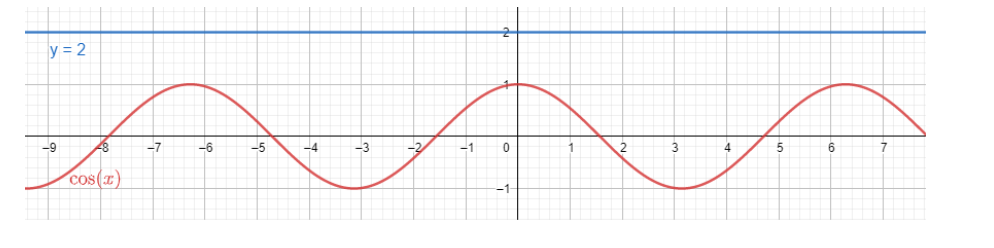
We can see that there is no intersecting point for the curves and the equation has no solution.
Note: Although for elementary knowledge the principal domain is enough to solve the problem. But if mentioned to find the general solution then the domain changes to $-\infty \le x\le \infty $. In that case we have to use the formula $x=n\pi \pm a$ for $\cos a=\cos b$ where $-\dfrac{\pi }{2}\le a\le \dfrac{\pi }{2}$.
Complete step by step solution:
We find the value of ${{\cos }^{-1}}\left( 2 \right)$. We need to find x for which $\cos \left( x \right)=2$.
We know that in the principal domain or the periodic value of $-\dfrac{\pi }{2}\le x\le \dfrac{\pi }{2}$ for $\cos \left( x \right)$, if we get $\cos a=\cos b$ where $-\dfrac{\pi }{2}\le a,b\le \dfrac{\pi }{2}$ then $a=b$.
But the range for $\cos \left( x \right)$ is $-1\le \cos \left( x \right)\le 1$. So, it is not possible to find $x$ for which $\cos \left( x \right)=2$.
Now we prove that graphically.
We also can show the solutions (primary and general) of the equation $\cos \left( x \right)=2$ through the graph. We take $y=\cos \left( x \right)=2$. We got two equations $y=\cos \left( x \right)$ and $y=2$. We place them on the graph and find the solutions as their intersecting points.
We can see that there is no intersecting point for the curves and the equation has no solution.
Note: Although for elementary knowledge the principal domain is enough to solve the problem. But if mentioned to find the general solution then the domain changes to $-\infty \le x\le \infty $. In that case we have to use the formula $x=n\pi \pm a$ for $\cos a=\cos b$ where $-\dfrac{\pi }{2}\le a\le \dfrac{\pi }{2}$.
Recently Updated Pages
Master Class 12 Economics: Engaging Questions & Answers for Success

Master Class 12 English: Engaging Questions & Answers for Success
Master Class 12 Social Science: Engaging Questions & Answers for Success
Master Class 12 Maths: Engaging Questions & Answers for Success
Master Class 12 Physics: Engaging Questions & Answers for Success
Master Class 11 Social Science: Engaging Questions & Answers for Success
Trending doubts
One Metric ton is equal to kg A 10000 B 1000 C 100 class 11 physics CBSE
Difference Between Prokaryotic Cells and Eukaryotic Cells
Two of the body parts which do not appear in MRI are class 11 biology CBSE
1 ton equals to A 100 kg B 1000 kg C 10 kg D 10000 class 11 physics CBSE
Draw a diagram of nephron and explain its structur class 11 biology CBSE
10 examples of friction in our daily life