




What is the graph of, $y={{\sin }^{-1}}(x)$ ?
Answer
 Verified
568.5k+ views
Hint: To plot the graph of any function, we first need to find the domain and range of the function. Here, the given function is, $y={{\sin }^{-1}}(x)$, which is the inverse of a ‘sine’ function. Thus, we shall use the properties of inverse function to find and plot the graph of ${{\sin }^{-1}}(x)$.
Complete step by step solution:
Let us first assign some terms that we are going to use later in our solution.
Let, $f(x)=\sin (x)$ be our fundamental function such that the equation, $y={{\sin }^{-1}}(x)$, is the inverse of this function.
By the property of inverse function, we can say that the domain of the fundamental function is equal to the range of the inverse function and the range of the fundamental function is equal to the domain of the inverse function.
Using this above property, we will first find the domain of ${{\sin }^{-1}}(x)$. This will be equal to the range of $\sin (x)$. Mathematically, this could be written as:
$\begin{align}
& \Rightarrow D\left[ {{\sin }^{-1}}(x) \right]=R\left[ \sin (x) \right] \\
& \therefore \Rightarrow D\left[ {{\sin }^{-1}}(x) \right]=\left[ -1,1 \right] \\
\end{align}$
Now, using the same property, we will find the range of ${{\sin }^{-1}}(x)$in the interval $\left[ -1,1 \right]$. Thus, for this restricted domain the range of ${{\sin }^{-1}}(x)$ will be equal to:
$\Rightarrow R\left[ {{\sin }^{-1}}(x) \right]=\left[ -\dfrac{\pi }{2},\dfrac{\pi }{2} \right]$
Now, we have the domain and the range of the sine inverse function.
Lastly, ${{\sin }^{-1}}(x)$ being an inverse function of $\sin (x)$, will be a mirror image of $\sin (x)$ about the, $y=x$ line. Thus the graph of ${{\sin }^{-1}}(x)$ can be plotted as follows:
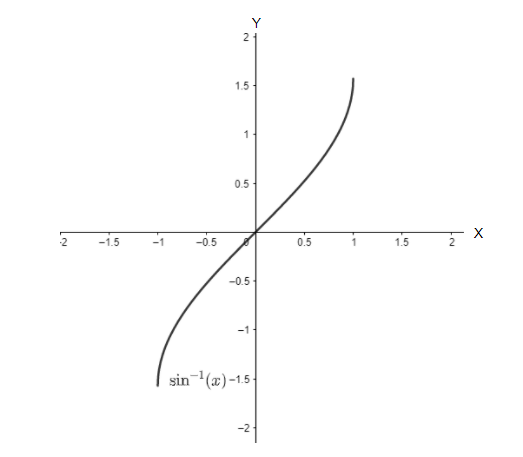
Here, the function validates all the required conditions. Hence, the above plot is the correct plot of $y={{\sin }^{-1}}(x)$.
Note: Before finding the plot of a function, we should check if the inverse of the fundamental function exists or not. If it exists, then we should always find the domain and range of the inverse function with the help of the fundamental function and then only apply the mirror technique to find the plot of the inverse function.
Complete step by step solution:
Let us first assign some terms that we are going to use later in our solution.
Let, $f(x)=\sin (x)$ be our fundamental function such that the equation, $y={{\sin }^{-1}}(x)$, is the inverse of this function.
By the property of inverse function, we can say that the domain of the fundamental function is equal to the range of the inverse function and the range of the fundamental function is equal to the domain of the inverse function.
Using this above property, we will first find the domain of ${{\sin }^{-1}}(x)$. This will be equal to the range of $\sin (x)$. Mathematically, this could be written as:
$\begin{align}
& \Rightarrow D\left[ {{\sin }^{-1}}(x) \right]=R\left[ \sin (x) \right] \\
& \therefore \Rightarrow D\left[ {{\sin }^{-1}}(x) \right]=\left[ -1,1 \right] \\
\end{align}$
Now, using the same property, we will find the range of ${{\sin }^{-1}}(x)$in the interval $\left[ -1,1 \right]$. Thus, for this restricted domain the range of ${{\sin }^{-1}}(x)$ will be equal to:
$\Rightarrow R\left[ {{\sin }^{-1}}(x) \right]=\left[ -\dfrac{\pi }{2},\dfrac{\pi }{2} \right]$
Now, we have the domain and the range of the sine inverse function.
Lastly, ${{\sin }^{-1}}(x)$ being an inverse function of $\sin (x)$, will be a mirror image of $\sin (x)$ about the, $y=x$ line. Thus the graph of ${{\sin }^{-1}}(x)$ can be plotted as follows:
Here, the function validates all the required conditions. Hence, the above plot is the correct plot of $y={{\sin }^{-1}}(x)$.
Note: Before finding the plot of a function, we should check if the inverse of the fundamental function exists or not. If it exists, then we should always find the domain and range of the inverse function with the help of the fundamental function and then only apply the mirror technique to find the plot of the inverse function.
Recently Updated Pages
Master Class 12 Business Studies: Engaging Questions & Answers for Success

Master Class 12 Chemistry: Engaging Questions & Answers for Success
Master Class 12 Biology: Engaging Questions & Answers for Success
Class 12 Question and Answer - Your Ultimate Solutions Guide
Master Class 11 English: Engaging Questions & Answers for Success
Master Class 11 Social Science: Engaging Questions & Answers for Success
Trending doubts
Which are the Top 10 Largest Countries of the World?
Draw a labelled sketch of the human eye class 12 physics CBSE
The end of compass needle which points towards north class 12 physics CBSE
Differentiate between homogeneous and heterogeneous class 12 chemistry CBSE
Why is the cell called the structural and functional class 12 biology CBSE
When was the first election held in India a 194748 class 12 sst CBSE