




What is the First Fresnel Zone?
Answer
 Verified
495.9k+ views
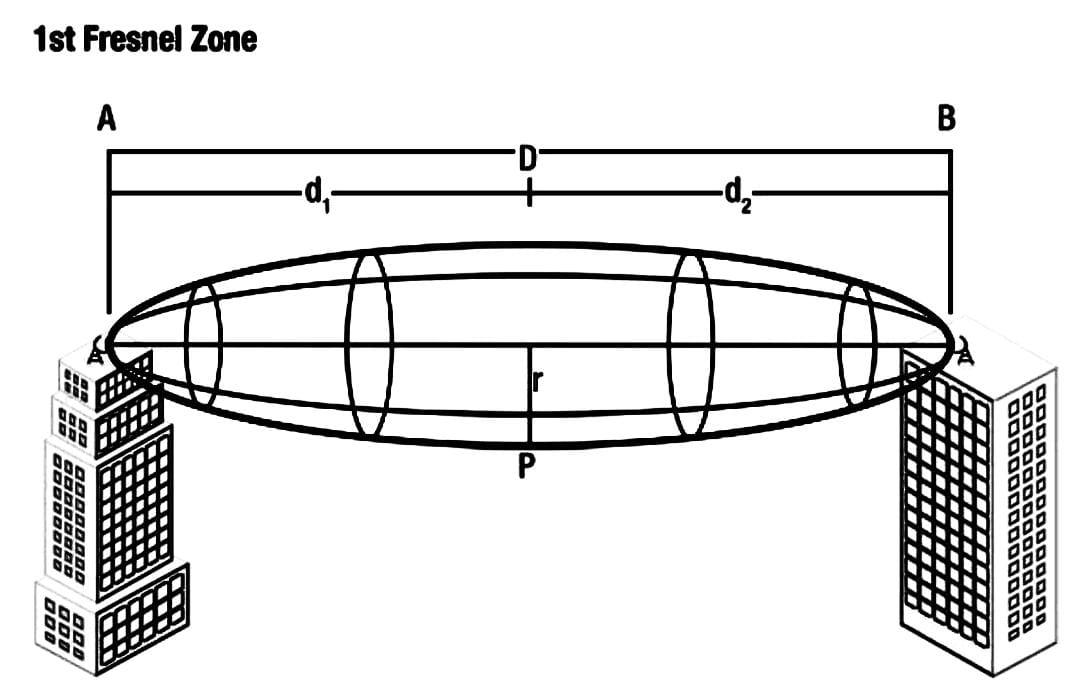
Hint: Let's review the Fresnel zone before we get into the question. A Fresnel zone is one of a series of confocal prolate ellipsoidal regions of space between and around a transmitter and a receiver, named after physicist Augustin-Jean Fresnel. From the transmitter to the receiver, the primary wave will travel in a relatively straight line.
Complete answer:
The first Fresnel zone is defined as a set of imaginary rings surrounding the direct path's centerline, with the distance between the transmitting and receiving antennas being one-half wavelength greater than the direct path between the antennas.
Although there are an infinite number of Fresnel Zones that can be calculated, the 1st Fresnel Zone has the greatest impact on Wireless Network performance. If there are any obstructions in the 1st Fresnel Zone, such as buildings, trees, or hills, the signal will be harmed at the receiver. When planning wireless links, the first Fresnel Zone should always be clear of obstruction, but this is impractical, so it is recommended that no more than \[40\% \] of the Fresnel Zone be obstructed, i.e. \[60\% \] clear, but it is recommended that it be no more than \[20\% \] or less blocked for optimum performance. The 1st Fresnel Zone has a number of obstacles.
Note:
It should be Kept in mind that the obstacles in the first Fresnel Zone will cause signals to be out of phase by \[0\] to \[{90^ \circ }\] , \[{90^ \circ }\] to \[{270^ \circ }\] in the second zone, \[{270^ \circ }\] to \[{450^ \circ }\] in the third zone, and so on.
Complete answer:
The first Fresnel zone is defined as a set of imaginary rings surrounding the direct path's centerline, with the distance between the transmitting and receiving antennas being one-half wavelength greater than the direct path between the antennas.
Although there are an infinite number of Fresnel Zones that can be calculated, the 1st Fresnel Zone has the greatest impact on Wireless Network performance. If there are any obstructions in the 1st Fresnel Zone, such as buildings, trees, or hills, the signal will be harmed at the receiver. When planning wireless links, the first Fresnel Zone should always be clear of obstruction, but this is impractical, so it is recommended that no more than \[40\% \] of the Fresnel Zone be obstructed, i.e. \[60\% \] clear, but it is recommended that it be no more than \[20\% \] or less blocked for optimum performance. The 1st Fresnel Zone has a number of obstacles.
Note:
It should be Kept in mind that the obstacles in the first Fresnel Zone will cause signals to be out of phase by \[0\] to \[{90^ \circ }\] , \[{90^ \circ }\] to \[{270^ \circ }\] in the second zone, \[{270^ \circ }\] to \[{450^ \circ }\] in the third zone, and so on.
Recently Updated Pages
Master Class 11 English: Engaging Questions & Answers for Success

Master Class 11 Social Science: Engaging Questions & Answers for Success
Master Class 11 Maths: Engaging Questions & Answers for Success
Master Class 11 Chemistry: Engaging Questions & Answers for Success
Master Class 11 Biology: Engaging Questions & Answers for Success
Master Class 11 Physics: Engaging Questions & Answers for Success
Trending doubts
One Metric ton is equal to kg A 10000 B 1000 C 100 class 11 physics CBSE
Difference Between Prokaryotic Cells and Eukaryotic Cells
Find the value of the expression given below sin 30circ class 11 maths CBSE
1 ton equals to A 100 kg B 1000 kg C 10 kg D 10000 class 11 physics CBSE
Two of the body parts which do not appear in MRI are class 11 biology CBSE
What are hard magnetic materials class 11 physics CBSE