




What is the dipole moment of azulene?
Answer
 Verified
588k+ views
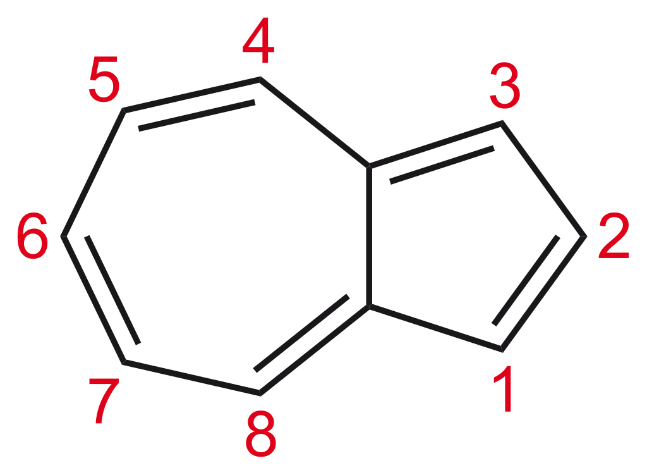
Hint: To solve this question, we first need to know what is azulene. Azulene is an isomer of naphthalene which is dark blue in color as opposed to colorless naphthalene. The structure of azulene is
Complete answer:
Let us first understand what a dipole moment is by taking an example of hydrochloric acid (HCl).
In HCl, there is an electronegative difference between H atom and Cl atom, and the more electronegative Cl atom attracts the shared electrons towards itself.
Since there is a non-uniformity in the sharing of electrons between the bonded atoms of the molecule, the more electronegative atom forms a partial negative charge in polar compounds whereas the less electronegative atoms form a partial positive charge in polar compounds.
${{H}^{\delta +}}-C{{l}^{\delta -}}$
This leads to the formation of polar bonds and hence the molecule shows bond polarity and the molecule develops an electrical dipole moment.
The dipole moment in a molecule is measured as follows:
\[\mu =e\times d\]
Where $\mu $ is the bond dipole, e is the charge and d is the distance between the bonded atom's nuclei.
Now the dipole moment of azulene is 3.60 \[\times {{10}^{-30}}\] C.m or 1.08D.
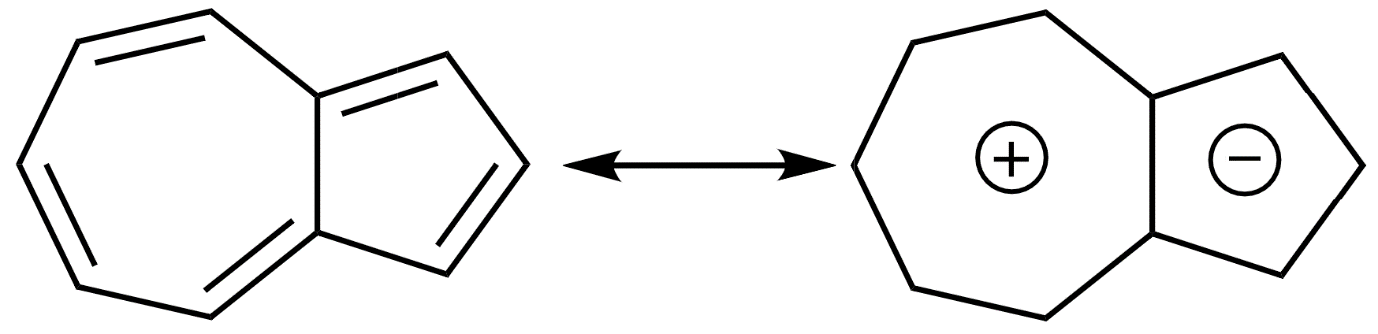
This is because, in the most stable resonance structure of azulene, there exists a positive charge in the 7 membered rings and a negative charge on the 5 membered rings.
Note:
Dipole moment is shown in both ionic compounds and polar covalent compounds, as the electron pairs are not shared equally between the two bonded atoms.
In ionic compounds like LiCl, the 2s orbital electrons of Li atom are included in the electronic structure of Cl atom to fulfill its outermost electron shell.
An example of a polar covalent compound is HCl.
Complete answer:
Let us first understand what a dipole moment is by taking an example of hydrochloric acid (HCl).
In HCl, there is an electronegative difference between H atom and Cl atom, and the more electronegative Cl atom attracts the shared electrons towards itself.
Since there is a non-uniformity in the sharing of electrons between the bonded atoms of the molecule, the more electronegative atom forms a partial negative charge in polar compounds whereas the less electronegative atoms form a partial positive charge in polar compounds.
${{H}^{\delta +}}-C{{l}^{\delta -}}$
This leads to the formation of polar bonds and hence the molecule shows bond polarity and the molecule develops an electrical dipole moment.
The dipole moment in a molecule is measured as follows:
\[\mu =e\times d\]
Where $\mu $ is the bond dipole, e is the charge and d is the distance between the bonded atom's nuclei.
Now the dipole moment of azulene is 3.60 \[\times {{10}^{-30}}\] C.m or 1.08D.
This is because, in the most stable resonance structure of azulene, there exists a positive charge in the 7 membered rings and a negative charge on the 5 membered rings.
Note:
Dipole moment is shown in both ionic compounds and polar covalent compounds, as the electron pairs are not shared equally between the two bonded atoms.
In ionic compounds like LiCl, the 2s orbital electrons of Li atom are included in the electronic structure of Cl atom to fulfill its outermost electron shell.
An example of a polar covalent compound is HCl.
Recently Updated Pages
Which will be the least stable resonating structure class 11 chemistry CBSE

How many 5 digit telephone numbers can be construc-class-11-maths-CBSE
How do you find the angle of the resultant vector class 11 physics CBSE
Draw labelled diagram of the following i Gram seed class 11 biology CBSE
1 Quintal is equal to a 110 kg b 10 kg c 100kg d 1000 class 11 physics CBSE
What is the need and importance of classification class 11 biology CBSE
Trending doubts
Find the value of the expression given below sin 30circ class 11 maths CBSE
10 examples of friction in our daily life
How many kilometers are there in 100 meters class 11 maths CBSE
Little leaf disease is developed due to deficiency class 11 biology CBSE
What is the maximum height of a projectile class 11 physics CBSE
State the laws of reflection of light