




What is the centre of symmetry?
Answer
 Verified
550.8k+ views
Hint :Centre of symmetry is a symmetry element used to measure the extent to which a given compound or structure is symmetrical. Unlike axes and planes, the centre of symmetry is just a single point that is usually present in all regular shapes.
Complete Step By Step Answer:
Covalent molecules as well as ionic compounds in their crystal lattices have a definite arrangement which imparts symmetry to them.
A point in any molecule or crystal lattice is nothing but an atom of the molecule or an ion present in an ionic lattice.
A centre of symmetry in covalent molecules is a point or an atom that lies exactly in the middle of the plain. All bonds formed with this atom reflect each other which means that for each bond formed in a particular direction there is a same bond (between the central atom and another atom of the same element as that of the first bond) that exists in a direction opposite to it.
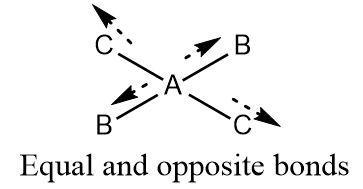
A molecule containing a centre of symmetry tends to have zero dipole moment even if the bonds are polar as dipole moment in one direction is cancelled by another dipole moment of equal magnitude but opposite direction.
A centre of symmetry in a solid lattice can be the centre of a unit cell. The atom that lies in the body centre is known as the centre of symmetry.
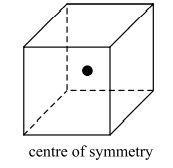
A cube can also have a centre of symmetry which is defined by a point in its exact centre such that each corner or vertex of the cube is equidistant to that point.
Note :
A centre of symmetry may not be confused with an alternate axis of symmetry that involves rotation followed by reflection. Structures or geometries that have a centre of symmetry also contain an axis or plane of symmetry in most cases.
Complete Step By Step Answer:
Covalent molecules as well as ionic compounds in their crystal lattices have a definite arrangement which imparts symmetry to them.
A point in any molecule or crystal lattice is nothing but an atom of the molecule or an ion present in an ionic lattice.
A centre of symmetry in covalent molecules is a point or an atom that lies exactly in the middle of the plain. All bonds formed with this atom reflect each other which means that for each bond formed in a particular direction there is a same bond (between the central atom and another atom of the same element as that of the first bond) that exists in a direction opposite to it.
A molecule containing a centre of symmetry tends to have zero dipole moment even if the bonds are polar as dipole moment in one direction is cancelled by another dipole moment of equal magnitude but opposite direction.
A centre of symmetry in a solid lattice can be the centre of a unit cell. The atom that lies in the body centre is known as the centre of symmetry.
A cube can also have a centre of symmetry which is defined by a point in its exact centre such that each corner or vertex of the cube is equidistant to that point.
Note :
A centre of symmetry may not be confused with an alternate axis of symmetry that involves rotation followed by reflection. Structures or geometries that have a centre of symmetry also contain an axis or plane of symmetry in most cases.
Recently Updated Pages
Master Class 11 English: Engaging Questions & Answers for Success

Master Class 11 Social Science: Engaging Questions & Answers for Success
Master Class 11 Maths: Engaging Questions & Answers for Success
Master Class 11 Biology: Engaging Questions & Answers for Success
Master Class 11 Physics: Engaging Questions & Answers for Success
Master Class 11 Chemistry: Engaging Questions & Answers for Success
Trending doubts
One Metric ton is equal to kg A 10000 B 1000 C 100 class 11 physics CBSE
Difference Between Prokaryotic Cells and Eukaryotic Cells
Find the value of the expression given below sin 30circ class 11 maths CBSE
Difference between physical and chemical change class 11 chemistry CBSE
Two of the body parts which do not appear in MRI are class 11 biology CBSE
Draw a diagram of a plant cell and label at least eight class 11 biology CBSE