




What is the bond order of $ Cl{O_2} $ ?
Answer
 Verified
513.9k+ views
Hint: To solve these types of questions we should first draw the Lewis structure. We count the number of total bonds and then divide it by the number of elements in which these bonds are made with the central atom.
Complete Step By Step Answer:
We can solve this question, by first drawing the Lewis dot structure of $ Cl{O_2} $
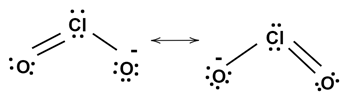
In the above figure, the total number of bonds is $ 3 $ . And if we try to draw different structures, these bonds will rearrange themselves between two elements. Or we can calculate it by counting the number of resonating structures this molecule can make.
$ {\text{Bond Order}} = \dfrac{{{\text{Total number of bonds}}}}{{{\text{Total number of resonating structures}}}} $
$ {\text{Bond Order}} = \dfrac{3}{2} = 1.5 $
So, from the above calculation we found that the bond order of $ Cl{O_2} $ is $ 1.5 $ .
Now, we will calculate formal charge on each oxygen atom-
$ {\text{Formal charge = valence electrons - nonbonding valence electrons - }}\dfrac{{{\text{bonding electrons}}}}{2} $
$ = 6 - 6 - \dfrac{2}{2} $
$ = - 1 $
The formal charge on each oxygen is $ - 1 $ .
Note:
We should also know about bond length. It is defined as the distance between the centers of two covalently bonded atoms. The length of the bond is determined by the number of bonded electrons (the bond order). If bond order is high, there will be stronger pull between two atoms and there will be shorter bond length. Therefore, bond length increases in the following order: triple bond < double bond < single bond.
Chlorine dioxide gas $ (Cl{O_2}) $ is used to sterilize medical and laboratory equipment, surfaces, rooms and tools. Chlorine dioxide can be used as oxidizer or disinfectant. It is a very strong oxidizer and it effectively kills pathogenic microorganisms such as fungi, bacteria and viruses.
Complete Step By Step Answer:
We can solve this question, by first drawing the Lewis dot structure of $ Cl{O_2} $
In the above figure, the total number of bonds is $ 3 $ . And if we try to draw different structures, these bonds will rearrange themselves between two elements. Or we can calculate it by counting the number of resonating structures this molecule can make.
$ {\text{Bond Order}} = \dfrac{{{\text{Total number of bonds}}}}{{{\text{Total number of resonating structures}}}} $
$ {\text{Bond Order}} = \dfrac{3}{2} = 1.5 $
So, from the above calculation we found that the bond order of $ Cl{O_2} $ is $ 1.5 $ .
Now, we will calculate formal charge on each oxygen atom-
$ {\text{Formal charge = valence electrons - nonbonding valence electrons - }}\dfrac{{{\text{bonding electrons}}}}{2} $
$ = 6 - 6 - \dfrac{2}{2} $
$ = - 1 $
The formal charge on each oxygen is $ - 1 $ .
Note:
We should also know about bond length. It is defined as the distance between the centers of two covalently bonded atoms. The length of the bond is determined by the number of bonded electrons (the bond order). If bond order is high, there will be stronger pull between two atoms and there will be shorter bond length. Therefore, bond length increases in the following order: triple bond < double bond < single bond.
Chlorine dioxide gas $ (Cl{O_2}) $ is used to sterilize medical and laboratory equipment, surfaces, rooms and tools. Chlorine dioxide can be used as oxidizer or disinfectant. It is a very strong oxidizer and it effectively kills pathogenic microorganisms such as fungi, bacteria and viruses.
Recently Updated Pages
Master Class 12 Economics: Engaging Questions & Answers for Success

Master Class 12 English: Engaging Questions & Answers for Success
Master Class 12 Social Science: Engaging Questions & Answers for Success
Master Class 12 Maths: Engaging Questions & Answers for Success
Master Class 12 Physics: Engaging Questions & Answers for Success
Master Class 9 General Knowledge: Engaging Questions & Answers for Success
Trending doubts
One Metric ton is equal to kg A 10000 B 1000 C 100 class 11 physics CBSE
Difference Between Prokaryotic Cells and Eukaryotic Cells
Two of the body parts which do not appear in MRI are class 11 biology CBSE
Find the value of the expression given below sin 30circ class 11 maths CBSE
1 ton equals to A 100 kg B 1000 kg C 10 kg D 10000 class 11 physics CBSE
Draw a diagram of nephron and explain its structur class 11 biology CBSE