




What is downstream processing?
Answer
 Verified
632.4k+ views
Hint: The biosynthesized product is purified and formulated with suitable preservatives before being distributed for public use. To accomplish this, a series of processes are employed which involve various types of physical and chemical methods.
Complete answer:
By the use of techniques of biotechnology, we synthesize various types of proteins and enzymes of the desired nature. As we synthesize them with the help of microorganisms, the obtained products are not in a pure state and have many types of impurities including the different secretions from the microorganisms. For making the product suitable to use and removing unwanted materials from it, a series of procedures are followed which are collectively known as downstream processing.
Additional information:
The stages and related processes in downstream processing are as follows –
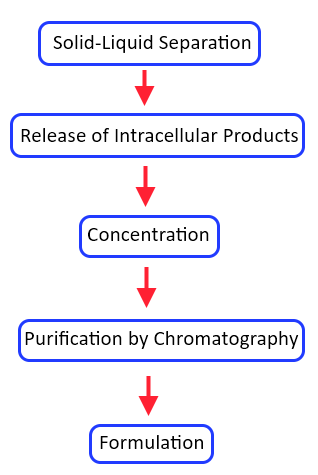
Solid-Liquid Separation – at this stage the undesired cells and other insoluble materials are removed from the culture broth by using processes like floatation, flocculation, filtration, and centrifugation.
Release of Intracellular Products – at this stage the biochemical products that are located within the cultured cells are obtained by breaking the cells using methods like ultrasonication, heat shock, high pressure, organic solvents, lysozymes, etc.
Concentration – here, using methods like membrane filtration, liquid-liquid extraction, precipitation evaporation, and adsorption, the extra amount of water present in the product is removed.
Purification by chromatography – here, the biological product is purified very precisely using chromatographic methods.
Formulation – this is the final stage and at this stage, it is made sure that the activity and stability of the desired product is maintained during the storage.
Note: After completion of the downstream processing, suitable preservatives are added to the product to ensure its storage and use for a longer time. After this, the product undergoes thorough clinical trials where its actions and effects are monitored. Following this, a strict quality control testing is done and then the product is released to be used by the public.
Complete answer:
By the use of techniques of biotechnology, we synthesize various types of proteins and enzymes of the desired nature. As we synthesize them with the help of microorganisms, the obtained products are not in a pure state and have many types of impurities including the different secretions from the microorganisms. For making the product suitable to use and removing unwanted materials from it, a series of procedures are followed which are collectively known as downstream processing.
Additional information:
The stages and related processes in downstream processing are as follows –
Solid-Liquid Separation – at this stage the undesired cells and other insoluble materials are removed from the culture broth by using processes like floatation, flocculation, filtration, and centrifugation.
Release of Intracellular Products – at this stage the biochemical products that are located within the cultured cells are obtained by breaking the cells using methods like ultrasonication, heat shock, high pressure, organic solvents, lysozymes, etc.
Concentration – here, using methods like membrane filtration, liquid-liquid extraction, precipitation evaporation, and adsorption, the extra amount of water present in the product is removed.
Purification by chromatography – here, the biological product is purified very precisely using chromatographic methods.
Formulation – this is the final stage and at this stage, it is made sure that the activity and stability of the desired product is maintained during the storage.
Note: After completion of the downstream processing, suitable preservatives are added to the product to ensure its storage and use for a longer time. After this, the product undergoes thorough clinical trials where its actions and effects are monitored. Following this, a strict quality control testing is done and then the product is released to be used by the public.
Recently Updated Pages
Master Class 12 Economics: Engaging Questions & Answers for Success

Master Class 12 English: Engaging Questions & Answers for Success
Master Class 12 Social Science: Engaging Questions & Answers for Success
Master Class 12 Maths: Engaging Questions & Answers for Success
Master Class 12 Physics: Engaging Questions & Answers for Success
Master Class 10 English: Engaging Questions & Answers for Success
Trending doubts
Explain the Treaty of Vienna of 1815 class 10 social science CBSE
Why is it 530 pm in india when it is 1200 afternoon class 10 social science CBSE
What is the full form of POSCO class 10 social science CBSE
Define Potential, Developed, Stock and Reserved resources
Which Country Has the Largest Border with India?
Choose the feminine form of the given noun Fox AFoxess class 10 english CBSE