




What is Catkin Inflorescence?
Answer
 Verified
536.4k+ views
Hint: A group or cluster of flowers arranged on a stem composed of a main branch or a complicated arrangement of branches is known as an inflorescence. It is the modified part of the seed plant's shoot where flowers are formed morphologically.
Complete answer:
The catkin is a type of compact or string-like inflorescence with a single relatively stout axis on which unisexual sessile or subsessile apetalous flowers are clustered in a spiral or whorled arrangement on a single relatively stout axis.
Catkin is an elongated cluster of single-sex flowers with scaly bracts and no petals. Catkins can be erect or pendulous, and they're usually quite small. Willows, birches, and oaks are among the trees that produce catkins
Pollen is carried from male to female catkins by the wind, or from male catkins to female flowers in a different inflorescence form by the wind (e.g., in spikes). A catkin-producing plant can be monoecious (both male and female flowers on a single individual) or dioecious (both male and female flowers on a single individual) depending on the species (female and male flowers are borne on separate individuals).
Thus, It is a racemose inflorescence with a main axis that grows indefinitely. The main axis is drooping and unbranched. In an acropetal manner, it bears sessile flowers close to the peduncle. Flowers are usually unisexual, with scaly bracts and small petals. Mulberry, oaks, birches, willows, and other trees are examples.
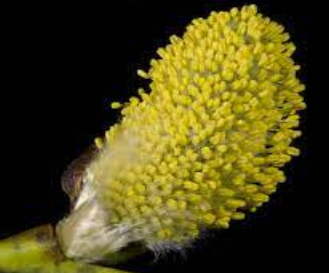
Note: Many different characteristics are used to describe inflorescences, including how the flowers are arranged on the peduncle, the order in which the flowers bloom, and how different clusters of flowers are grouped within it. Plants in nature can have a variety of types, so these terms are just generalizations. Natural selection has largely shaped these structural types.
Complete answer:
The catkin is a type of compact or string-like inflorescence with a single relatively stout axis on which unisexual sessile or subsessile apetalous flowers are clustered in a spiral or whorled arrangement on a single relatively stout axis.
Catkin is an elongated cluster of single-sex flowers with scaly bracts and no petals. Catkins can be erect or pendulous, and they're usually quite small. Willows, birches, and oaks are among the trees that produce catkins
Pollen is carried from male to female catkins by the wind, or from male catkins to female flowers in a different inflorescence form by the wind (e.g., in spikes). A catkin-producing plant can be monoecious (both male and female flowers on a single individual) or dioecious (both male and female flowers on a single individual) depending on the species (female and male flowers are borne on separate individuals).
Thus, It is a racemose inflorescence with a main axis that grows indefinitely. The main axis is drooping and unbranched. In an acropetal manner, it bears sessile flowers close to the peduncle. Flowers are usually unisexual, with scaly bracts and small petals. Mulberry, oaks, birches, willows, and other trees are examples.
Note: Many different characteristics are used to describe inflorescences, including how the flowers are arranged on the peduncle, the order in which the flowers bloom, and how different clusters of flowers are grouped within it. Plants in nature can have a variety of types, so these terms are just generalizations. Natural selection has largely shaped these structural types.
Recently Updated Pages
Master Class 11 Social Science: Engaging Questions & Answers for Success

Master Class 11 Chemistry: Engaging Questions & Answers for Success
Master Class 12 Business Studies: Engaging Questions & Answers for Success
Master Class 12 Chemistry: Engaging Questions & Answers for Success
Master Class 12 Biology: Engaging Questions & Answers for Success
Class 12 Question and Answer - Your Ultimate Solutions Guide
Trending doubts
One Metric ton is equal to kg A 10000 B 1000 C 100 class 11 physics CBSE
Difference Between Prokaryotic Cells and Eukaryotic Cells
Two of the body parts which do not appear in MRI are class 11 biology CBSE
Explain zero factorial class 11 maths CBSE
10 examples of friction in our daily life
Name the Largest and the Smallest Cell in the Human Body ?