




What is a tuning fork?
Answer
 Verified
546.3k+ views
Hint : Sound is produced by the vibration of the particle in a medium that propagates as an acoustic wave and vibration will be transmitted through a transmission medium such as solid, liquid and gas. The tuning fork uses the basic idea of acoustic due to vibration of particles in medium.
Complete step-by-step solution:
The tuning fork is an acoustic resonator or sound resonator. The tuning fork are used to assess vibratory sensation and hearing that is air conduction and bone conduction
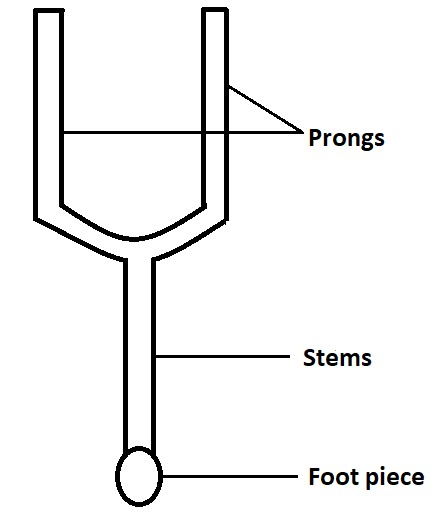
Tuning fork is in the form of two prongs along with the prongs or tines which is in $U$ shaped bar of elastic metal usually made up of steel or aluminium provided with a steel handle as shown in above figure. The two arms of $U$ are called prongs whereas the handle is called a stem. After striking prongs against a surface or with an object it resonates at a specific constant pitch due to vibration and it emits a pure musical tone once the high overtone fades out.
Additional information:
Acoustics is the branch of physics which deals with study of mechanical waves in solids, liquids and gases which includes vibration, ultrasound, infrasound and sound and the scientist who works in the field of acoustics is called an acoustician.
Some of the applications of acoustics are aero acoustics, architectural acoustics, musical acoustics, audio signal processing, bioacoustics, speech, environmental noise, noise control, underwater psychoacoustics, ultrasound acoustics.
Note: A tuning fork’s pitch depends on the mass and length of the two prongs and they are the main sources of the standard pitch for tuning musical instruments such as Rhodes piano and in some tests of hearing.
Complete step-by-step solution:
The tuning fork is an acoustic resonator or sound resonator. The tuning fork are used to assess vibratory sensation and hearing that is air conduction and bone conduction
Tuning fork is in the form of two prongs along with the prongs or tines which is in $U$ shaped bar of elastic metal usually made up of steel or aluminium provided with a steel handle as shown in above figure. The two arms of $U$ are called prongs whereas the handle is called a stem. After striking prongs against a surface or with an object it resonates at a specific constant pitch due to vibration and it emits a pure musical tone once the high overtone fades out.
Additional information:
Acoustics is the branch of physics which deals with study of mechanical waves in solids, liquids and gases which includes vibration, ultrasound, infrasound and sound and the scientist who works in the field of acoustics is called an acoustician.
Some of the applications of acoustics are aero acoustics, architectural acoustics, musical acoustics, audio signal processing, bioacoustics, speech, environmental noise, noise control, underwater psychoacoustics, ultrasound acoustics.
Note: A tuning fork’s pitch depends on the mass and length of the two prongs and they are the main sources of the standard pitch for tuning musical instruments such as Rhodes piano and in some tests of hearing.
Recently Updated Pages
Master Class 11 English: Engaging Questions & Answers for Success

Master Class 11 Social Science: Engaging Questions & Answers for Success
Master Class 11 Maths: Engaging Questions & Answers for Success
Master Class 11 Chemistry: Engaging Questions & Answers for Success
Master Class 11 Biology: Engaging Questions & Answers for Success
Master Class 11 Physics: Engaging Questions & Answers for Success
Trending doubts
One Metric ton is equal to kg A 10000 B 1000 C 100 class 11 physics CBSE
Difference Between Prokaryotic Cells and Eukaryotic Cells
Find the value of the expression given below sin 30circ class 11 maths CBSE
1 ton equals to A 100 kg B 1000 kg C 10 kg D 10000 class 11 physics CBSE
Two of the body parts which do not appear in MRI are class 11 biology CBSE
Draw a diagram of nephron and explain its structur class 11 biology CBSE