




What is a couple?
Answer
 Verified
605.7k+ views
Hint: We need to understand the different types of forces and their applications. There are different kinds of forces depending on the method, direction, number, and nature of the application. A couple is such a type of force which has special properties.
Complete step-by-step solution
A force is the amount of energy spent on an object of mass ‘m’ per unit length with an acceleration ‘a’. From Newton's second law of motion. The force is defined as the rate of change of momentum with time.
\[\begin{align}
& \dfrac{dp}{dt}=ma \\
& \Rightarrow F=ma \\
\end{align}\]
There are different types of forces depending on the properties of the force applied. The thrust, tension, couple, normal reaction, weight are examples of a few forces in our daily life. The thrust is the force experienced by a floating body. The tension is the force experienced by a rope hung with a weight. The weight is the force due to the mass and the gravitational force. The normal reaction is the reaction or opposing force due to the weight.
We can discuss the couple in detail. The couple is a pair of equal and opposite forces separated by a distance. We know that according to Newton's third law of motion. Two equal and opposite forces will result in the mutual cancellation of the forces. But the couple forces are separated by a distance, which becomes an inevitable force required in our daily life.
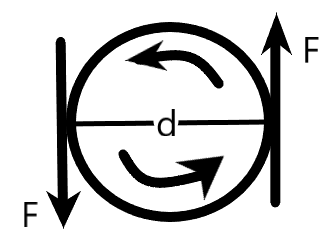
The couple enables the rotational motion of a substance. The opening of bottles and other containers is possible by the application of couple of forces.
Note: We use the couple forces almost always in our day-to-day life. The forces to cause a cap of a bottle to open required balance from both sides for opening as a single force will not allow the opening on the cap as effectively as we do.
Complete step-by-step solution
A force is the amount of energy spent on an object of mass ‘m’ per unit length with an acceleration ‘a’. From Newton's second law of motion. The force is defined as the rate of change of momentum with time.
\[\begin{align}
& \dfrac{dp}{dt}=ma \\
& \Rightarrow F=ma \\
\end{align}\]
There are different types of forces depending on the properties of the force applied. The thrust, tension, couple, normal reaction, weight are examples of a few forces in our daily life. The thrust is the force experienced by a floating body. The tension is the force experienced by a rope hung with a weight. The weight is the force due to the mass and the gravitational force. The normal reaction is the reaction or opposing force due to the weight.
We can discuss the couple in detail. The couple is a pair of equal and opposite forces separated by a distance. We know that according to Newton's third law of motion. Two equal and opposite forces will result in the mutual cancellation of the forces. But the couple forces are separated by a distance, which becomes an inevitable force required in our daily life.
The couple enables the rotational motion of a substance. The opening of bottles and other containers is possible by the application of couple of forces.
Note: We use the couple forces almost always in our day-to-day life. The forces to cause a cap of a bottle to open required balance from both sides for opening as a single force will not allow the opening on the cap as effectively as we do.
Recently Updated Pages
Master Class 12 Economics: Engaging Questions & Answers for Success

Master Class 12 English: Engaging Questions & Answers for Success
Master Class 12 Social Science: Engaging Questions & Answers for Success
Master Class 12 Maths: Engaging Questions & Answers for Success
Master Class 12 Physics: Engaging Questions & Answers for Success
Master Class 9 General Knowledge: Engaging Questions & Answers for Success
Trending doubts
One Metric ton is equal to kg A 10000 B 1000 C 100 class 11 physics CBSE
Difference Between Prokaryotic Cells and Eukaryotic Cells
Two of the body parts which do not appear in MRI are class 11 biology CBSE
Find the value of the expression given below sin 30circ class 11 maths CBSE
1 ton equals to A 100 kg B 1000 kg C 10 kg D 10000 class 11 physics CBSE
Draw a diagram of nephron and explain its structur class 11 biology CBSE