




What does intensity mean?
Answer
 Verified
611.4k+ views
Hint: Intensity can be used to measure the energy transmitted from a source, the more the energy, the more is the intensity. It depends on the power or energy and the area perpendicular to the plane of transmission. Intensity is a characteristic of the source and hence different for different sources. It is a scalar quantity.
Complete step by step solution:
The intensity is the measure of energy transmitted from a source. Intensity is defined as the power that is transmitted per unit area and the area is perpendicular to the direction in which energy is being propagated. The SI unit of intensity is watts per square metre ($W\,{{m}^{-2}}$).
The intensity is given as-
$\begin{align}
& I=\dfrac{P}{{{A}_{\bot }}} \\
& \Rightarrow I=\dfrac{E}{(A\sin \theta )t} \\
\end{align}$
Here, $I$ is the intensity
$P$ is the power
${{A}_{\bot }}$ is the perpendicular component of area
$E$ is the total energy
$\theta $ is the angle between the plane of propagation of energy and area
$t$ is the time taken
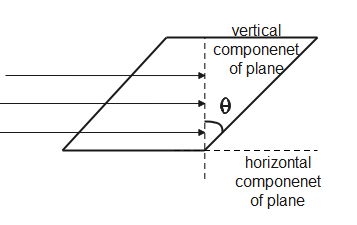
The figure shown above depicts the horizontal and vertical components of area of a plane and the angle between them
The intensity also follows inverse square law which means that the intensity radiating from a source is inversely proportional to the square of the distance from the source, therefore,
$I\propto \dfrac{1}{{{r}^{2}}}$
Here, $r$ is the distance from the source of energy
Therefore, the intensity is the power transmitted per unit area perpendicular to the plane of transmission.
Note: The intensity can also be calculated as the product of energy density and velocity. Power can also be calculated as the product of force and velocity. The energy of photons in light depends on the intensity; as the intensity increases, the energy of photons also increases and vice versa.
Complete step by step solution:
The intensity is the measure of energy transmitted from a source. Intensity is defined as the power that is transmitted per unit area and the area is perpendicular to the direction in which energy is being propagated. The SI unit of intensity is watts per square metre ($W\,{{m}^{-2}}$).
The intensity is given as-
$\begin{align}
& I=\dfrac{P}{{{A}_{\bot }}} \\
& \Rightarrow I=\dfrac{E}{(A\sin \theta )t} \\
\end{align}$
Here, $I$ is the intensity
$P$ is the power
${{A}_{\bot }}$ is the perpendicular component of area
$E$ is the total energy
$\theta $ is the angle between the plane of propagation of energy and area
$t$ is the time taken
The figure shown above depicts the horizontal and vertical components of area of a plane and the angle between them
The intensity also follows inverse square law which means that the intensity radiating from a source is inversely proportional to the square of the distance from the source, therefore,
$I\propto \dfrac{1}{{{r}^{2}}}$
Here, $r$ is the distance from the source of energy
Therefore, the intensity is the power transmitted per unit area perpendicular to the plane of transmission.
Note: The intensity can also be calculated as the product of energy density and velocity. Power can also be calculated as the product of force and velocity. The energy of photons in light depends on the intensity; as the intensity increases, the energy of photons also increases and vice versa.
Recently Updated Pages
Explain the structure of megasporangium class 12 biology CBSE

Why is chloroform kept in dark coloured bottles class 12 chemistry CBSE
Derive the balancing condition of a Wheatstone bri class 12 physics CBSE
Draw VI characteristics of a pn junction diode Explain class 12 physics CBSE
Is it possible to carry pride in ones language too class 12 english CBSE
In a population at Hardy Weinberg equilibrium the allele class 12 biology CBSE
Trending doubts
Draw a labelled sketch of the human eye class 12 physics CBSE
Which are the Top 10 Largest Countries of the World?
Draw ray diagrams each showing i myopic eye and ii class 12 physics CBSE
One megawatt is equal to how many units of electri class 12 physics CBSE
Which is the correct genotypic ratio of mendel dihybrid class 12 biology CBSE
Give 10 examples of unisexual and bisexual flowers