




What are the bond angles in\[{{H}_{3}}O\]?
Answer
 Verified
560.7k+ views
Hint: Bond angles are the angles between the adjacent atoms in the molecule. The bond angle in any molecule varies with the presence of the bond pair of electrons and the lone pair of electrons according to the VSEPR theory. The \[{{H}_{3}}O\] molecule is present in the form of cation \[{{H}_{3}}{{O}^{+}}\]called as hydronium ion whose geometry is pyramidal.
Complete answer:
The shapes of molecules affect the bond angles between them, which are the angles between adjacent atoms. These shapes are identified using VSEPR theory that stands for valence shell electron pair repulsion theory. This theory suggests that a shape of a molecule depends on the valence pair of electrons in the atoms of that molecule. These valence electrons are distributed in the form of bond pairs and lone pairs. The interactions of these pairs are in the order, lone pair – lone pair > lone pair – bond pair > bond pair – bond pair. This implies that lone pair-lone pair interaction is more due to which the shape of the molecule distorts and the bond angle changes.
We have been given \[{{H}_{3}}O\] molecule that is present in the form of\[{{H}_{3}}{{O}^{+}}\] called hydronium ion. This ion consists of an irregular geometry. The total valence electrons in the molecule are 3 in hydrogen and 5 in oxygen cation that makes 8. They are distributed as lone and bond pairs, among which 6 electrons form 3 bond pairs and the remaining 2 electrons consist of lone pairs on oxygen. This makes the hybrid state of the molecule to be $s{{p}^{3}}$ and the shape pyramidal. Due to pyramidal shape all the bond angles become $107{}^\circ $. The molecule is,
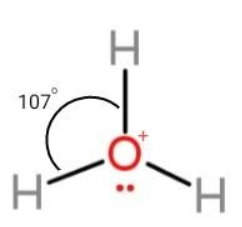
Hence, the bond angles in\[{{H}_{3}}{{O}^{+}}\] molecules are $107{}^\circ $.
Note:
The hybrid state according to the VSEPR can be determined by a formula through which the shapes of the molecules can be identified. The formula is $X={{S}_{A}}+\dfrac{1}{2}(G-V\pm E)$, where${{S}_{A}}$ is number of surrounding atoms, X is hybrid state, G is the valence electrons in central atom, V is valence of surrounding atoms, E is charge (added when negative, subtracted when positive). For, \[{{H}_{3}}{{O}^{+}}\]it gives X = 4 that shows, the $s{{p}^{3}}$pyramidal shape, same as $N{{H}_{3}}$.
Complete answer:
The shapes of molecules affect the bond angles between them, which are the angles between adjacent atoms. These shapes are identified using VSEPR theory that stands for valence shell electron pair repulsion theory. This theory suggests that a shape of a molecule depends on the valence pair of electrons in the atoms of that molecule. These valence electrons are distributed in the form of bond pairs and lone pairs. The interactions of these pairs are in the order, lone pair – lone pair > lone pair – bond pair > bond pair – bond pair. This implies that lone pair-lone pair interaction is more due to which the shape of the molecule distorts and the bond angle changes.
We have been given \[{{H}_{3}}O\] molecule that is present in the form of\[{{H}_{3}}{{O}^{+}}\] called hydronium ion. This ion consists of an irregular geometry. The total valence electrons in the molecule are 3 in hydrogen and 5 in oxygen cation that makes 8. They are distributed as lone and bond pairs, among which 6 electrons form 3 bond pairs and the remaining 2 electrons consist of lone pairs on oxygen. This makes the hybrid state of the molecule to be $s{{p}^{3}}$ and the shape pyramidal. Due to pyramidal shape all the bond angles become $107{}^\circ $. The molecule is,
Hence, the bond angles in\[{{H}_{3}}{{O}^{+}}\] molecules are $107{}^\circ $.
Note:
The hybrid state according to the VSEPR can be determined by a formula through which the shapes of the molecules can be identified. The formula is $X={{S}_{A}}+\dfrac{1}{2}(G-V\pm E)$, where${{S}_{A}}$ is number of surrounding atoms, X is hybrid state, G is the valence electrons in central atom, V is valence of surrounding atoms, E is charge (added when negative, subtracted when positive). For, \[{{H}_{3}}{{O}^{+}}\]it gives X = 4 that shows, the $s{{p}^{3}}$pyramidal shape, same as $N{{H}_{3}}$.
Recently Updated Pages
Master Class 11 English: Engaging Questions & Answers for Success

Master Class 11 Social Science: Engaging Questions & Answers for Success
Master Class 11 Maths: Engaging Questions & Answers for Success
Master Class 11 Biology: Engaging Questions & Answers for Success
Master Class 11 Physics: Engaging Questions & Answers for Success
Master Class 11 Chemistry: Engaging Questions & Answers for Success
Trending doubts
One Metric ton is equal to kg A 10000 B 1000 C 100 class 11 physics CBSE
Difference Between Prokaryotic Cells and Eukaryotic Cells
Find the value of the expression given below sin 30circ class 11 maths CBSE
1 ton equals to A 100 kg B 1000 kg C 10 kg D 10000 class 11 physics CBSE
Two of the body parts which do not appear in MRI are class 11 biology CBSE
What are hard magnetic materials class 11 physics CBSE