




What are ribs?
Answer
 Verified
606k+ views
Hint: Basically they are the long curved bones, and they are also the bones of the chest. They have three essential functions: protect organs under them, support and also help in respiration. They generally enclose and protect both the heart and the lungs.
Complete answer:
So, ribs are the set of twelve bones that form the protective cage of the thorax. They articulate with the vertebral column at the back, and end earlier as cartilage (known as the costal cartilage).
The ribs shield the internal thoracic organs as part of the bony thoracic. They also have a part to play in breathing – during breast enlargement, the ribcage shifts to allow lung inflation.
Structure of Rib
There are two types of ribs – atypical and typical. The typical ribs do have the generalised structure. On the other hand atypical ribs have differences in the structure.
The standard human rib cage consists of 24 ribs in 12 pairs, the sternum and xiphoid process, the costal cartilage and the 12 thoracic vertebrae.
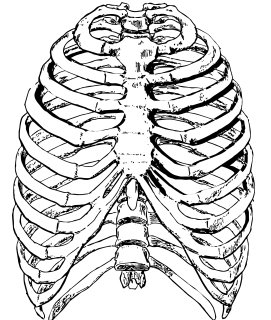
Fig: Ribs
Additional Information: The rib cage is the framework of the ribs attached to the vertebral column and the sternum in the chest of most vertebrates, which encloses and protects the heart and lungs. In humans, this rib cage, also defined as the thoracic cage, is a bony and cartilaginous structure that covers the thoracic cavity and protects the shoulder girdle to form the centre of the human skeleton
Note: Along with the skin and corresponding fascia and muscles, the rib cage forms the thoracic wall as well as provides connections to the muscles of the spine, thorax, upper abdomen and back
Complete answer:
So, ribs are the set of twelve bones that form the protective cage of the thorax. They articulate with the vertebral column at the back, and end earlier as cartilage (known as the costal cartilage).
The ribs shield the internal thoracic organs as part of the bony thoracic. They also have a part to play in breathing – during breast enlargement, the ribcage shifts to allow lung inflation.
Structure of Rib
There are two types of ribs – atypical and typical. The typical ribs do have the generalised structure. On the other hand atypical ribs have differences in the structure.
The standard human rib cage consists of 24 ribs in 12 pairs, the sternum and xiphoid process, the costal cartilage and the 12 thoracic vertebrae.
Fig: Ribs
Additional Information: The rib cage is the framework of the ribs attached to the vertebral column and the sternum in the chest of most vertebrates, which encloses and protects the heart and lungs. In humans, this rib cage, also defined as the thoracic cage, is a bony and cartilaginous structure that covers the thoracic cavity and protects the shoulder girdle to form the centre of the human skeleton
Note: Along with the skin and corresponding fascia and muscles, the rib cage forms the thoracic wall as well as provides connections to the muscles of the spine, thorax, upper abdomen and back
Recently Updated Pages
Master Class 11 Social Science: Engaging Questions & Answers for Success

Master Class 11 Chemistry: Engaging Questions & Answers for Success
Master Class 12 Business Studies: Engaging Questions & Answers for Success
Master Class 12 Chemistry: Engaging Questions & Answers for Success
Master Class 12 Biology: Engaging Questions & Answers for Success
Class 12 Question and Answer - Your Ultimate Solutions Guide
Trending doubts
One Metric ton is equal to kg A 10000 B 1000 C 100 class 11 physics CBSE
Difference Between Prokaryotic Cells and Eukaryotic Cells
Two of the body parts which do not appear in MRI are class 11 biology CBSE
Explain zero factorial class 11 maths CBSE
10 examples of friction in our daily life
Name the Largest and the Smallest Cell in the Human Body ?