




What are lenticels in biology?
Answer
 Verified
575.4k+ views
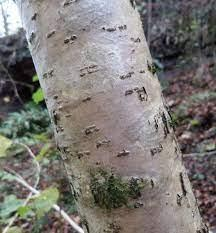
Hint: On stems and roots, lenticels appear as elevated circular, oval, or elongated patches. Lenticels are rough, cork-like structures that grow on juvenile branches of woody plants. Porous tissue creates a lot of huge intercellular gaps between cells beneath them.
Complete answer:
A lenticel is a porous tissue found in the periderm of secondary thickening organs, as well as the bark of woody stems and roots of dicotyledonous flowering plants, that consists of cells with vast intercellular spaces.
It acts as a pore, allowing direct gas exchange between internal tissues and the atmosphere via the bark, which would otherwise be impervious to gases. A tiny pore near a plant's stomata that permits gaseous exchange between the plant's internal and exterior surroundings.
Its lenticular (lens-like) shape inspired the word lenticel, which is pronounced with a [s]. One of the traits used to identify trees is the shape of their lenticels.
Lenticels promote gas exchange of oxygen, carbon dioxide, and water vapour in plant bodies that induce secondary growth. Lenticel production occurs beneath stomatal complexes during early growth, just before the first periderm develops.
This tissue emerges from cell division in the phellogen or substomatal ground tissue and fills the lenticel. Lenticular discoloration can also occur, such as in mangoes, due to the quantity of lignin in the cell walls.
Note: The production of lenticels appears to be linked to the growth and strength of the shoot, as well as the tissue's hydrose, or internal moisture. Lenticel formation continues in the new periderm as stems and roots mature.
Complete answer:
A lenticel is a porous tissue found in the periderm of secondary thickening organs, as well as the bark of woody stems and roots of dicotyledonous flowering plants, that consists of cells with vast intercellular spaces.
It acts as a pore, allowing direct gas exchange between internal tissues and the atmosphere via the bark, which would otherwise be impervious to gases. A tiny pore near a plant's stomata that permits gaseous exchange between the plant's internal and exterior surroundings.
Its lenticular (lens-like) shape inspired the word lenticel, which is pronounced with a [s]. One of the traits used to identify trees is the shape of their lenticels.
Lenticels promote gas exchange of oxygen, carbon dioxide, and water vapour in plant bodies that induce secondary growth. Lenticel production occurs beneath stomatal complexes during early growth, just before the first periderm develops.
This tissue emerges from cell division in the phellogen or substomatal ground tissue and fills the lenticel. Lenticular discoloration can also occur, such as in mangoes, due to the quantity of lignin in the cell walls.
Note: The production of lenticels appears to be linked to the growth and strength of the shoot, as well as the tissue's hydrose, or internal moisture. Lenticel formation continues in the new periderm as stems and roots mature.
Recently Updated Pages
If x a + bt + ct2 where x is in meters and t is in class 11 physics CBSE

A car covers the first half distance between two places class 11 physics CBSE
The resultant of two vectors overrightarrow P and overrightarrow class 11 physics CBSE
Find the value of cos 135 class 11 maths CBSE
A mass M is held in place by an applied force F and class 11 physics CBSE
A solution of glucose in water is labelled as 10 dfracwv class 11 chemistry CBSE
Trending doubts
One Metric ton is equal to kg A 10000 B 1000 C 100 class 11 physics CBSE
Find the value of the expression given below sin 30circ class 11 maths CBSE
Draw a diagram of nephron and explain its structur class 11 biology CBSE
10 examples of friction in our daily life
Proton was discovered by A Thomson B Rutherford C Chadwick class 11 chemistry CBSE
Bond order ofO2 O2+ O2 and O22 is in order A O2 langle class 11 chemistry CBSE