




What are Blastomeres?
Answer
 Verified
560.4k+ views
Hint: Blastomeres are formed as a result of post fertilisation. This stage lasts till the first week of embryonic development. It is an essential part of blastula formation.
Complete answer:
A blastomere is a cell that is produced as a result of cell division or cleavage of the zygote. Cleavage is the process of cell division that takes place in the embryonic state. The blastomere formation begins just after the fertilisation and continues till the development of the embryo. The zygote divides into two cells. These are the two-celled stages of blastomere. It is the first mitotic division of the fertilised ovum. After subsequent divisions a group of cells are formed, It is known as the blastomeres. The division results in a smaller cell as the size of the embryo does not increase.
The 16 to 32 blastomere stage is known as a morula. After the formation of the morula, the cytosolic material in the blastomere develops membrane functions as a sodium pump. This pump helps in supporting life. The size of the blastomere is dependent on the frequency and size of the cleavage. After the 8-celled stage, the blastomere form adherens junctions which help in changing the morphology of the cells and the cells and the cells begin to differentiate.
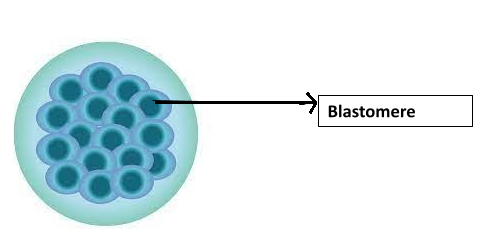
Note: The blastomeres are the totipotent cells, they are potent in developing the whole adult organism from a single cell. There can arise a disorder in the continuous division of the blastomere which can result in the uneven result of cell division.
Complete answer:
A blastomere is a cell that is produced as a result of cell division or cleavage of the zygote. Cleavage is the process of cell division that takes place in the embryonic state. The blastomere formation begins just after the fertilisation and continues till the development of the embryo. The zygote divides into two cells. These are the two-celled stages of blastomere. It is the first mitotic division of the fertilised ovum. After subsequent divisions a group of cells are formed, It is known as the blastomeres. The division results in a smaller cell as the size of the embryo does not increase.
The 16 to 32 blastomere stage is known as a morula. After the formation of the morula, the cytosolic material in the blastomere develops membrane functions as a sodium pump. This pump helps in supporting life. The size of the blastomere is dependent on the frequency and size of the cleavage. After the 8-celled stage, the blastomere form adherens junctions which help in changing the morphology of the cells and the cells and the cells begin to differentiate.
Note: The blastomeres are the totipotent cells, they are potent in developing the whole adult organism from a single cell. There can arise a disorder in the continuous division of the blastomere which can result in the uneven result of cell division.
Recently Updated Pages
Master Class 11 Social Science: Engaging Questions & Answers for Success

Master Class 11 English: Engaging Questions & Answers for Success
Master Class 11 Accountancy: Engaging Questions & Answers for Success
Master Class 11 Physics: Engaging Questions & Answers for Success
Master Class 11 Computer Science: Engaging Questions & Answers for Success
Master Class 11 Business Studies: Engaging Questions & Answers for Success
Trending doubts
Find the value of the expression given below sin 30circ class 11 maths CBSE
One Metric ton is equal to kg A 10000 B 1000 C 100 class 11 physics CBSE
10 examples of friction in our daily life
Draw a diagram of nephron and explain its structur class 11 biology CBSE
The teeth used for biting and cutting food are called class 11 biology CBSE
Proton was discovered by A Thomson B Rutherford C Chadwick class 11 chemistry CBSE