




Weight of a body is a scalar quantity. True or false.
A. True
B. False
Answer
 Verified
638.1k+ views
Hint: Try to understand the concept of scalar and vector quantity. Try to imagine if a physical quantity has both the direction and magnitude or it has only magnitude not direction. This way you can find your answer.
Complete Step-by-Step solution:
Scalar quantity can be defined as a physical quantity which has only magnitude, not direction.
A vector quantity can be defined as a physical quantity which has both the magnitude and direction.
Consider the following example.
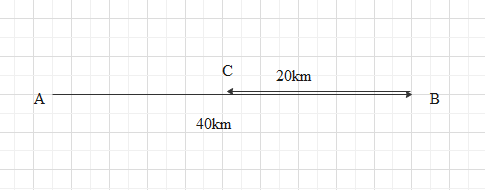
If we travel from point A to point B. the distance will be 40 km. It has only magnitude. Next if we move backward to point C the total distance travelled is $40+20=60km.$ So, distance has only the magnitude, not a direction. So, distance is a scalar quantity.
Now, if we consider displacement it will give the real distance between the points A and C with the direction from A to C. The displacement will be 20 km in the direction A to C. So, displacement is a vector quantity.
Weight can be defined as the force by which a body is attracted towards the centre of the planet. It can be expressed as $w=mg$, where m is mass of the object and g is the acceleration due to gravity. So, we can define weight as a force with direction towards the centre of the planet. weight has both the magnitude and direction. Hence, weight is a vector quantity.
The correct option is (B) False.
Note: Mass of a body is scalar quantity. Mass has only magnitude, not direction. If we consider weight it is the force experienced by the object due to its mass. Hence, weight has both the magnitude and direction.
Complete Step-by-Step solution:
Scalar quantity can be defined as a physical quantity which has only magnitude, not direction.
A vector quantity can be defined as a physical quantity which has both the magnitude and direction.
Consider the following example.
If we travel from point A to point B. the distance will be 40 km. It has only magnitude. Next if we move backward to point C the total distance travelled is $40+20=60km.$ So, distance has only the magnitude, not a direction. So, distance is a scalar quantity.
Now, if we consider displacement it will give the real distance between the points A and C with the direction from A to C. The displacement will be 20 km in the direction A to C. So, displacement is a vector quantity.
Weight can be defined as the force by which a body is attracted towards the centre of the planet. It can be expressed as $w=mg$, where m is mass of the object and g is the acceleration due to gravity. So, we can define weight as a force with direction towards the centre of the planet. weight has both the magnitude and direction. Hence, weight is a vector quantity.
The correct option is (B) False.
Note: Mass of a body is scalar quantity. Mass has only magnitude, not direction. If we consider weight it is the force experienced by the object due to its mass. Hence, weight has both the magnitude and direction.
Recently Updated Pages
Master Class 11 English: Engaging Questions & Answers for Success

Master Class 11 Social Science: Engaging Questions & Answers for Success
Master Class 11 Maths: Engaging Questions & Answers for Success
Master Class 11 Biology: Engaging Questions & Answers for Success
Master Class 11 Physics: Engaging Questions & Answers for Success
Master Class 11 Chemistry: Engaging Questions & Answers for Success
Trending doubts
Explain the Treaty of Vienna of 1815 class 10 social science CBSE
What is the full form of CNG A Complete Natural Gas class 10 social science CBSE
In cricket, what is a "Yorker" designed to do?
What is the full form of POSCO class 10 social science CBSE
Define Potential, Developed, Stock and Reserved resources
What were the majoritarian measures taken in Sri Lanka class 10 social science CBSE