




We wish to obtain an erect image of an object using a concave mirror of focal length 15cm. What should be the range of distance of the object from the mirror? What is the nature of the image? Is the image smaller or larger than the object? Draw a ray diagram to show the image formation in this case.
Answer
 Verified
641.4k+ views
Hint: We know that the concave mirrors form images of different size and nature when kept at different distances from the mirror. We can relate the distance from the object to the mirror and the focal length to generalize the conditions for image formation.
Complete step by step solution:
We know that concave mirrors are known as the converging mirrors as they converge the incoming rays to a point thus forming images. The rays from an infinite source are focused on the focus of the mirror whose distance from the mirror is called the focal length. Usually, for a mirror, the focal length is half the distance from the center of curvature of the spherical mirror.
We know that for a mirror we can use the mirror equation to get the unknown quantities. The mirror formula is given as –
\[\dfrac{1}{f}=\dfrac{1}{v}+\dfrac{1}{u}\]
Where f is the focal length of the mirror,
v is the image distance from the mirror,
u is the object distance from the mirror.
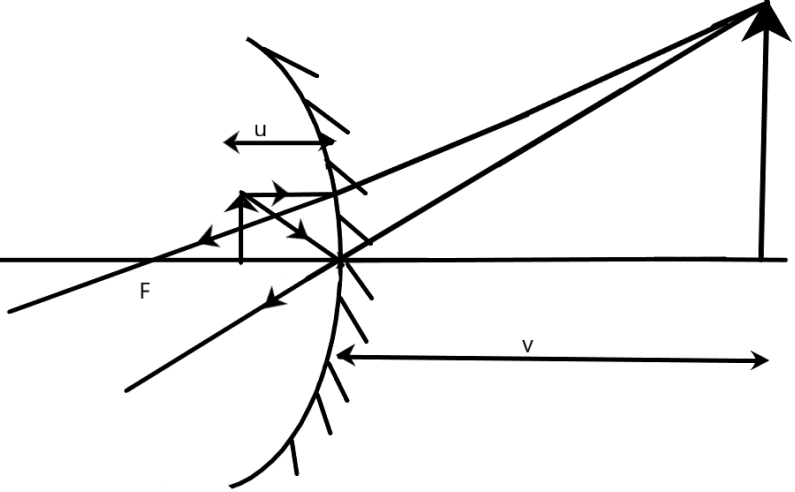
For a concave mirror to form an erect image, the object should be placed between the mirror and the focus of the mirror. As we observe from the figure above, the image formed is a virtual image. The range in which we can acquire an erect image is when the object distance is less than 15 cm in this case as the focal length is 15cm.
Also, the image is larger than the object as seen above.
So, we can conclude that –
The image formed is virtual and erect.
The image is larger than the object.
The object should be in the range \[0< u< 15cm\].
Note: The concave mirrors can only form images by extending diverging beams in this case when the object is between the mirror and the focus. In all other cases, it forms an image by converging the rays falling on it thus validating as a converging mirror.
Complete step by step solution:
We know that concave mirrors are known as the converging mirrors as they converge the incoming rays to a point thus forming images. The rays from an infinite source are focused on the focus of the mirror whose distance from the mirror is called the focal length. Usually, for a mirror, the focal length is half the distance from the center of curvature of the spherical mirror.
We know that for a mirror we can use the mirror equation to get the unknown quantities. The mirror formula is given as –
\[\dfrac{1}{f}=\dfrac{1}{v}+\dfrac{1}{u}\]
Where f is the focal length of the mirror,
v is the image distance from the mirror,
u is the object distance from the mirror.
For a concave mirror to form an erect image, the object should be placed between the mirror and the focus of the mirror. As we observe from the figure above, the image formed is a virtual image. The range in which we can acquire an erect image is when the object distance is less than 15 cm in this case as the focal length is 15cm.
Also, the image is larger than the object as seen above.
So, we can conclude that –
The image formed is virtual and erect.
The image is larger than the object.
The object should be in the range \[0< u< 15cm\].
Note: The concave mirrors can only form images by extending diverging beams in this case when the object is between the mirror and the focus. In all other cases, it forms an image by converging the rays falling on it thus validating as a converging mirror.
Recently Updated Pages
Write any three differences between metals and nonmetals class 10 social science CBSE

Amit standing on a horizontal plane finds a bird flying class 10 maths CBSE
Two circles of radii 5 cm and 3 cm intersect at two class 10 maths CBSE
Solve the following i John and Jivanti together have class 10 maths CBSE
What is the relation between orthocenter circumcentre class 10 maths CBSE
Two plane mirrors are inclined at 70circ A ray incident class 10 physics CBSE
Trending doubts
Explain the Treaty of Vienna of 1815 class 10 social science CBSE
Which country is known as "The land of Fire and Ice"?
1 GB equals how many MB?
10 examples of evaporation in daily life with explanations
What is the full form of POSCO class 10 social science CBSE
Which is the hottest planet in the Solar system A Earth class 10 social science CBSE