




We know that $tan2\theta =\dfrac{2\tan \theta }{1-{{\tan }^{2}}\theta }$ , so verify this identity for $\theta =30{}^\circ $ .
Answer
 Verified
621.9k+ views
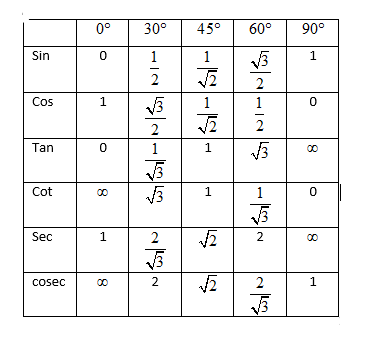
Hint: To solve the above question, you need to individually solve the right-hand side and left-hand side of the equation individually by putting the required values and show that both sides of the equation are equal. For putting the required values you need to use the trigonometric ratio table contains the values of different trigonometric ratios for trigonometric standard angles such as $0{}^\circ ,30{}^\circ ,45{}^\circ ,60{}^\circ \text{ and 90}{}^\circ $ .
Complete step by step solution:
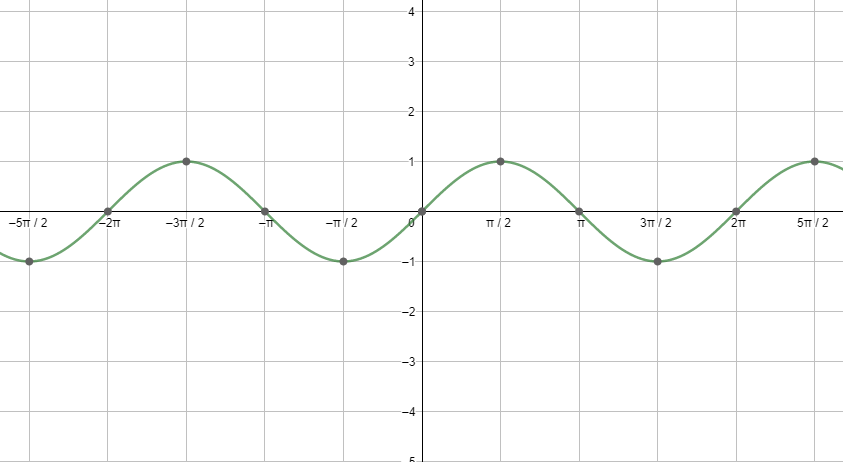
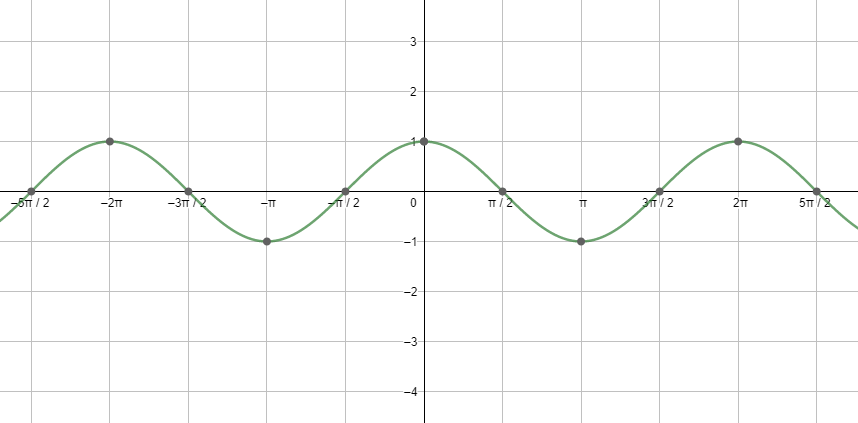
Before moving to the solution, let us discuss the nature of sine and cosine function, which we would be using in the solution. We can better understand this using the graph of sine and cosine.
First, let us start with the graph of sinx.
Next, let us see the graph of cosx.
Looking at both the graphs, and using the relations between the different trigonometric ratios, we get
Let us start the solution to the above question by simplifying the left-hand side of the equation $tan2\theta =\dfrac{2\tan \theta }{1-{{\tan }^{2}}\theta }$ by putting the value $\theta =30{}^\circ $ .
$tan2\theta $
$=\tan \left( 2\times 30{}^\circ \right)$
$=\tan 60{}^\circ $
And we know that the value of $\tan 60{}^\circ $ is equal to $\sqrt{3}$ . So, we get
$=\tan 60{}^\circ =\sqrt{3}$
So, the left-hand side of the equation $tan2\theta =\dfrac{2\tan \theta }{1-{{\tan }^{2}}\theta }$ is equal to $\sqrt{3}$ .
Now let us simplify the right-hand side of the equation by putting the values $\theta =30{}^\circ $ .
$\dfrac{2\tan \theta }{1-{{\tan }^{2}}\theta }$
$=\dfrac{2\tan 30{}^\circ }{1-{{\tan }^{2}}30{}^\circ }$
Now we know that $\tan 30{}^\circ =\dfrac{1}{\sqrt{3}}$ .
$=\dfrac{2\tan 30{}^\circ }{1-{{\tan }^{2}}30{}^\circ }$
$=\dfrac{2\left( \dfrac{1}{\sqrt{3}} \right)}{1-{{\left( \dfrac{1}{\sqrt{3}} \right)}^{2}}}$
$=\dfrac{\dfrac{2}{\sqrt{3}}}{1-\dfrac{1}{3}}=\dfrac{\dfrac{2}{\sqrt{3}}}{\dfrac{2}{3}}=\sqrt{3}$
Therefore, we can say that the left-hand side of the equation $tan2\theta =\dfrac{2\tan \theta }{1-{{\tan }^{2}}\theta }$ is equal to the right-hand side. So, we have verified the above equation.
Note: Be careful while putting the values of the different trigonometric ratios in the expression for solving the question. Also, be careful with the calculation part, as, in such questions, most errors occur in the calculation part. For example: students in a hurry write $1-{{\left( \dfrac{1}{\sqrt{3}} \right)}^{2}}$ as $1+\dfrac{1}{3}$ , using the property that square of negative number is positive but here the negative sign is outside the bracket.
Complete step by step solution:
Before moving to the solution, let us discuss the nature of sine and cosine function, which we would be using in the solution. We can better understand this using the graph of sine and cosine.
First, let us start with the graph of sinx.
Next, let us see the graph of cosx.
Looking at both the graphs, and using the relations between the different trigonometric ratios, we get
Let us start the solution to the above question by simplifying the left-hand side of the equation $tan2\theta =\dfrac{2\tan \theta }{1-{{\tan }^{2}}\theta }$ by putting the value $\theta =30{}^\circ $ .
$tan2\theta $
$=\tan \left( 2\times 30{}^\circ \right)$
$=\tan 60{}^\circ $
And we know that the value of $\tan 60{}^\circ $ is equal to $\sqrt{3}$ . So, we get
$=\tan 60{}^\circ =\sqrt{3}$
So, the left-hand side of the equation $tan2\theta =\dfrac{2\tan \theta }{1-{{\tan }^{2}}\theta }$ is equal to $\sqrt{3}$ .
Now let us simplify the right-hand side of the equation by putting the values $\theta =30{}^\circ $ .
$\dfrac{2\tan \theta }{1-{{\tan }^{2}}\theta }$
$=\dfrac{2\tan 30{}^\circ }{1-{{\tan }^{2}}30{}^\circ }$
Now we know that $\tan 30{}^\circ =\dfrac{1}{\sqrt{3}}$ .
$=\dfrac{2\tan 30{}^\circ }{1-{{\tan }^{2}}30{}^\circ }$
$=\dfrac{2\left( \dfrac{1}{\sqrt{3}} \right)}{1-{{\left( \dfrac{1}{\sqrt{3}} \right)}^{2}}}$
$=\dfrac{\dfrac{2}{\sqrt{3}}}{1-\dfrac{1}{3}}=\dfrac{\dfrac{2}{\sqrt{3}}}{\dfrac{2}{3}}=\sqrt{3}$
Therefore, we can say that the left-hand side of the equation $tan2\theta =\dfrac{2\tan \theta }{1-{{\tan }^{2}}\theta }$ is equal to the right-hand side. So, we have verified the above equation.
Note: Be careful while putting the values of the different trigonometric ratios in the expression for solving the question. Also, be careful with the calculation part, as, in such questions, most errors occur in the calculation part. For example: students in a hurry write $1-{{\left( \dfrac{1}{\sqrt{3}} \right)}^{2}}$ as $1+\dfrac{1}{3}$ , using the property that square of negative number is positive but here the negative sign is outside the bracket.
Recently Updated Pages
Master Class 12 Business Studies: Engaging Questions & Answers for Success

Master Class 12 Biology: Engaging Questions & Answers for Success
Master Class 12 Chemistry: Engaging Questions & Answers for Success
Class 12 Question and Answer - Your Ultimate Solutions Guide
Master Class 11 Social Science: Engaging Questions & Answers for Success
Master Class 11 English: Engaging Questions & Answers for Success
Trending doubts
Explain the Treaty of Vienna of 1815 class 10 social science CBSE
Which Indian city is known as the "City of Victory"?
Which instrument is used to measure the Blood Pressure?
Who Won 36 Oscar Awards? Record Holder Revealed
What is the median of the first 10 natural numbers class 10 maths CBSE
Why is it 530 pm in india when it is 1200 afternoon class 10 social science CBSE