




We know that $\sin 2\theta =\dfrac{2\tan \theta }{1+{{\tan }^{2}}\theta }$ , so verify this identity for $\theta =30{}^\circ $ .
Answer
 Verified
663.6k+ views
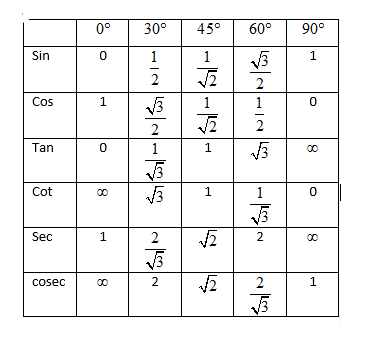
Hint: To solve the above question, you need to individually solve the right-hand side and left-hand side of the equation individually by putting the required values and show that both sides of the equation are equal. For putting the required values you need to use the trigonometric ratio table contains the values of different trigonometric ratios for trigonometric standard angles such as $0{}^\circ ,30{}^\circ ,45{}^\circ ,60{}^\circ \text{ and 90}{}^\circ $ .
Complete step by step solution:
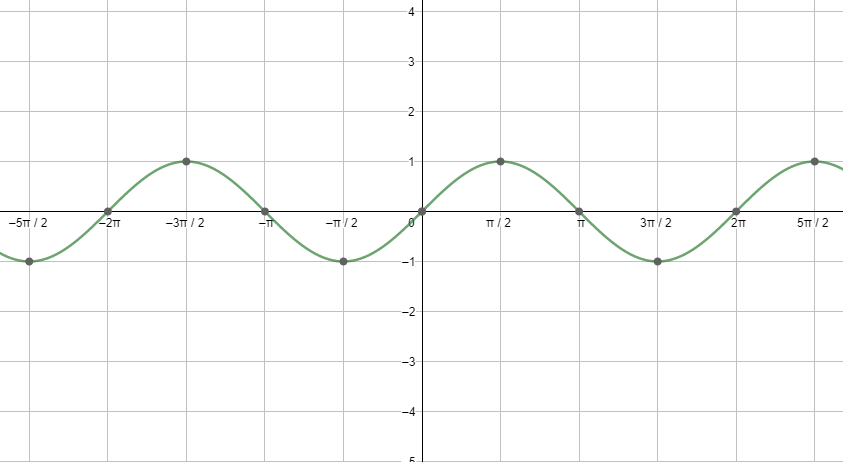
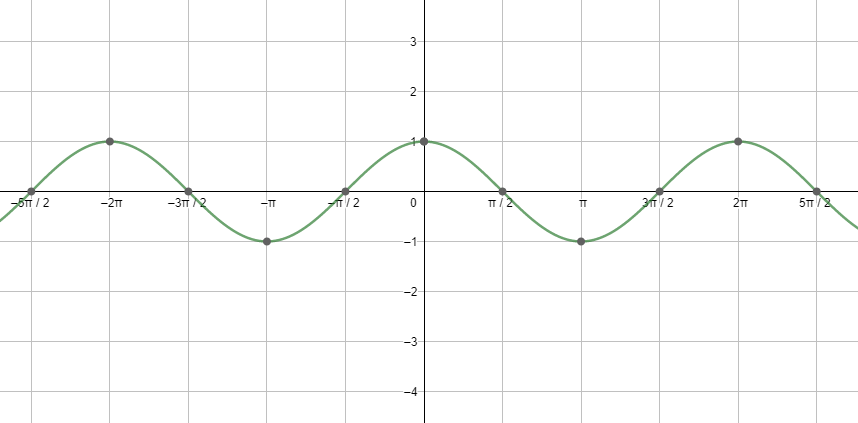
Before moving to the solution, let us discuss the nature of sine and cosine function, which we would be using in the solution. We can better understand this using the graph of sine and cosine.
First, let us start with the graph of sinx.
Next, let us see the graph of cosx.
Looking at both the graphs, and using the relations between the different trigonometric ratios, we get
Let us start the solution to the above question by simplifying the left-hand side of the equation $\sin 2\theta =\dfrac{2\tan \theta }{1+{{\tan }^{2}}\theta }$ by putting the value $\theta =30{}^\circ $ .
$\sin 2\theta $
$=\sin \left( 2\times 30{}^\circ \right)$
$=\sin 60{}^\circ $
And we know that the value of $\sin 60{}^\circ $ is equal to $\dfrac{\sqrt{3}}{2}$ . So, we get
$=\sin 60{}^\circ =\dfrac{\sqrt{3}}{2}$
So, the left-hand side of the equation $\sin 2\theta =\dfrac{2\tan \theta }{1+{{\tan }^{2}}\theta }$ is equal to $\dfrac{\sqrt{3}}{2}$ .
Now let us simplify the right-hand side of the equation by putting the values $\theta =30{}^\circ $ .
$\dfrac{2\tan \theta }{1+{{\tan }^{2}}\theta }$
$=\dfrac{2\tan 30{}^\circ }{1+{{\tan }^{2}}30{}^\circ }$
Now we know that $\tan 30{}^\circ =\dfrac{1}{\sqrt{3}}$ .
$=\dfrac{2\tan 30{}^\circ }{1+{{\tan }^{2}}30{}^\circ }$
$=\dfrac{2\left( \dfrac{1}{\sqrt{3}} \right)}{1+{{\left( \dfrac{1}{\sqrt{3}} \right)}^{2}}}$
$=\dfrac{\dfrac{2}{\sqrt{3}}}{1+\dfrac{1}{3}}=\dfrac{\dfrac{2}{\sqrt{3}}}{\dfrac{4}{3}}=\dfrac{\sqrt{3}}{2}$
Therefore, we can say that the left-hand side of the equation $\sin 2\theta =\dfrac{2\tan \theta }{1+{{\tan }^{2}}\theta }$ is equal to the right-hand side. So, we have verified the above equation.
Note: Be careful while putting the values of the different trigonometric ratios in the expression for solving the question as the values of different trigonometric ratios are really confusing and there is always a possibility that you may get confused and put $\sin 30{}^\circ =\dfrac{\sqrt{3}}{2}\text{ and sin60}{}^\circ \text{=}\dfrac{1}{2}$ , which is wrong.
Complete step by step solution:
Before moving to the solution, let us discuss the nature of sine and cosine function, which we would be using in the solution. We can better understand this using the graph of sine and cosine.
First, let us start with the graph of sinx.
Next, let us see the graph of cosx.
Looking at both the graphs, and using the relations between the different trigonometric ratios, we get
Let us start the solution to the above question by simplifying the left-hand side of the equation $\sin 2\theta =\dfrac{2\tan \theta }{1+{{\tan }^{2}}\theta }$ by putting the value $\theta =30{}^\circ $ .
$\sin 2\theta $
$=\sin \left( 2\times 30{}^\circ \right)$
$=\sin 60{}^\circ $
And we know that the value of $\sin 60{}^\circ $ is equal to $\dfrac{\sqrt{3}}{2}$ . So, we get
$=\sin 60{}^\circ =\dfrac{\sqrt{3}}{2}$
So, the left-hand side of the equation $\sin 2\theta =\dfrac{2\tan \theta }{1+{{\tan }^{2}}\theta }$ is equal to $\dfrac{\sqrt{3}}{2}$ .
Now let us simplify the right-hand side of the equation by putting the values $\theta =30{}^\circ $ .
$\dfrac{2\tan \theta }{1+{{\tan }^{2}}\theta }$
$=\dfrac{2\tan 30{}^\circ }{1+{{\tan }^{2}}30{}^\circ }$
Now we know that $\tan 30{}^\circ =\dfrac{1}{\sqrt{3}}$ .
$=\dfrac{2\tan 30{}^\circ }{1+{{\tan }^{2}}30{}^\circ }$
$=\dfrac{2\left( \dfrac{1}{\sqrt{3}} \right)}{1+{{\left( \dfrac{1}{\sqrt{3}} \right)}^{2}}}$
$=\dfrac{\dfrac{2}{\sqrt{3}}}{1+\dfrac{1}{3}}=\dfrac{\dfrac{2}{\sqrt{3}}}{\dfrac{4}{3}}=\dfrac{\sqrt{3}}{2}$
Therefore, we can say that the left-hand side of the equation $\sin 2\theta =\dfrac{2\tan \theta }{1+{{\tan }^{2}}\theta }$ is equal to the right-hand side. So, we have verified the above equation.
Note: Be careful while putting the values of the different trigonometric ratios in the expression for solving the question as the values of different trigonometric ratios are really confusing and there is always a possibility that you may get confused and put $\sin 30{}^\circ =\dfrac{\sqrt{3}}{2}\text{ and sin60}{}^\circ \text{=}\dfrac{1}{2}$ , which is wrong.
Recently Updated Pages
Write any three differences between metals and nonmetals class 10 social science CBSE

Amit standing on a horizontal plane finds a bird flying class 10 maths CBSE
Two circles of radii 5 cm and 3 cm intersect at two class 10 maths CBSE
Solve the following i John and Jivanti together have class 10 maths CBSE
What is the relation between orthocenter circumcentre class 10 maths CBSE
Two plane mirrors are inclined at 70circ A ray incident class 10 physics CBSE
Trending doubts
Explain the Treaty of Vienna of 1815 class 10 social science CBSE
1 GB equals how many MB?
10 examples of evaporation in daily life with explanations
What is the full form of POSCO class 10 social science CBSE
Which is the hottest planet in the Solar system A Earth class 10 social science CBSE
Name any four life processes in living things class 10 biology CBSE