




How is water transported moving upward in the plants?
Answer
 Verified
525.9k+ views
Hint: Like every other living organism, plants also require water to carry out various metabolic processes. They absorb this water from ground through their fine thread like roots that nourishes their entire body.
Complete answer:
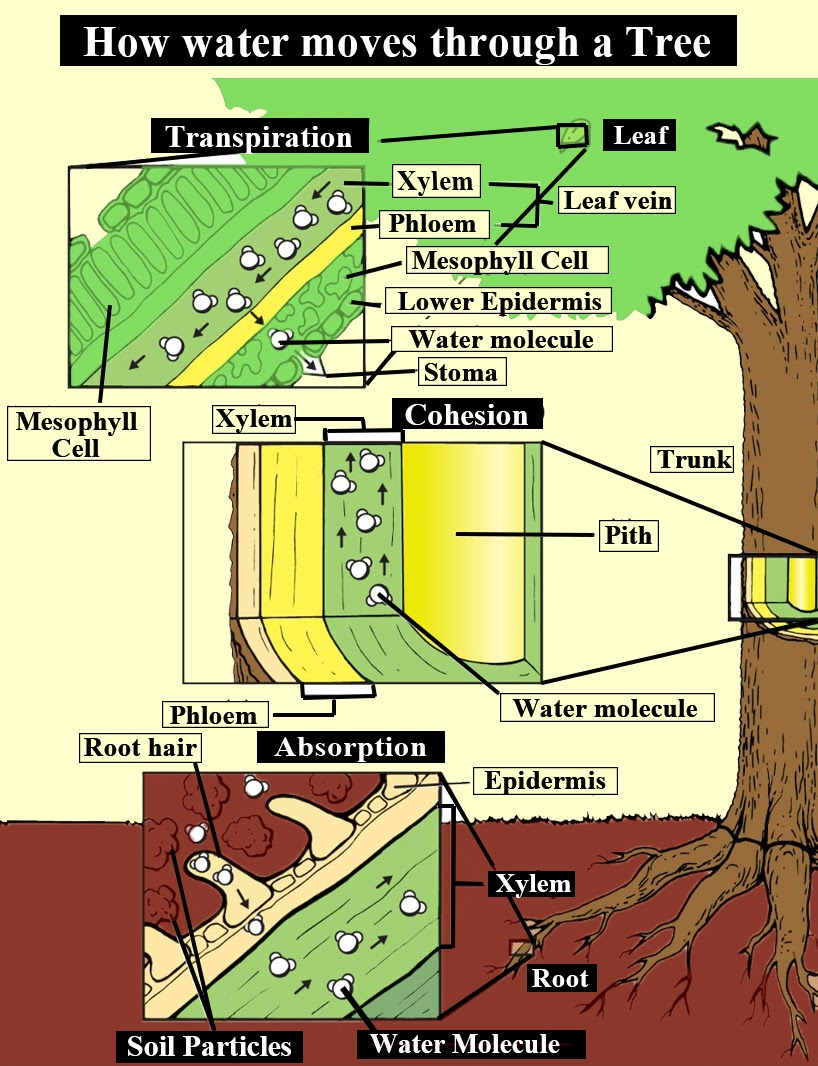
The sap (water with minerals) coming from roots manages to move in an upwards direction (against gravity) towards leaves and other plant parts due to the action of three different forces. Whenever sap is absorbed from soil through roots, the three forces (that is, root pressure, capillary pressure, cohesive tension) start acting upon it, causing it to move in an upward direction. First, water is absorbed by the root fibres through the process of Osmosis. This is followed by action of root pressure, that is basically a transverse osmotic pressure due to which absorbed water is transferred from root fibres to xylem tissues. Once water enters into the xylem tissues, cohesion tension (an attractive force) is produced between water molecules due to which a state of tension is created within the xylem tissue causing further movement of the sap in an upward direction. This is followed by capillary action that produces a kind of suction force that pulls water molecules from all the void areas towards the upper areas of the plant body. However, this suction force is aided by transpirational pull (pulling force arising due to the vacuum created by the process of transpiration). Likewise, the three forces cause movement of sap throughout the plant body.
Note:
The water absorbed by roots of plants is transported through xylem tissues. This xylem tissue functions exactly like our veins that keep dividing further into fine hair like structures in order to reach all parts of the plant body.
Complete answer:
The sap (water with minerals) coming from roots manages to move in an upwards direction (against gravity) towards leaves and other plant parts due to the action of three different forces. Whenever sap is absorbed from soil through roots, the three forces (that is, root pressure, capillary pressure, cohesive tension) start acting upon it, causing it to move in an upward direction. First, water is absorbed by the root fibres through the process of Osmosis. This is followed by action of root pressure, that is basically a transverse osmotic pressure due to which absorbed water is transferred from root fibres to xylem tissues. Once water enters into the xylem tissues, cohesion tension (an attractive force) is produced between water molecules due to which a state of tension is created within the xylem tissue causing further movement of the sap in an upward direction. This is followed by capillary action that produces a kind of suction force that pulls water molecules from all the void areas towards the upper areas of the plant body. However, this suction force is aided by transpirational pull (pulling force arising due to the vacuum created by the process of transpiration). Likewise, the three forces cause movement of sap throughout the plant body.
Note:
The water absorbed by roots of plants is transported through xylem tissues. This xylem tissue functions exactly like our veins that keep dividing further into fine hair like structures in order to reach all parts of the plant body.
Recently Updated Pages
Master Class 11 Social Science: Engaging Questions & Answers for Success

Master Class 11 Physics: Engaging Questions & Answers for Success
Master Class 11 Maths: Engaging Questions & Answers for Success
Master Class 11 Economics: Engaging Questions & Answers for Success
Master Class 11 Computer Science: Engaging Questions & Answers for Success
Master Class 11 Chemistry: Engaging Questions & Answers for Success
Trending doubts
One Metric ton is equal to kg A 10000 B 1000 C 100 class 11 physics CBSE
How many bones are in the spine class 11 biology CBSE
1 Quintal is equal to a 110 kg b 10 kg c 100kg d 1000 class 11 physics CBSE
There are 720 permutations of the digits 1 2 3 4 5 class 11 maths CBSE
State and prove Bernoullis theorem class 11 physics CBSE
Difference Between Prokaryotic Cells and Eukaryotic Cells