




Water in a river flows from wets to east at $4km/h$. A man on the north bank capable of swimming at km/h crossed the river in the shortest possible time. Then he should swim along?
(A) North
(B) south
(C) ${{30}^{0}}$west of north
(D) ${{30}^{0}}$east of north
Answer
 Verified
614.1k+ views
Hint:In this problem the water is also moving and when the man attempts to swim across the river, then the movement of the water will affect his motion. The man wanted to cover the distance in the shortest possible time and as such he did not attempt to move directly to the opposite bank. So, we can make use of vectors to arrive at the meaningful solution.
Complete answer:
Let us first represent the velocity vectors of the man, and the river.
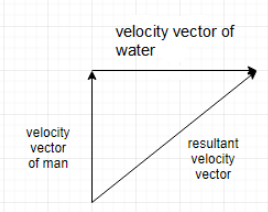
We can see here in order to move to the opposite side the man should move in the direction perpendicular to the motion of the water. And when he moves such, ultimately his motion will be in the direction of the resultant vector. Thus, the man should swim towards the south.
Hence, the option B is the correct answer.
Note:we were to tell only the direction of the motion. Had we been asked to find the resultant velocity for that we should have been given the velocity of the man and then we would have used the triangle law of vector addition to find the resultant velocity. These kinds of problems are solved by using vector algebra and using laws of vector addition.
Complete answer:
Let us first represent the velocity vectors of the man, and the river.
We can see here in order to move to the opposite side the man should move in the direction perpendicular to the motion of the water. And when he moves such, ultimately his motion will be in the direction of the resultant vector. Thus, the man should swim towards the south.
Hence, the option B is the correct answer.
Note:we were to tell only the direction of the motion. Had we been asked to find the resultant velocity for that we should have been given the velocity of the man and then we would have used the triangle law of vector addition to find the resultant velocity. These kinds of problems are solved by using vector algebra and using laws of vector addition.
Recently Updated Pages
Master Class 11 Social Science: Engaging Questions & Answers for Success

Master Class 11 English: Engaging Questions & Answers for Success
Master Class 11 Accountancy: Engaging Questions & Answers for Success
Master Class 11 Physics: Engaging Questions & Answers for Success
Master Class 11 Computer Science: Engaging Questions & Answers for Success
Master Class 11 Business Studies: Engaging Questions & Answers for Success
Trending doubts
One Metric ton is equal to kg A 10000 B 1000 C 100 class 11 physics CBSE
Find the value of the expression given below sin 30circ class 11 maths CBSE
Draw a diagram of nephron and explain its structur class 11 biology CBSE
10 examples of friction in our daily life
Proton was discovered by A Thomson B Rutherford C Chadwick class 11 chemistry CBSE
The teeth used for biting and cutting food are called class 11 biology CBSE