




Vexillary aestivation is found in:
(a)Rosacea
(b)Cruciferae
(c)Cucurbitaceae
(d)Papilionaceae
Answer
 Verified
633.9k+ views
Hint: Aestivation is the mode of arrangement of sepals (calyx) or petals (corolla) in the floral bud with respect to the other members of the same whorl.
Complete answer:
Vexillary aestivation is found in Papilionaceae.
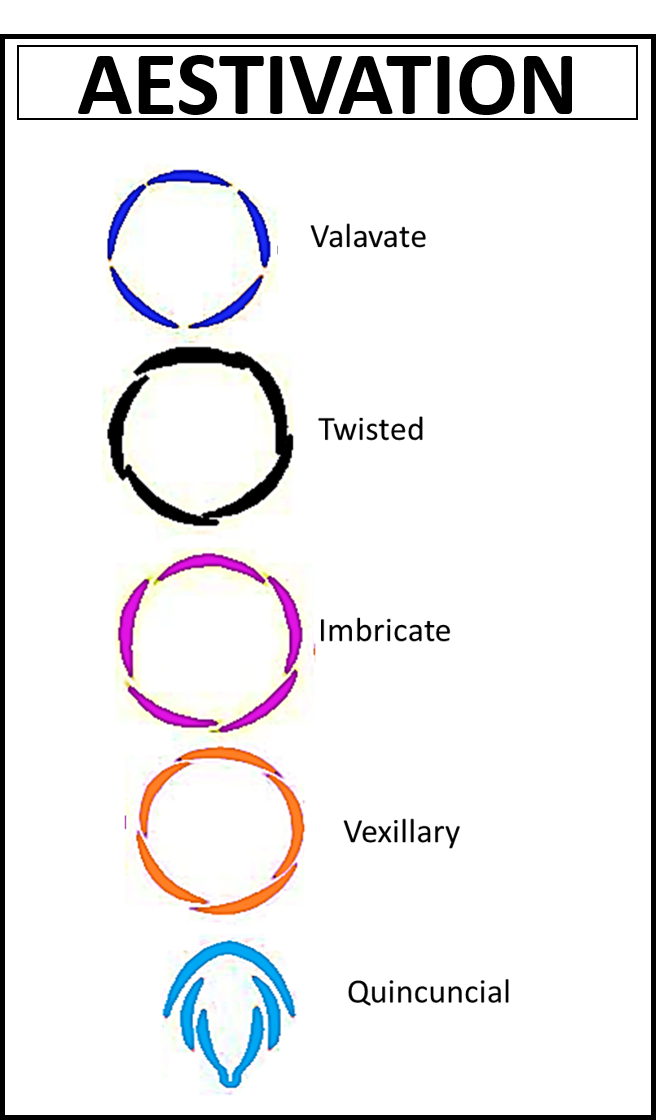
Aestivation is divided into five main types:- Vexillary, Valvate, Twisted, Imbricate, and Quincuncial.
Vexillary Aestivation:- Vexillary aestivation is the arrangement of the corolla in which the anterior petal is the innermost and the posterior petal is the outermost and largest. It is also called as descending imbricate. There is a large petal called 'Standard' which has two lobes fused. The standard petal overlaps two lateral petals called wings which in return overlap the two anterior-most petals called 'keel' or 'carina'. It is the characteristic feature of the papilionaceae family, so also called papilionaceous aestivation.
Additional Information: The other types of aestivation are-
-Valvate Aestivation:- Here the sepals or petals are arranged in a whorl and just touch the margin of one another. For example- Calotropis.
-Twisted Aestivation:- One margin of sepal or petal overlaps to that of the next one. Example- China rose.
-Imbricate Aestivation:- Margin of flower overlaps but not in any particular manner. Example- Gulmohar.
-Quincuncial Aestivation:- When the petals are arranged in a manner that two petals are completely out of the whorl and two are completely inside while one left is half outer and half is on the inner side. Example- Ranunculus.
So, the correct answer is 'Papilionaceae'.
Note: -The order Leguminales consists of three families among which Papilionaceae is the largest family.
-The plants belonging to this family are generally herbs or shrubs (often climbing), very rare trees.
-This family comprises mainly leguminous plants such as alfalfa, clover, beans, peas, chickpeas, lentils, carob, soybeans, peanuts, and tamarind, etc.
Complete answer:
Vexillary aestivation is found in Papilionaceae.
Aestivation is divided into five main types:- Vexillary, Valvate, Twisted, Imbricate, and Quincuncial.
Vexillary Aestivation:- Vexillary aestivation is the arrangement of the corolla in which the anterior petal is the innermost and the posterior petal is the outermost and largest. It is also called as descending imbricate. There is a large petal called 'Standard' which has two lobes fused. The standard petal overlaps two lateral petals called wings which in return overlap the two anterior-most petals called 'keel' or 'carina'. It is the characteristic feature of the papilionaceae family, so also called papilionaceous aestivation.
Additional Information: The other types of aestivation are-
-Valvate Aestivation:- Here the sepals or petals are arranged in a whorl and just touch the margin of one another. For example- Calotropis.
-Twisted Aestivation:- One margin of sepal or petal overlaps to that of the next one. Example- China rose.
-Imbricate Aestivation:- Margin of flower overlaps but not in any particular manner. Example- Gulmohar.
-Quincuncial Aestivation:- When the petals are arranged in a manner that two petals are completely out of the whorl and two are completely inside while one left is half outer and half is on the inner side. Example- Ranunculus.
So, the correct answer is 'Papilionaceae'.
Note: -The order Leguminales consists of three families among which Papilionaceae is the largest family.
-The plants belonging to this family are generally herbs or shrubs (often climbing), very rare trees.
-This family comprises mainly leguminous plants such as alfalfa, clover, beans, peas, chickpeas, lentils, carob, soybeans, peanuts, and tamarind, etc.
Recently Updated Pages
Master Class 11 English: Engaging Questions & Answers for Success

Master Class 11 Social Science: Engaging Questions & Answers for Success
Master Class 11 Maths: Engaging Questions & Answers for Success
Master Class 11 Biology: Engaging Questions & Answers for Success
Master Class 11 Physics: Engaging Questions & Answers for Success
Master Class 11 Chemistry: Engaging Questions & Answers for Success
Trending doubts
One Metric ton is equal to kg A 10000 B 1000 C 100 class 11 physics CBSE
What is cell theory Who formulated it class 11 biology CBSE
Phyllotaxy is the arrangement of ALeaflets BLeaves class 11 biology CBSE
Difference Between Prokaryotic Cells and Eukaryotic Cells
The symbiotic association of fungi and algae is called class 11 biology CBSE
Cell theory was formulated by A Schleiden and Schwann class 11 biology CBSE