




How many vertices does an angle have?
Answer
 Verified
641.7k+ views
Hint: First look at definition of vertex, angle in geometrical point of view. Now try to draw an angle. Find the numbers of vertices used in the process of drawing. Then add the vertices used. This total number of vertices used is nothing but the number of vertices in an angle. This is the required result in the question given above vertices.
Complete step-by-step answer:
Vertices- In geometry, a vertex is a point where two or more curved lines or edges meet. As a consequence of this definition, the point where two lines meet to form an angle and the corners of polygons and polyhedra are vertices. Singular form is said to be vertex. Vertices is the plural form.
Angle- In plane geometry, an angle is a figure formed by two rays, called the sides of an angle, sharing a common endpoint called the vertex of an angle. Angles formed by two rays lie in a plane, but this plane does not have to be a Euclidean plane. Angles formed by intersection of two curves in a plane are defined as the angle determined by the tangent rays at the points of intersection. Similarly the spherical angle between 2 great circles on a sphere is the dihedral angle between the planes determined by the great circles.
For example we will draw an angle of ${{60}^{0}}$ in the plane. Take a plane (for clarity take x-y coordinate plane) for example- Place a ray in the plane (for clarity take it parallel to x- axis).
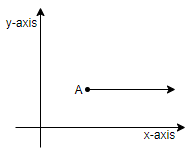
Mark the end point of the ray by the variable given by A. Now mark the protractor’s middle on A and place it such a way that the base of the protractor must be on the ray given by A.
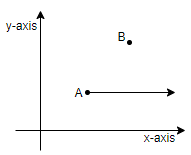
Now mark a point B at ${{60}^{0}}$ from the base of the protractor, we get
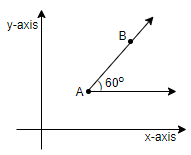
Now draw a ray from A to B (do not stop at B) keeping A as an endpoint, mark the angle between the rays as ${{60}^{0}}$. From the above diagram we can say A is the vertex of angle. Similarly every angle has a vertex.
So, the number of vertices to an angle is 1.
Note: Generally students take line segments and keep endpoints on the other side also and think that number of vertices are 3. But Angle’s definition says that it is formed by rays. So, we must take rays which have only 1 endpoint. Place the protractor properly or else you might end up getting the wrong angle. So, do it carefully.
Complete step-by-step answer:
Vertices- In geometry, a vertex is a point where two or more curved lines or edges meet. As a consequence of this definition, the point where two lines meet to form an angle and the corners of polygons and polyhedra are vertices. Singular form is said to be vertex. Vertices is the plural form.
Angle- In plane geometry, an angle is a figure formed by two rays, called the sides of an angle, sharing a common endpoint called the vertex of an angle. Angles formed by two rays lie in a plane, but this plane does not have to be a Euclidean plane. Angles formed by intersection of two curves in a plane are defined as the angle determined by the tangent rays at the points of intersection. Similarly the spherical angle between 2 great circles on a sphere is the dihedral angle between the planes determined by the great circles.
For example we will draw an angle of ${{60}^{0}}$ in the plane. Take a plane (for clarity take x-y coordinate plane) for example- Place a ray in the plane (for clarity take it parallel to x- axis).
Mark the end point of the ray by the variable given by A. Now mark the protractor’s middle on A and place it such a way that the base of the protractor must be on the ray given by A.
Now mark a point B at ${{60}^{0}}$ from the base of the protractor, we get
Now draw a ray from A to B (do not stop at B) keeping A as an endpoint, mark the angle between the rays as ${{60}^{0}}$. From the above diagram we can say A is the vertex of angle. Similarly every angle has a vertex.
So, the number of vertices to an angle is 1.
Note: Generally students take line segments and keep endpoints on the other side also and think that number of vertices are 3. But Angle’s definition says that it is formed by rays. So, we must take rays which have only 1 endpoint. Place the protractor properly or else you might end up getting the wrong angle. So, do it carefully.

Recently Updated Pages
Master Class 6 English: Engaging Questions & Answers for Success

Master Class 6 Maths: Engaging Questions & Answers for Success
Master Class 6 Science: Engaging Questions & Answers for Success
Master Class 6 Social Science: Engaging Questions & Answers for Success
Class 6 Question and Answer - Your Ultimate Solutions Guide
Master Class 5 English: Engaging Questions & Answers for Success
Trending doubts
How many millions make a billion class 6 maths CBSE
Give 10 examples for herbs , shrubs , climbers , creepers
Number of Prime between 1 to 100 is class 6 maths CBSE
What are the main physical divisions of India class 6 social science CBSE
What is the smallest onedigit number that is 0 or class 6 maths CBSE
What is the opposite gender of Gander class 6 english CBSE