




How do you verify that resistance of a conductor is proportional to the length of the conductor for constant cross section area and temperature?
Answer
 Verified
645k+ views
Hint: To verify proportionality with length, vary length and take observations. The current decreases with increase in resistance if voltage applied is constant. For a constant voltage use a battery.
Complete Step-by-Step solution:
We can verify this with a simple experiment.
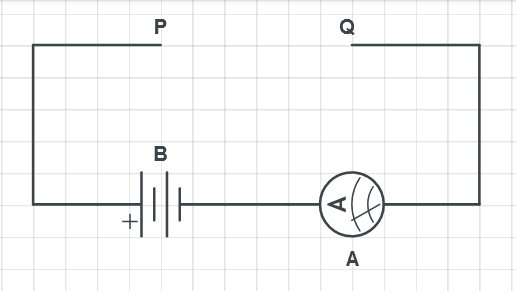
Circuit diagram:
Procedure:
As shown in the circuit diagram, connect an ammeter in series with the battery leaving a gap between P and Q.
Take metal wires of same material having different length and same cross sectional area. Connect the first wire between P and Q and measure the current using an ammeter. Note down this reading.
Now change wire and note down the current readings.
Repeat this procedure for 4-5 wires having different length.
Observation:
You will observe that the value of current decreases as we increase the length of wire. So from this we can say that as we are increasing the length the resistance is also increasing for given constant potential difference. Therefore we conclude that resistance of a conductor is proportional to the length of the conductor for constant cross section area and temperature.
Thus, \[R\propto L\]
Note: The resistance also varies with temperature and impurity in a given material. So it is very important to carry out this experiment in a constant temperature environment and also use wires of the same material. Choose an ammeter which shows noticeable change in readings when we change length of wire. If the ammeter is not showing noticeable change then change the ammeter having more least count. Since the metals have very small resistance current would be very high and the ammeter may show full scale deflection. To bring the deflection within range you can add additional high resistance in series with battery.
Complete Step-by-Step solution:
We can verify this with a simple experiment.
Circuit diagram:
Procedure:
As shown in the circuit diagram, connect an ammeter in series with the battery leaving a gap between P and Q.
Take metal wires of same material having different length and same cross sectional area. Connect the first wire between P and Q and measure the current using an ammeter. Note down this reading.
Now change wire and note down the current readings.
Repeat this procedure for 4-5 wires having different length.
Observation:
You will observe that the value of current decreases as we increase the length of wire. So from this we can say that as we are increasing the length the resistance is also increasing for given constant potential difference. Therefore we conclude that resistance of a conductor is proportional to the length of the conductor for constant cross section area and temperature.
Thus, \[R\propto L\]
Note: The resistance also varies with temperature and impurity in a given material. So it is very important to carry out this experiment in a constant temperature environment and also use wires of the same material. Choose an ammeter which shows noticeable change in readings when we change length of wire. If the ammeter is not showing noticeable change then change the ammeter having more least count. Since the metals have very small resistance current would be very high and the ammeter may show full scale deflection. To bring the deflection within range you can add additional high resistance in series with battery.
Recently Updated Pages
Master Class 11 English: Engaging Questions & Answers for Success

Master Class 11 Social Science: Engaging Questions & Answers for Success
Master Class 11 Maths: Engaging Questions & Answers for Success
Master Class 11 Biology: Engaging Questions & Answers for Success
Master Class 11 Physics: Engaging Questions & Answers for Success
Master Class 11 Chemistry: Engaging Questions & Answers for Success
Trending doubts
Explain the Treaty of Vienna of 1815 class 10 social science CBSE
What is the Total Duration of Football Match?
The shortest day of the year in India
In which year voting age was reduced from 21 to 18?
10 examples of evaporation in daily life with explanations
What planets have no moons Which one has only one moon class 10 physics CBSE