




Vascular bundles in dicot stems are:
(a)Open, collateral, endarch
(b)Closed, collateral, endarch
(c)Open, collateral, exarch
(d)Closed, collateral, exarch
Answer
 Verified
626.1k+ views
Hint: Vascular bundles are a collection of tube-like tissues that flow through plants and are a part of the transport system, transporting critical substances to various parts of the plant. The vascular bundle consists of two forms: xylem and phloem.
Complete step-by-step answer:
Xylem transports water and nutrients and phloem transports organic molecules, these, in addition, will include supporting and protective tissues, phloem on the outer surface, and xylem on the inside. Because of the presence of cambium the vascular bundles of dicot stem are open. In the dicot stem, vascular bundles are arranged in a ring around the pith and the pith is concentrated at the core of the stem.
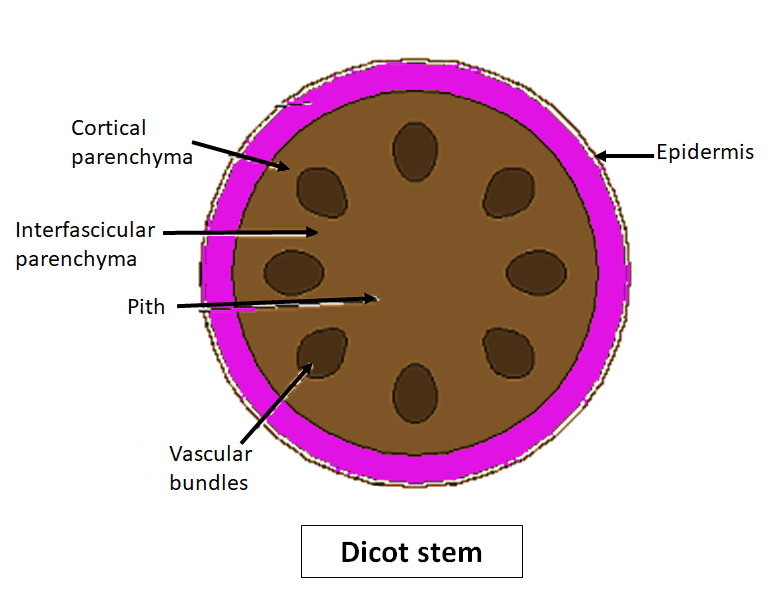
Xylem is described as an endarch and is used when there is more than one strand of primary xylem in a stem or root. The xylem develops from the inside towards the periphery, i.e., centrifugally. The protoxylem is closest to the center of the stem or root and the metaxylem closest to the periphery of the stem. The stems of dicot plants typically have endarch development and the roots are normally considered to have exarch development. Closed vascular bundles are present in monocots as they lack cambium. Vascular bundles in monocot stems are closed, collateral, and endarch.
So, the correct answer is ‘open, collateral, endarch’.
Note: The stems of dicot plants have a well-defined epidermis with a cuticle, a layer of dermis along with multicellular stem hair. Examples are sunflower and Cucurbita. Cambium separates xylem and phloem, and all the tissue from the cambium layer outward is considered bark, while all the tissue inside the cambium layer to the center of the tree is wood.
Complete step-by-step answer:
Xylem transports water and nutrients and phloem transports organic molecules, these, in addition, will include supporting and protective tissues, phloem on the outer surface, and xylem on the inside. Because of the presence of cambium the vascular bundles of dicot stem are open. In the dicot stem, vascular bundles are arranged in a ring around the pith and the pith is concentrated at the core of the stem.
Xylem is described as an endarch and is used when there is more than one strand of primary xylem in a stem or root. The xylem develops from the inside towards the periphery, i.e., centrifugally. The protoxylem is closest to the center of the stem or root and the metaxylem closest to the periphery of the stem. The stems of dicot plants typically have endarch development and the roots are normally considered to have exarch development. Closed vascular bundles are present in monocots as they lack cambium. Vascular bundles in monocot stems are closed, collateral, and endarch.
So, the correct answer is ‘open, collateral, endarch’.
Note: The stems of dicot plants have a well-defined epidermis with a cuticle, a layer of dermis along with multicellular stem hair. Examples are sunflower and Cucurbita. Cambium separates xylem and phloem, and all the tissue from the cambium layer outward is considered bark, while all the tissue inside the cambium layer to the center of the tree is wood.
Recently Updated Pages
Master Class 12 Economics: Engaging Questions & Answers for Success

Master Class 12 English: Engaging Questions & Answers for Success
Master Class 12 Social Science: Engaging Questions & Answers for Success
Master Class 12 Maths: Engaging Questions & Answers for Success
Master Class 12 Physics: Engaging Questions & Answers for Success
Master Class 9 General Knowledge: Engaging Questions & Answers for Success
Trending doubts
One Metric ton is equal to kg A 10000 B 1000 C 100 class 11 physics CBSE
Difference Between Prokaryotic Cells and Eukaryotic Cells
Two of the body parts which do not appear in MRI are class 11 biology CBSE
1 ton equals to A 100 kg B 1000 kg C 10 kg D 10000 class 11 physics CBSE
10 examples of friction in our daily life
DNA is not present in A Nucleus B Mitochondria C Chloroplast class 11 biology CBSE