




$\vartriangle ABC$ is an isosceles right triangle with area P. The radius of the circle that passes through the points A, B and C is :
(a) $\sqrt{P}$
(b) $\sqrt{\dfrac{P}{2}}$
(c) $\dfrac{\sqrt{P}}{2}$
(d) $\sqrt{2P}$
Answer
 Verified
594.6k+ views
Hint: We know that the angle subtended by the diameter is a right angle. Using the converse of this theorem, we can find the centre(O) of our circle. We then need to prove that $\angle AOB=\angle AOC={{90}^{\circ }}$ , by congruence of $\vartriangle AOB\text{ and }\vartriangle AOC$ . Now, we can equate the area P with the area taking BC as base and OA as height of the triangle. Hence, we can find the radius.
Complete step by step solution:
We are given that $\vartriangle ABC$ is an isosceles right triangle. So, two of its sides will be equal.
So, we have AB = AC.
The circle passes through all of its points A, B and C. Thus, the figure is
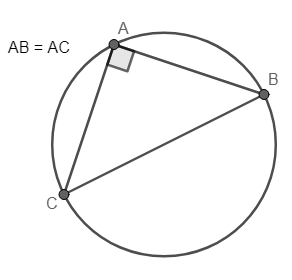
Now, we know that the angle subtended by a diameter on the same circle is a right angle. Thus, by the converse of this theorem, we can say that if the angle subtended on the circle is a right angle, then that angle is subtended by the diameter.
Since $\angle BAC={{90}^{\circ }}$ , we can say that BC is the diameter of our circle.
Let us assume a point O, that is the midpoint of BC. Then, O will also the centre of our circle.
Let us construct a line AO, as shown in the figure below
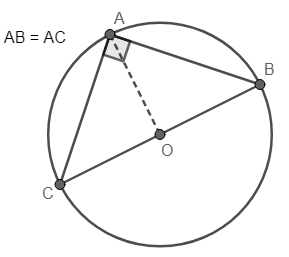
Now, in $\vartriangle AOB\text{ and }\vartriangle AOC$ , we have
AB = AC (it is given that $\vartriangle ABC$ is an isosceles triangle)
OB = OC (both are radius of the circle)
AO = AO (common)
Hence, by SSS congruence criteria, it is clear that $\vartriangle AOB\cong \vartriangle AOC$ .
Now by corresponding angles of congruent triangles, we can say that
$\angle AOB=\angle AOC...\left( i \right)$
But BC is a straight line and the sum of angles of a straight line is ${{180}^{\circ }}$ .
Hence, $\angle AOB+\angle AOC={{180}^{\circ }}$
Using equation (i), we can write
$\angle AOB+\angle AOB={{180}^{\circ }}$
$\Rightarrow 2\angle AOB={{180}^{\circ }}$
$\Rightarrow \angle AOB=\angle AOC={{90}^{\circ }}$
Also, OA, OB and OC all are the radius of our circle. Hence, OA = OB = OC.
Let the radius of the circle be r.
Then, OA = OB = OC = r.
So, now our figure looks like this.
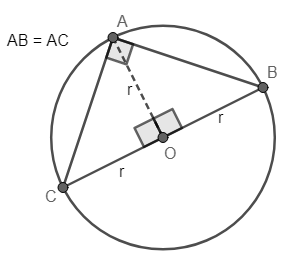
Now, we are given that are area of our triangle $\vartriangle ABC$ is P.
$Area=P$
$\dfrac{1}{2}\times BC\times OA=P$
In $\vartriangle ABC$ , we have BC = 2r and OA = r. Therefore,
$\dfrac{1}{2}\times 2r\times r=P$
$\Rightarrow {{r}^{2}}=P$
$\Rightarrow r=\sqrt{P}$
So, the radius of the circle is $\sqrt{P}$ .
So, the correct answer is “Option A”.
Note: Some students may directly equate the area found by taking BC as base and OA as height with P, which will be an incomplete solution. We will first have to show that the line OA is perpendicular to line BC. We should take care while writing the corresponding angles of congruent triangles, to avoid any confusion.
Complete step by step solution:
We are given that $\vartriangle ABC$ is an isosceles right triangle. So, two of its sides will be equal.
So, we have AB = AC.
The circle passes through all of its points A, B and C. Thus, the figure is
Now, we know that the angle subtended by a diameter on the same circle is a right angle. Thus, by the converse of this theorem, we can say that if the angle subtended on the circle is a right angle, then that angle is subtended by the diameter.
Since $\angle BAC={{90}^{\circ }}$ , we can say that BC is the diameter of our circle.
Let us assume a point O, that is the midpoint of BC. Then, O will also the centre of our circle.
Let us construct a line AO, as shown in the figure below
Now, in $\vartriangle AOB\text{ and }\vartriangle AOC$ , we have
AB = AC (it is given that $\vartriangle ABC$ is an isosceles triangle)
OB = OC (both are radius of the circle)
AO = AO (common)
Hence, by SSS congruence criteria, it is clear that $\vartriangle AOB\cong \vartriangle AOC$ .
Now by corresponding angles of congruent triangles, we can say that
$\angle AOB=\angle AOC...\left( i \right)$
But BC is a straight line and the sum of angles of a straight line is ${{180}^{\circ }}$ .
Hence, $\angle AOB+\angle AOC={{180}^{\circ }}$
Using equation (i), we can write
$\angle AOB+\angle AOB={{180}^{\circ }}$
$\Rightarrow 2\angle AOB={{180}^{\circ }}$
$\Rightarrow \angle AOB=\angle AOC={{90}^{\circ }}$
Also, OA, OB and OC all are the radius of our circle. Hence, OA = OB = OC.
Let the radius of the circle be r.
Then, OA = OB = OC = r.
So, now our figure looks like this.
Now, we are given that are area of our triangle $\vartriangle ABC$ is P.
$Area=P$
$\dfrac{1}{2}\times BC\times OA=P$
In $\vartriangle ABC$ , we have BC = 2r and OA = r. Therefore,
$\dfrac{1}{2}\times 2r\times r=P$
$\Rightarrow {{r}^{2}}=P$
$\Rightarrow r=\sqrt{P}$
So, the radius of the circle is $\sqrt{P}$ .
So, the correct answer is “Option A”.
Note: Some students may directly equate the area found by taking BC as base and OA as height with P, which will be an incomplete solution. We will first have to show that the line OA is perpendicular to line BC. We should take care while writing the corresponding angles of congruent triangles, to avoid any confusion.
Recently Updated Pages
Differentiate between voluntary action and reflex class 10 biology CBSE

The uses of bleaching powder are A It is used bleaching class 10 chemistry CBSE
Fill in the blanks with abstract nouns of the words class 10 english CBSE
How many threedigit numbers are there class 10 maths CBSE
What is a reflex arc class 10 biology CBSE
Construct a square whose diagonal is 6cm Measure the class 10 maths CBSE
Trending doubts
Explain the Treaty of Vienna of 1815 class 10 social science CBSE
The slogan Jai Hind was given by A Lal Bahadur Shastri class 10 social science CBSE
10 examples of evaporation in daily life with explanations
What is the full form of POSCO class 10 social science CBSE
Identify the feminine form of noun nephew a shenephew class 10 english CBSE
CSIR full form?