




Various products formed on oxidation of 2,5- dimethylhexan-3-one are :
(i)
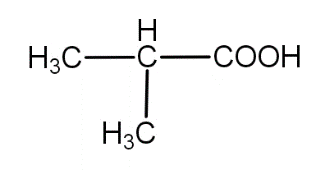
(ii)
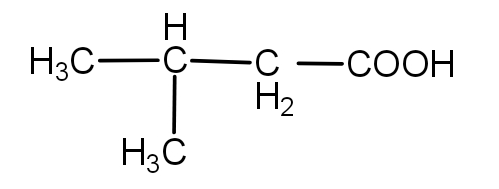
(iii) $C{H_3}COOH$
(iv) HCOOH
a.) (i) and (ii)
b.) (i), (ii) and (iii)
c.) (i), (ii), (iii) and (iv)
d.) (iii) and (iv)
Answer
 Verified
618k+ views
Hint The oxidation of ketones involves carbon-carbon bond cleavage. The substrate may cleave into two different reagents that may get oxidized. Normally, the ketone is oxidised to give carboxylic acid. The various reagents in which the substrate has cleaved will also get oxidised on the ketone part resulting in a variety of carboxylic acids.
Complete step by step answer :
First, let us see what oxidation is. The oxidation is defined as the process of addition of oxygen or the removal of hydrogen from the substrate molecule. In terms of electrons, it is the loss of electrons from the substrate.
As we have studied that the oxidation of ketones involves carbon-carbon bond cleavage.
The reaction involved is mentioned below:
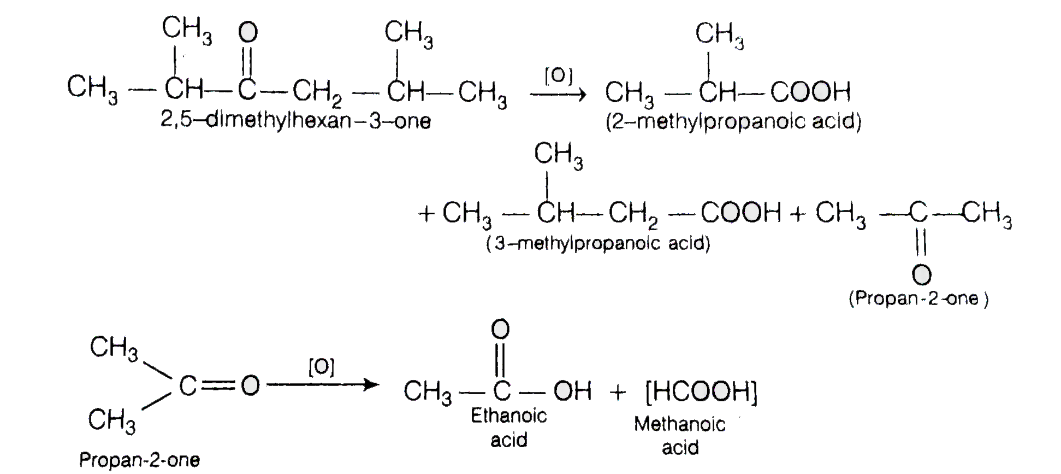
The substrate given to us i.e. 2,5- dimethylhexan-3-one is a ketone. So, its oxidation can also involve carbon-carbon bond cleavage. This oxidation may result in the formation of a number of products as - ( 2- Methylpropanoic acid), (3- Methylbutanoic acid), $C{H_3}COOH$
(Ethanoic acid) and HCOOH ( formic acid). The formic acid is formed from the propane.
So, the correct answer is the option c.
Note: It must be noted that oxidation occurs when the hydrogen is abstracted or the oxygen is added to the substrate. Whenever a substrate gets oxidised, there will be some other molecule that has got reduced because of oxidation and reduction, both processes move simultaneously.
Complete step by step answer :
First, let us see what oxidation is. The oxidation is defined as the process of addition of oxygen or the removal of hydrogen from the substrate molecule. In terms of electrons, it is the loss of electrons from the substrate.
As we have studied that the oxidation of ketones involves carbon-carbon bond cleavage.
The reaction involved is mentioned below:
The substrate given to us i.e. 2,5- dimethylhexan-3-one is a ketone. So, its oxidation can also involve carbon-carbon bond cleavage. This oxidation may result in the formation of a number of products as - ( 2- Methylpropanoic acid), (3- Methylbutanoic acid), $C{H_3}COOH$
(Ethanoic acid) and HCOOH ( formic acid). The formic acid is formed from the propane.
So, the correct answer is the option c.
Note: It must be noted that oxidation occurs when the hydrogen is abstracted or the oxygen is added to the substrate. Whenever a substrate gets oxidised, there will be some other molecule that has got reduced because of oxidation and reduction, both processes move simultaneously.
Recently Updated Pages
Onehalf of a convex lens is covered with a black paper class 12 physics CBSE

Differentiate between lanthanoids and actinoids class 12 chemistry CBSE
An object 5 cm in length is held 25 cm away from a class 12 physics CBSE
Name the following halides according to the IUPAC system class 12 chemistry CBSE
An infinite ladder network of resistances is constructed class 12 physics CBSE
How will you bring about the following conversions class 12 chemistry CBSE
Trending doubts
Draw a labelled sketch of the human eye class 12 physics CBSE
Which are the Top 10 Largest Countries of the World?
Draw ray diagrams each showing i myopic eye and ii class 12 physics CBSE
Which is the correct genotypic ratio of mendel dihybrid class 12 biology CBSE
Differentiate between homogeneous and heterogeneous class 12 chemistry CBSE
What is the Full Form of PVC, PET, HDPE, LDPE, PP and PS ?