




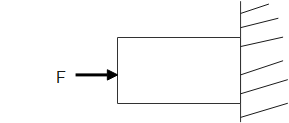
What is the value of the force F to be applied horizontally on a block of mass$5$ kg which is in contact with a wall, as shown in the figure. (Take g= $10m{s^{ - 2}}$ ) such that it does not fall down. The coefficient of friction between the block and the wall is $0.4$ .
Answer
 Verified
552.9k+ views
Hint: To solve questions related to friction and gravity, we need to understand the concept of direction of frictional force. Also, we need to understand how the pair of action reactions works and draw Free body diagrams to represent the body and the different forces acting on it.
Complete step by step solution:
First, draw the free body diagram of the situation.
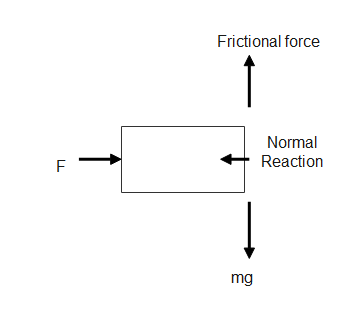
Drawing the free body diagram, we see that if we want the body to remain in equilibrium, the frictional force between the wall and the body has to be greater enough to balance the body’s weight which is acting downwards. Now we also know that the value of frictional force is dependent on Normal reaction. Thus, we have to find the value of a normal reaction at first.
From the Free body diagram, we see that there is no horizontal net force, as the body is pressed against the wall, thus net horizontal force is zero.
Thus, $F = {\text{ N}}$
We know frictional force F is equal to $\mu N$ , where $\mu $ is the coefficient of friction and $N$ is the normal reaction.
Now according to observation, frictional force equals the weight of the body, thus:
$f = mg$ and $f = $ $\mu N$
Thus, $\mu N = mg$ .
We are given the values of mass of the body ($5$ kg) and the value of acceleration due to gravity ( $10m{s^{ - 2}}$ ) and coefficient of friction( $0.4$ ).
Thus $N = \dfrac{{mg}}{\mu }$
= $125$ N. As $F = {\text{ N}}$ thus Force equals $125$ N.
Hence the correct option is option D.
Note: Please ensure that before starting to workout this problem you draw the Free body diagram of the body as it will give us a clear idea of all the forces. We often make mistakes in considering the normal reaction, so see all the forces carefully and then consider it. All the listed formulas are to be remembered.
Complete step by step solution:
First, draw the free body diagram of the situation.
Drawing the free body diagram, we see that if we want the body to remain in equilibrium, the frictional force between the wall and the body has to be greater enough to balance the body’s weight which is acting downwards. Now we also know that the value of frictional force is dependent on Normal reaction. Thus, we have to find the value of a normal reaction at first.
From the Free body diagram, we see that there is no horizontal net force, as the body is pressed against the wall, thus net horizontal force is zero.
Thus, $F = {\text{ N}}$
We know frictional force F is equal to $\mu N$ , where $\mu $ is the coefficient of friction and $N$ is the normal reaction.
Now according to observation, frictional force equals the weight of the body, thus:
$f = mg$ and $f = $ $\mu N$
Thus, $\mu N = mg$ .
We are given the values of mass of the body ($5$ kg) and the value of acceleration due to gravity ( $10m{s^{ - 2}}$ ) and coefficient of friction( $0.4$ ).
Thus $N = \dfrac{{mg}}{\mu }$
= $125$ N. As $F = {\text{ N}}$ thus Force equals $125$ N.
Hence the correct option is option D.
Note: Please ensure that before starting to workout this problem you draw the Free body diagram of the body as it will give us a clear idea of all the forces. We often make mistakes in considering the normal reaction, so see all the forces carefully and then consider it. All the listed formulas are to be remembered.
Recently Updated Pages
Basicity of sulphurous acid and sulphuric acid are

Master Class 11 English: Engaging Questions & Answers for Success
Master Class 11 Physics: Engaging Questions & Answers for Success
Master Class 11 Computer Science: Engaging Questions & Answers for Success
Master Class 11 Chemistry: Engaging Questions & Answers for Success
Master Class 11 Social Science: Engaging Questions & Answers for Success
Trending doubts
Difference Between Prokaryotic Cells and Eukaryotic Cells
Two of the body parts which do not appear in MRI are class 11 biology CBSE
One Metric ton is equal to kg A 10000 B 1000 C 100 class 11 physics CBSE
10 examples of friction in our daily life
Draw a diagram of nephron and explain its structur class 11 biology CBSE
What will happen if the mucus is not secreted by the class 11 biology CBSE