




What is the value of impedance of a resonant series LCR circuit?
Answer
 Verified
498k+ views
Hint: To answer this question you should know the concept of LCR circuit. It is said that an AC source of voltage ${\text{V = }}{{\text{V}}_m}\sin \omega t$ is connected to a series combination of L, C and R. Use the phasor diagram to obtain expressions for impedance of the circuit and phase angle between voltage and current. Find the condition when current will be in phase with the voltage and the circuit in this condition is called resonant circuit. Circuit in which inductance L, capacitance C and resistance R are connected in series and the circuit admits maximum current, then such circuit is called a series resonant circuit.
Complete answer:
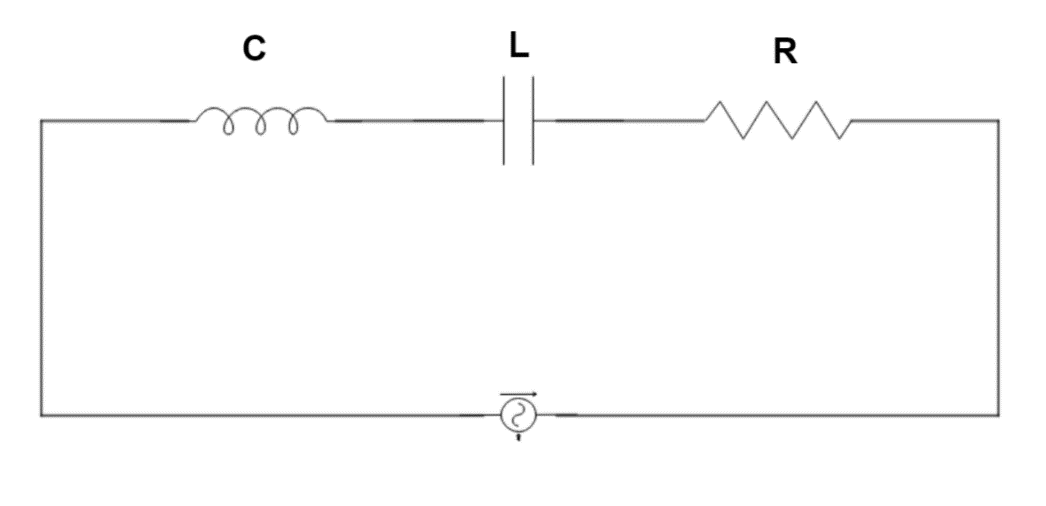
From the LCR circuit we see that the resistor, inductor and capacitance are in series. Therefore, the ac current in each element is the same at any time, having the same amplitude and phase. Let it be $i = {i_m}\sin \left( {\omega t + \phi } \right)$
Where $\phi $ is the phase difference between the voltage across the source and the current in the circuit.
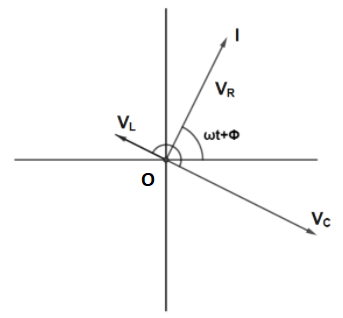
Let I be the phasor representing the current in the circuit. Further, let ${{\text{V}}_L}$ , ${{\text{V}}_C}$ , ${{\text{V}}_R}$ and ${\text{V}}$represent the voltage across the inductor, resistor, capacitor and the source, respectively. we know that V, is parallel to I. ${{\text{V}}_C}$is $\dfrac{\pi }{2}$ behind I and${{\text{V}}_L}$ is $\dfrac{\pi }{2}$ ahead of I.
In an RLC circuit, impedance triangle is a right-angled triangle in which base is ohmic resistance R, perpendicular is reactance $\left( {{{\text{X}}_C}{\text{ - }}{{\text{X}}_L}} \right)$ and hypotenuse is impedance (Z).
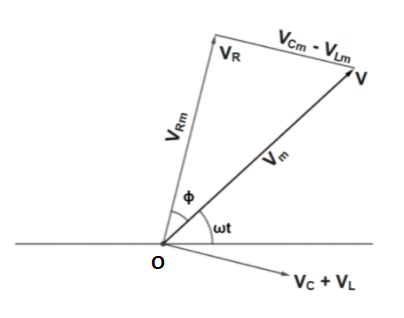
${{\text{V}}_L}$ , ${{\text{V}}_C}$ , ${{\text{V}}_R}$ and ${\text{I}}$ is shown in the figure with appropriate phase-relations.
The length of these phasors or the amplitude of ${{\text{V}}_L}$ , ${{\text{V}}_C}$ , ${{\text{V}}_R}$ are:
${{\text{V}}_{Rm}}{\text{ = }}{{\text{i}}_m}{\text{R}}$ , ${{\text{V}}_{Cm}}{\text{ = }}{{\text{i}}_m}{X_C}$ , ${{\text{V}}_{Lm}}{\text{ = }}{{\text{i}}_m}{X_L}$
The voltage equation for the circuit can be written as
${{\vec V = }}{{{\vec V}}_L}{\text{ + }}{{{\vec V}}_R}{\text{ + }}{{{\vec V}}_C} - - - (1)$
Since ${{\text{V}}_L}$ and ${{\text{V}}_C}$ are always along the same line and in opposite directions, they can be combined into a single phasor \[|{\text{ }}{{\text{V}}_L}{\text{ + }}{{\text{V}}_C}{\text{ |}}\] which has a magnitude ${{\text{V}}_{Cm}}{\text{ - }}{{\text{V}}_{Lm}}$.
$|{\text{ }}{{{\vec V}}_L}{\text{ + }}{{{\vec V}}_C}{\text{ | = }}{{\text{V}}_{Cm}}{\text{ - }}{{\text{V}}_{Lm}}$
Since V is represented as the hypotenuse of a right-triangle whose sides are ${\text{V}}$, ${{\text{V}}_R}$ and \[\left( {{{\text{V}}_L}{\text{ + }}{{\text{V}}_C}} \right)\] the Pythagorean theorem gives:
${\text{V}}_m^2{\text{ = V}}_{^{Rm}}^2{\text{ + }}{\left( {{{\text{V}}_{Cm}}{\text{ - }}{{\text{V}}_{Lm}}} \right)^2}$
Substituting the values of ${{\text{V}}_{Rm}}$, ${{\text{V}}_{Cm}}$ and ${{\text{V}}_{Lm}}$ into the above equation, we have
$ \Rightarrow {\text{V}}_m^2{\text{ = i}}_m^2{{\text{R}}^2}{\text{ + }}{\left( {{{\text{i}}_m}{{\text{X}}_C}{\text{ - }}{{\text{i}}_m}{{\text{X}}_L}} \right)^2}$
$ \Rightarrow {\text{V}}_m^2{\text{ = i}}_m^2{{\text{R}}^2}{\text{ + i}}_m^2{\left( {{{\text{X}}_C}{\text{ - }}{{\text{X}}_L}} \right)^2}$
$ \Rightarrow {\text{V}}_m^2{\text{ = i}}_m^2\left( {{{\text{R}}^2}{\text{ + }}{{\left( {{{\text{X}}_C}{\text{ - }}{{\text{X}}_L}} \right)}^2}} \right)$
Or,
${i_m} = \dfrac{{{V_m}}}{{\sqrt {{R^2} + {{\left( {{{\text{X}}_C}{\text{ - }}{{\text{X}}_L}} \right)}^2}} }}$
By the analogy to the resistance in a circuit, we introduce the impedance Z in an ac circuit:
${i_m} = \dfrac{{{V_m}}}{Z}$
Where ${\text{Z = }}\sqrt {{{\text{R}}^2} + {{\left( {{{\text{X}}_C}{\text{ - }}{{\text{X}}_L}} \right)}^2}} - - - (2)$
From figure,
$\tan \phi = \dfrac{{{{\text{V}}_{Cm}}{\text{ - }}{{\text{V}}_{Lm}}}}{{{{\text{V}}_{Rm}}}} = \dfrac{{{{\text{i}}_m}\left( {{{\text{X}}_C}{\text{ - }}{{\text{X}}_L}} \right)}}{{{{\text{i}}_m}{\text{R}}}}$
$\phi = {\tan ^{ - 1}}\left( {\dfrac{{{{\text{X}}_C}{\text{ - }}{{\text{X}}_L}}}{{\text{R}}}} \right)$
Condition for current and voltage are in phase:
${{\text{V}}_L}{\text{ = }}{{\text{V}}_C}$ or ${{\text{X}}_L}{\text{ = }}{{\text{X}}_C}$
Therefore, equation two becomes
${\text{Z = }}\sqrt {{{\text{R}}^2} + 0} $ (Because ${{\text{X}}_L}{\text{ = }}{{\text{X}}_C}$ therefore ${{\text{X}}_L}{\text{ - }}{{\text{X}}_C}{\text{ = 0}}$)
\[\therefore {\text{Z = R}}\]
This circuit is called a resonant circuit.
Therefore, the value of impedance of a resonant series LCR circuit is ${\text{Z = R}}$
Note:
When a condenser of capacity C charged to certain potential is connected to inductor L, energy stored in C oscillates between L and C where frequency of energy oscillations is given by $f = \dfrac{1}{{2\pi \sqrt {LC} }}$ . In an LCR circuit, if there is no loss of energy, then total energy in L and C at every instant will remain constant. The maximum current in an LR circuit is determined by the emf E and resistance R. The maximum charge on the capacitor in a RC circuit is determined by the emf E and capacitance C. A capacitor cannot be charged or discharged instantaneously.
Complete answer:
From the LCR circuit we see that the resistor, inductor and capacitance are in series. Therefore, the ac current in each element is the same at any time, having the same amplitude and phase. Let it be $i = {i_m}\sin \left( {\omega t + \phi } \right)$
Where $\phi $ is the phase difference between the voltage across the source and the current in the circuit.
Let I be the phasor representing the current in the circuit. Further, let ${{\text{V}}_L}$ , ${{\text{V}}_C}$ , ${{\text{V}}_R}$ and ${\text{V}}$represent the voltage across the inductor, resistor, capacitor and the source, respectively. we know that V, is parallel to I. ${{\text{V}}_C}$is $\dfrac{\pi }{2}$ behind I and${{\text{V}}_L}$ is $\dfrac{\pi }{2}$ ahead of I.
In an RLC circuit, impedance triangle is a right-angled triangle in which base is ohmic resistance R, perpendicular is reactance $\left( {{{\text{X}}_C}{\text{ - }}{{\text{X}}_L}} \right)$ and hypotenuse is impedance (Z).
${{\text{V}}_L}$ , ${{\text{V}}_C}$ , ${{\text{V}}_R}$ and ${\text{I}}$ is shown in the figure with appropriate phase-relations.
The length of these phasors or the amplitude of ${{\text{V}}_L}$ , ${{\text{V}}_C}$ , ${{\text{V}}_R}$ are:
${{\text{V}}_{Rm}}{\text{ = }}{{\text{i}}_m}{\text{R}}$ , ${{\text{V}}_{Cm}}{\text{ = }}{{\text{i}}_m}{X_C}$ , ${{\text{V}}_{Lm}}{\text{ = }}{{\text{i}}_m}{X_L}$
The voltage equation for the circuit can be written as
${{\vec V = }}{{{\vec V}}_L}{\text{ + }}{{{\vec V}}_R}{\text{ + }}{{{\vec V}}_C} - - - (1)$
Since ${{\text{V}}_L}$ and ${{\text{V}}_C}$ are always along the same line and in opposite directions, they can be combined into a single phasor \[|{\text{ }}{{\text{V}}_L}{\text{ + }}{{\text{V}}_C}{\text{ |}}\] which has a magnitude ${{\text{V}}_{Cm}}{\text{ - }}{{\text{V}}_{Lm}}$.
$|{\text{ }}{{{\vec V}}_L}{\text{ + }}{{{\vec V}}_C}{\text{ | = }}{{\text{V}}_{Cm}}{\text{ - }}{{\text{V}}_{Lm}}$
Since V is represented as the hypotenuse of a right-triangle whose sides are ${\text{V}}$, ${{\text{V}}_R}$ and \[\left( {{{\text{V}}_L}{\text{ + }}{{\text{V}}_C}} \right)\] the Pythagorean theorem gives:
${\text{V}}_m^2{\text{ = V}}_{^{Rm}}^2{\text{ + }}{\left( {{{\text{V}}_{Cm}}{\text{ - }}{{\text{V}}_{Lm}}} \right)^2}$
Substituting the values of ${{\text{V}}_{Rm}}$, ${{\text{V}}_{Cm}}$ and ${{\text{V}}_{Lm}}$ into the above equation, we have
$ \Rightarrow {\text{V}}_m^2{\text{ = i}}_m^2{{\text{R}}^2}{\text{ + }}{\left( {{{\text{i}}_m}{{\text{X}}_C}{\text{ - }}{{\text{i}}_m}{{\text{X}}_L}} \right)^2}$
$ \Rightarrow {\text{V}}_m^2{\text{ = i}}_m^2{{\text{R}}^2}{\text{ + i}}_m^2{\left( {{{\text{X}}_C}{\text{ - }}{{\text{X}}_L}} \right)^2}$
$ \Rightarrow {\text{V}}_m^2{\text{ = i}}_m^2\left( {{{\text{R}}^2}{\text{ + }}{{\left( {{{\text{X}}_C}{\text{ - }}{{\text{X}}_L}} \right)}^2}} \right)$
Or,
${i_m} = \dfrac{{{V_m}}}{{\sqrt {{R^2} + {{\left( {{{\text{X}}_C}{\text{ - }}{{\text{X}}_L}} \right)}^2}} }}$
By the analogy to the resistance in a circuit, we introduce the impedance Z in an ac circuit:
${i_m} = \dfrac{{{V_m}}}{Z}$
Where ${\text{Z = }}\sqrt {{{\text{R}}^2} + {{\left( {{{\text{X}}_C}{\text{ - }}{{\text{X}}_L}} \right)}^2}} - - - (2)$
From figure,
$\tan \phi = \dfrac{{{{\text{V}}_{Cm}}{\text{ - }}{{\text{V}}_{Lm}}}}{{{{\text{V}}_{Rm}}}} = \dfrac{{{{\text{i}}_m}\left( {{{\text{X}}_C}{\text{ - }}{{\text{X}}_L}} \right)}}{{{{\text{i}}_m}{\text{R}}}}$
$\phi = {\tan ^{ - 1}}\left( {\dfrac{{{{\text{X}}_C}{\text{ - }}{{\text{X}}_L}}}{{\text{R}}}} \right)$
Condition for current and voltage are in phase:
${{\text{V}}_L}{\text{ = }}{{\text{V}}_C}$ or ${{\text{X}}_L}{\text{ = }}{{\text{X}}_C}$
Therefore, equation two becomes
${\text{Z = }}\sqrt {{{\text{R}}^2} + 0} $ (Because ${{\text{X}}_L}{\text{ = }}{{\text{X}}_C}$ therefore ${{\text{X}}_L}{\text{ - }}{{\text{X}}_C}{\text{ = 0}}$)
\[\therefore {\text{Z = R}}\]
This circuit is called a resonant circuit.
Therefore, the value of impedance of a resonant series LCR circuit is ${\text{Z = R}}$
Note:
When a condenser of capacity C charged to certain potential is connected to inductor L, energy stored in C oscillates between L and C where frequency of energy oscillations is given by $f = \dfrac{1}{{2\pi \sqrt {LC} }}$ . In an LCR circuit, if there is no loss of energy, then total energy in L and C at every instant will remain constant. The maximum current in an LR circuit is determined by the emf E and resistance R. The maximum charge on the capacitor in a RC circuit is determined by the emf E and capacitance C. A capacitor cannot be charged or discharged instantaneously.
Recently Updated Pages
Master Class 11 Social Science: Engaging Questions & Answers for Success

Master Class 11 Chemistry: Engaging Questions & Answers for Success
Master Class 12 Business Studies: Engaging Questions & Answers for Success
Master Class 12 Chemistry: Engaging Questions & Answers for Success
Master Class 12 Biology: Engaging Questions & Answers for Success
Class 12 Question and Answer - Your Ultimate Solutions Guide
Trending doubts
One Metric ton is equal to kg A 10000 B 1000 C 100 class 11 physics CBSE
Difference Between Prokaryotic Cells and Eukaryotic Cells
Two of the body parts which do not appear in MRI are class 11 biology CBSE
Explain zero factorial class 11 maths CBSE
10 examples of friction in our daily life
Name the Largest and the Smallest Cell in the Human Body ?